Springbok Player Ratings: Fullback Failure Against Dynamic De Villiers as Boks Lose Ground in Perth
Read more
IOL
iol.co.za

Springbok Player Ratings: Fullback Failure Against Dynamic De Villiers as Boks Lose Ground in Perth

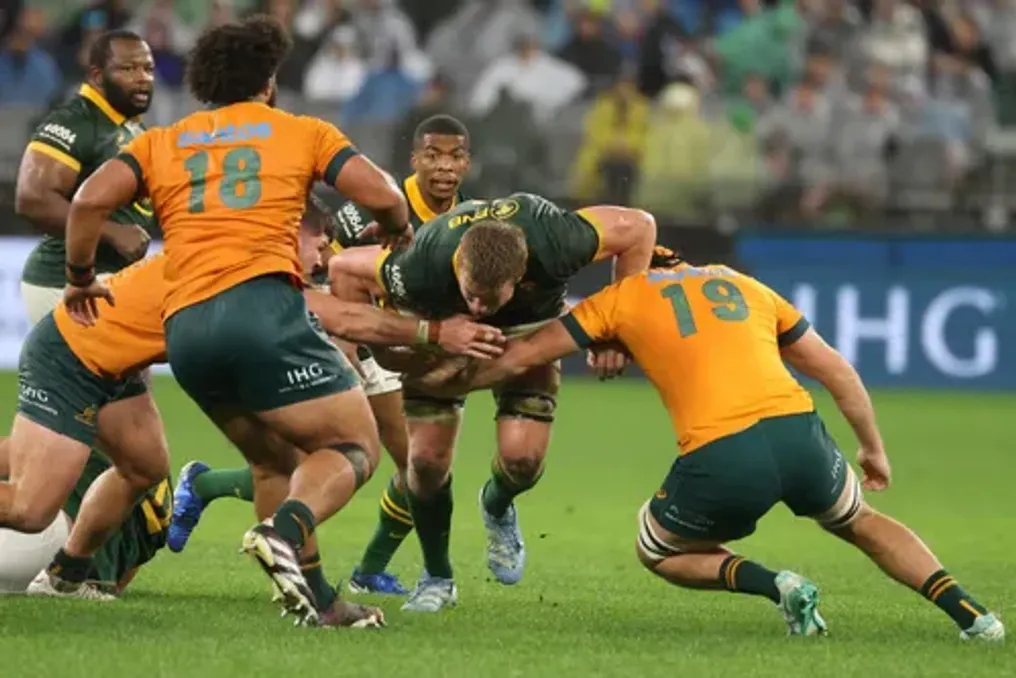
This match initially seemed an easy win for the tired Springboks, but few could have predicted such a difference in performance between the substitutes and the experienced 'Bomb Squad'. The Australian team appeared more motivated and energetic, while the South Africans looked sluggish.

International Rugby

IOL Sport conducted a rating of the Springbok players. Among them, 15-year-old Apelale FASSI received a 3 because he made a foolish forward pass to an unprotected Ethan Hooker, costing the Boks a try. Furthermore, he failed to handle the aerial ball, leading to an Australian score, and dropped a pass, ending a promising backline movement.

14-year-old Edwill van der Merwe received 7 points for a neat seventh try in his eighth match. He almost scored an acrobatic try. 13-year-old Kanan Moody received 8 points for excellent reading of the Wallabies' attack in defense; it was his best game at outside centre, marked by strong runs.

Andre Esterhuizen received 6.5 points for a magnificent long pass that helped Moody create conditions for Van der Merwe's try, as well as for softer passes from this large player. Ethan Hooker (No. 11) received 6 points; his play was typically active, but he was penalized for an overly vertical tackle and again for holding in the tackle. It was one of those days where he couldn't capitalize on the loose ball.

Handre Pollard (No. 10) received 7.5 points; he missed an attempt to find a touch early in the game, but his penalty kicking was flawless, and his game management was very good. Herschel Jantjes (No. 9) received 7.5 points for clear distribution from the scrum-half and will be pleased with his return to play. Marco van Staden (No. 8) received 5.5 points, as he was penalized for clumsy handling on the ground and looked not very confident in the No. 8 position.

Elraig Lou (No. 7) received 5.5 points; he put in a lot of effort but made too many errors, including losing three points due to a ruck infringement. Paul de Villiers (No. 6) received 8 points, regaining form after his last appearance for the Boks, and earned penalties through interceptions. His play as a free forward was impressive, and he was named possibly the best Bok.

Franco Mostert (No. 5) received 6 points; he was penalized for leaving his stance at the ruck to nullify a good aerial catch by Pollard. He was likely slightly out of form after a long break due to injury. Eben Etzebeth (No. 4) received 8 points for the veteran's polished all-around game, demonstrating outstanding skills in the out-line and mauls. Zack Potten (No. 3) received 6 points, being penalized for not staying on his feet at the ruck and not having a major impact in the scrum.

Johan Grobbelaar (No. 2) received 6 points for successful participation in the maul; it was sensible play, but he did not show outstanding results. Jan-Hendrik Vessels (No. 1) received 5.5 points as he did not exert the desired influence, and part of his play was careless.

Malcolm Marx (7)

He helped change the course of the game, as expected of a world-class player. However, the question arises as to why he did not pass to an unprotected teammate for a certain attempt near the end of the match?

Ox Nche (7.5) demonstrated huge influence in the scrum and made several big ball carries.

Wilco Louw (8)

He destroyed his opponent when he came onto the field.

Lood de Jager (6)

He failed to catch the ball in an important attacking out-line.

Jasper Wiese (7)

As usual, he was very active and played a big role in the team's comeback.

Morne van den Berg (8)

He once again demonstrated what a classic scrum-half he is. He now occupies the No. 1 scrum-half position for the Boks.

Sacha Feinberg-Mngomezulu (8)

He looked fresh from the moment he entered the field, which was his best game of the year.

Quan Horn (6)

He lost the aerial contest by not jumping for the ball. It was an average game.
Similar stories

Test match between Springboks and Wallabies in Perth seen as preparation for the 2027 Rugby World Cup playoffs
Read more
iol.co.za

Test match between Springboks and Wallabies in Perth seen as preparation for the 2027 Rugby World Cup playoffs

The upcoming test match between the Springboks and the Wallabies in Perth provides the Springboks team with an opportunity to conduct practical training ahead of the 2027 Rugby World Cup playoffs.

Despite the immediate goal of winning away against the Wallabies, the coaching staff under Rassie Erasmus is already analyzing all logistical and game details in anticipation of defending the title next year in Australia.

The Springboks are scheduled to return to this venue in October 2027, where they will face Romania in the third group match of the World Cup, making this test match a strategic operational rehearsal.

The group match itself is expected to be predetermined, as the Boks are likely to easily defeat the Romanian team. However, it is the first playoff match in Perth that will command the full attention of the Springboks.

Since the Springboks are likely to finish first in Group B, they will face the best team that finished third in Groups D, E, or F in the Round of 16. Siya Kolisi's team is expected to meet one of the teams from Japan, Samoa, or Tonga in this match before a possible quarter-final clash against their long-time rivals, the All Blacks.

Playing in Perth next Saturday allows the Boks to adapt in advance to the specific environmental conditions and logistical features of the city. Furthermore, Western Australia has a large South African community, and the upcoming match will give the Boks insight into the loud support in 'Perthfontein' that they might expect in 2027.

When South Africa meets Romania next year, as well as whoever awaits them in the Round of 16, the opponents may differ, but the environment will remain the same. By conducting rehearsals at the stadium, hotels, and training facilities now, Erasmus ensures that his team eliminates unknown variables, striving to reach peak form by the start of the main World Cup stage.

In the World Cup campaign, where success is determined by minor advantages, this early reconnaissance in Perth could prove to be a subtle yet decisive edge.

Springboks defeat All Blacks, demonstrating potential yet to be fully realized
Read more
iol.co.za

Springboks defeat All Blacks, demonstrating potential yet to be fully realized

After winning the Webb Ellis Cup in France in 2023, the Springboks have undergone a significant evolution that should worry their global rivals. The team, under the leadership of Rassie Erasmus, has not been satisfied with past successes, actively expanding its rugby repertoire. They have transformed from a pragmatic, strike-oriented team into one of the most versatile teams observed in over a century of test rugby.

However, the most alarming aspect for opponents ahead of the 2027 Rugby World Cup in Australia is the realization that the team has not yet reached its absolute peak. A recent series of matches, culminating in the Springboks' 3–1 victory over the All Blacks, exposed this reality. In the first three matches played in Johannesburg, Cape Town, and Soweto, the Springboks were essentially operating at third gear, winning two of them by reverting to the qualities that make them strong.

In these games, they appeared clumsy in possession, rushed in decision-making, and made uncharacteristic errors. Nevertheless, even when not playing at full capacity, South Africa's fundamental pillars—unbreakable commitment, relentless defensive pressure, dominance in collisions, and unparalleled ruck play—proved robust enough to pull the team out of difficult situations and secure crucial wins.

When the team switched to full power

It is rare in test rugby for a loss to the All Blacks to occur when playing significantly below one's potential. When Erasmus's team finally switched to a higher level in the final match of the series in Baltimore, their full potential was unleashed. Demonstrating 'Tony-ball'—the fluid, multi-faceted attacking structure promoted by attack coach Tony Brown—at the M&T Bank Stadium, the Springboks displayed a wide and creative running pattern.

Under the clear ball distribution and running abilities of Sacha Feinberg-Musengomozulu and Mani Libbok, combined with the lethal outside running of Kurt-Lee Arendse, South Africa bypassed the All Blacks with speed, blending ruthless power with effortless grace.

What makes the Boks' trajectory toward 2027 so daunting is the seamless integration of next-generation talent with battle-hardened two-time World Cup winners who seem to only improve with age. Players such as captain Siya Kolisi, Eben Etzebeth, Malcolm Marx, Pieter-Steph du Toit, and the central pairing of Damian de Allende and Jesse Kriel continue to perform excellently in their mid-thirties.

Thanks to unprecedented squad depth at all positions and an evolving tactical plan that merges the brutality of the forwards with the finesse of the backline, the Springboks are no longer just winning—they are redefining the way the game is played. If this is what the Springboks look like while still building, seeing them at full power will be a truly frightening spectacle.

Popular