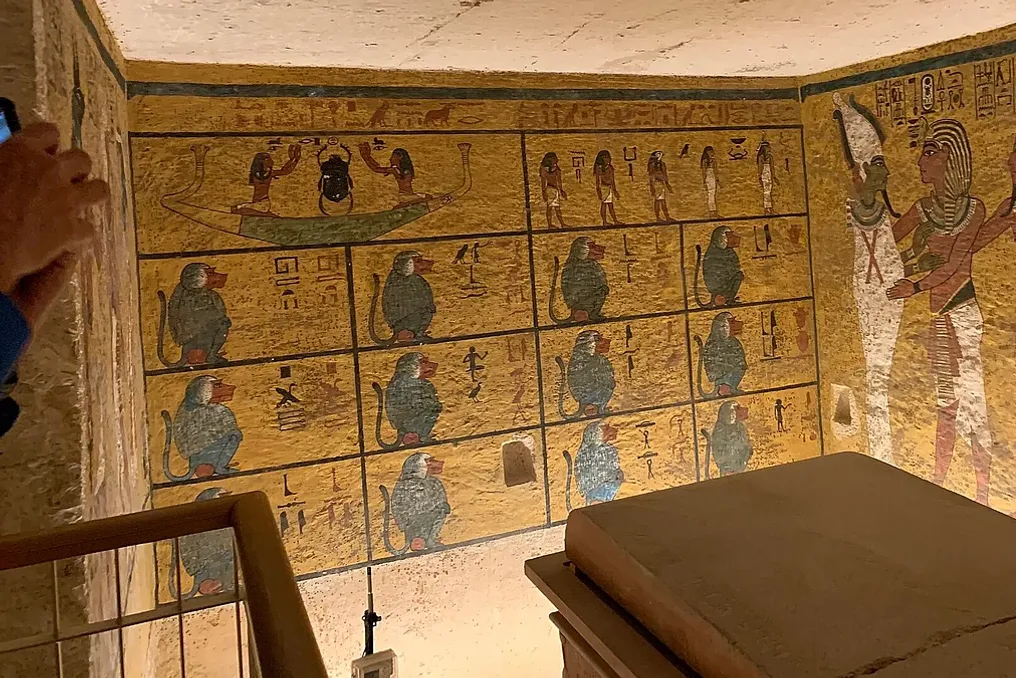
More than a century after the discovery of Tutankhamun's tomb in Egypt, archaeologists are once again questioning what might be hidden behind its walls. The latest scans have revealed signs that could suggest previously unknown corridors and rooms near the tomb in Luxor's Valley of the Kings, reviving the long-standing hypothesis that the lost burial of Queen Nefertiti is nearby.
However, scientists emphasize that they are not claiming to have found her tomb. The recent studies used several methods to examine the ground around Tutankhamun's tomb, known as KV62, including ground-penetrating radar and microgravity measurements. Researchers note that the results suggest the presence of a larger complex of corridors and rooms extending beyond the known tomb.
One area of particular interest was where researchers detected a low-density area containing an approximately square zone of higher density, which potentially could be a chamber with artifacts. Nevertheless, the signals are at the limit of the technology used, requiring further study before scientists can draw definitive conclusions about the contents.
This idea was first proposed in 2015 by British Egyptologist Nicholas Reeves, who suggested that Tutankhamun's burial chamber might only be part of a much larger tomb. Tutankhamun's tomb had long puzzled archaeologists due to its unusually small size for a royal burial.
Reeves opined that the young pharaoh, who died suddenly, might have been buried in chambers that originally belonged to an existing royal tomb, with other sections sealed off by walls. He hypothesized that these hidden rooms could contain the burial of Nefertiti, one of ancient Egypt's most famous queens. This theory has been discussed ever since.
In 2018, another radar survey found no signs of hidden chambers near Tutankhamun's tomb, which at the time seemed to disprove this theory. However, the latest investigations have brought this question back into focus through the use of various examination methods and the detection of new anomalies in the area.
Currently, researchers need permission from the Supreme Council of Antiquities of Egypt to continue their work. Upon receiving approval, the team plans to carefully drill into the area and use miniature cameras to inspect what lies further inside. According to one of the research participants, work could begin as early as November. It remains unclear whether the readings reflect ancient chambers or have any connection to Nefertiti, but after many years of contradictory scans, the new findings have brought one of Egypt's greatest archaeological mysteries back to life.