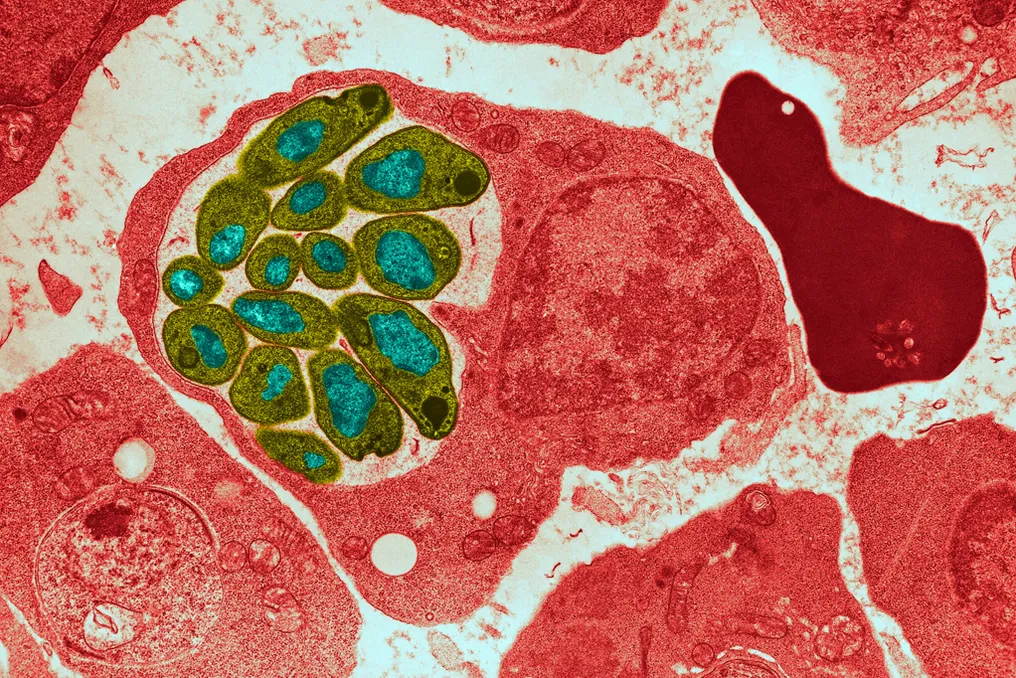
An international group of researchers tested a set of 18 molecules created in the lab based on existing compounds used to treat malaria against the parasite that causes the disease. The Institute of Physics of San Carlos (IFSC) of the University of São Paulo (USP) participated in the study. In laboratory and animal tests, one of the molecules, named 2d, was able to destroy the parasite in infected blood without developing resistance to treatment.
The study also identified another promising substance for fighting malaria—5d, which suppresses the parasite's energy production, thereby limiting its survival. These results, published in the journal ACS Infectious Diseases, represent the first step toward developing new drugs against this disease.
Significance of the Malaria Problem
Professor Rafael Victorio Carvalho Guido from IFSC informed the USP Journal that malaria remains one of the deadliest and most devastating infectious diseases in the world, seriously affecting public health and the economy in many tropical and subtropical regions, especially in African countries. According to the World Health Organization (WHO), in 2025, the disease caused over 282 million cases and about 610 thousand deaths annually, with 75% of these deaths occurring in children under five years old.
Current standard malaria treatment is based on a combination of drugs containing artemisinin derivatives, known as combination therapies, such as the combination of artesunate with pironidine. Traditional remedies like chloroquine and atovaquone are also used. Although these drugs have saved millions of lives, their effectiveness is threatened by the emergence and spread of resistant parasites. Furthermore, available vaccines provide only partial protection and, unfortunately, have low efficacy. This situation makes the search for new medications acting through different mechanisms to destroy resistant parasites extremely necessary.
Goals and Methodology of the Study
The main goal of this study was to create and evaluate new molecules capable of combating malaria, with a special focus on the problem of resistance that the parasite develops to modern drugs. Researchers sought to modify the chemical structure of already known substances, such as pironidine and quinine, to create more potent, safer, and faster-acting compounds, as well as to understand the exact mechanism of their destruction of the parasite.
During the work, 18 synthetic molecules belonging to the class of acridine and acridone derivatives were synthesized and tested. These substances were not obtained directly from nature but were designed and synthesized in the laboratory by research partners, using the chemical structure of already known antimalarial drugs as a model. Tests were conducted at various stages to assess the effectiveness, mechanism of action, and safety of these compounds.
As Guido noted, the molecules were tested in the lab against strains of the parasite Plasmodium falciparum resistant to multiple commercial drugs. Tests were also conducted on real patient samples from the Amazon. The most promising compound, named 2d, was tested directly on P. falciparum and P. vivax samples collected from patients in Porto Velho, Rondônia, where it showed effectiveness in destroying parasites.
To determine the mechanism of action, microscopy and biochemical analyses showed that compound 2d acts quickly and accumulates near the parasite's digestive vacuole. It prevents the neutralization of toxic residue formed during the digestion of human blood, leading to the parasite's death from this own residue.
Another molecule, compound 5a, demonstrated the ability to attack the parasite's 'power station,' i.e., its mitochondrion, indicating that this chemical group can act through various mechanisms within the parasite's body.
In animal models, in experiments on infected mice, oral administration of compound 2d led to the complete elimination of parasites from the bloodstream and 100% animal survival after 30 days of observation with excellent tolerance. In conclusion, no formation of resistance to compound 2d was observed in laboratory resistance development tests, suggesting the potential for long-term drug effectiveness.
Path to Clinical Application
However, for a promising compound to become an available drug, it must pass all stages of pharmaceutical development. These include pharmacological optimization, improvement of physical and chemical properties, such as molecular solubility and stability in the body, as well as preclinical safety studies, including thorough toxicological tests to confirm safety at therapeutic doses. Then come clinical trials in humans: Phase 1 to assess safety in volunteers, followed by Phases 2 and 3 to confirm clinical efficacy and determine the optimal dosage. The process concludes with regulatory approval by submitting data to health regulatory bodies, such as Anvisa in Brazil.
This study is the result of multi-center and international scientific cooperation, led by IFSC and Collaborations Pharmaceuticals, Inc. from the USA. Researchers from Brazilian institutions also participated, such as USP, Federal University of São Paulo (Unifesp) in the São Paulo and Baixada Santista campuses, Oswaldo Cruz Foundation (Fiocruz Rondônia), the Leishmaniasis and Malaria Bioanalysis Platform in Porto Velho, the Rondônia Tropical Medicine Research Center (Cepem) in Porto Velho, as well as international institutions, including the Center for Biotechnology Research of the Russian Academy of Sciences in Moscow and the University of Utrecht in the Netherlands.