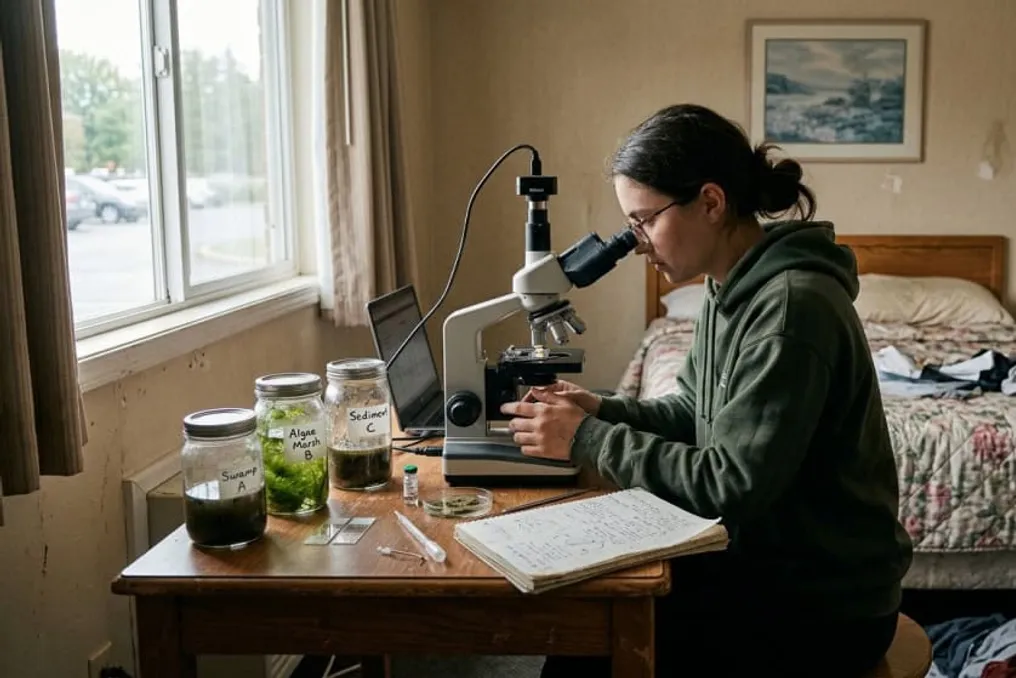
Scientists have identified two new species of the rare unicellular microorganism Paulinella during an expedition conducted in a motel room in North Carolina, USA.
This discovery could potentially help researchers study how complex organisms integrated structures capable of photosynthesis, which is related to the evolution of life on Earth.
In the spring of 2025, evolutionary biologist Julia Van Etten turned an $80 motel room (about 414 Brazilian reais) into a kind of laboratory. Inside were containers with brackish water, pieces of marsh vegetation, and microscopes set up on bedside tables.
The search for Paulinella was not new to Van Etten; she had been looking for this organism for years, using a $300 microscope (about 1554 Brazilian reais) that was in her sofa. The species is characterized by its small size, rarity, and slow growth, which makes it difficult to culture and study.
During this trip, she was assisted by Andrew Willoughby, a plant genome biologist, and John Burns, a scientist from the Bigelow Laboratory for Ocean Sciences. Burns brought unusual equipment to the motel. He used a colored pencil wrapped in a toothbrush bristle as a tool to move microorganisms. Then Burns used a mouth pipette to separate Paulinella samples from other life forms in the samples.
Willoughby noted while observing the procedure that it was 'biology I don't do.' While examining the organisms, he noticed something his colleagues missed: the scales of some specimens overlapped in one direction, while in others, the pattern appeared inverted. This difference led to the hypothesis that these might be two different species.
The researchers transferred the samples to an electron microscope, where the differences became evident at high resolution. Subsequently, DNA was extracted and sent to a team in South Korea, led by evolutionary biologist Kwan Soo Yoon from Songguk University. Sequencing confirmed that the samples belonged to two previously unknown species.
Thanks to this discovery, the total number of known photosynthetic Paulinella species has reached six. This organism contains a chromatophore—a structure derived from a photosynthetic bacterium that was incorporated into the cell and retained its own DNA. This process interests scientists because it resembles a much older episode. Sergio Muñoz-Gómez, an evolutionary biologist from Purdue University, stated: 'This can teach us a great deal.'
Scientists are studying Paulinella to understand how independent organisms can integrate and eventually form more complex biological systems. This case also attracts the attention of researchers working on engineering photosynthetic organisms in the lab. The goal is to better understand the natural process and determine if it can be reproduced artificially.
Van Etten and Willoughby have already begun the next stage of research, this time involving citizen scientists and enthusiasts to search for other Paulinella species.