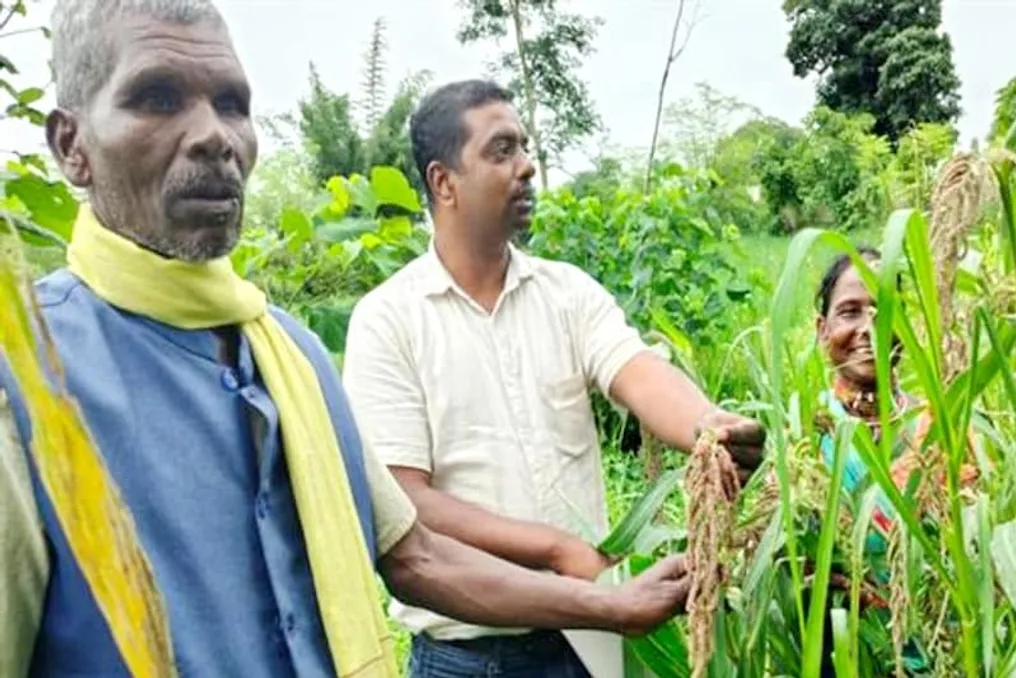
For the tribal families of Baiga and Bhumia living in the village of Majgawan, Salaiya Tola settlement, Shahdol district, grain is not just food, but the foundation of their identity, traditions, and well-being. In the modern era of intensive agriculture, where chemical fertilizers and hybrid seeds are actively used, these tribal families carefully preserve age-old local seeds in home storerooms, treating them as priceless treasures.
Despite the growing popularity of modern and hybrid varieties in agriculture, farmers from the Baiga and Bhumia communities in Majgawan continue to cultivate their ancient local varieties. Traditional rice varieties such as Jolar, Bansapor, Tharri, Saraiya, Gurmatiya, Karn Phul, and Bendjri can still be seen in the fields here. Furthermore, various grains, including Ledari Kodo, Basin Kodo, Kodali Kodo, Bemera Kutki, Jali Kutki, Chotakhi Kutki, Bhadaiili Kutki, Kagun, Sama, and Milo, are used in the diet and agriculture.
A farmer from Majgawan, Bolli Singh, notes that the local rice and grain varieties grown on his field form the basis of his daily diet. He emphasizes that his ability to cycle 20 to 25 kilometers even after 60 years is directly related to consuming traditional and pure food. He says that work becomes successful when the harvest from the field reaches the kitchen.
Birmatia Baiga from Salaiya Tola cultivates traditional crops such as Sama rice, Kutki, Sikia, Kakun, Saraiya, and Tharri. She explains that the practice of saving seeds collected from one season's harvest and using them for sowing in the next season is a long-standing tradition of her lineage. Birmatia believes that the memories and agricultural methods of her ancestors are contained within these seeds. Therefore, it is crucial to preserve them so that the next generation can experience the taste, nutritional value, and significance of these traditional grains.
Dhanvatiya Baiga from the same village cultivates crops such as Junhru, Pailahai, Barbati, maize, kodo, and kutki. When asked about seed availability, she easily replies that if she does not have seeds at home, they can be found in neighboring hill villages. This demonstrates that seed preservation is not just the effort of one family, but a collective heritage of the entire community. Because the harvest is collected and stored in storerooms, these families are ensured food stability throughout the year. Their independent and happy life is based on owning their land, their seeds, and their labor.
According to agronomist Dr. BK Prajapati, the farmers of the Baiga and Bhumia communities in the Majgawan district play a vital role in preserving ancient knowledge of agriculture and biodiversity since ancient times. The preservation of local varieties, even in the modern era, serves as a model for agricultural science and environmental protection.