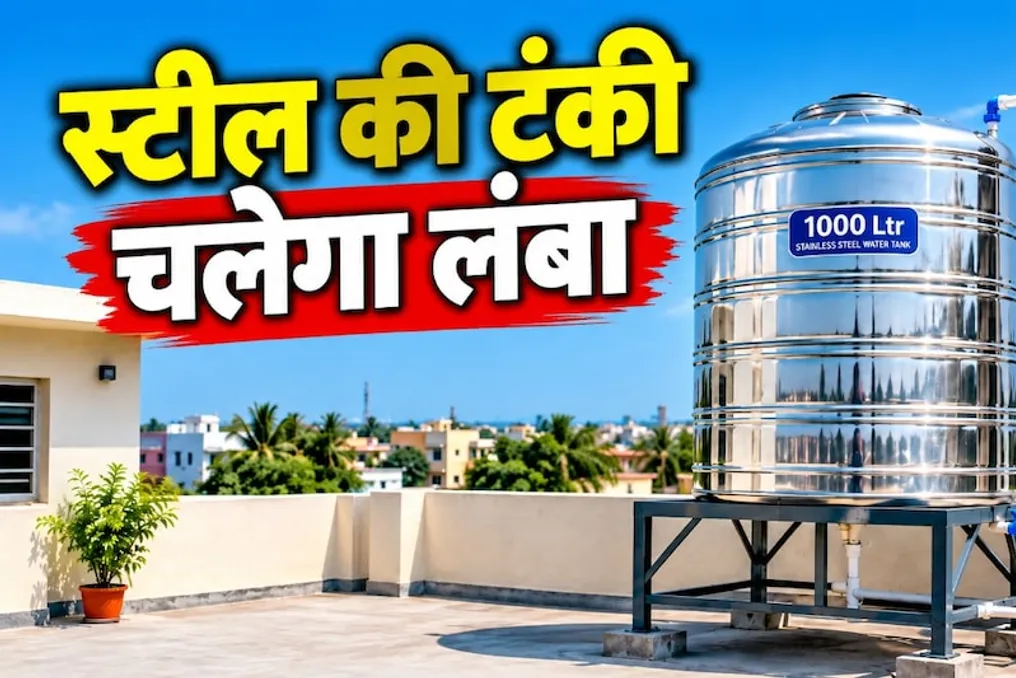
Most people do not think about their water storage tank until a problem arises. During intense heat, plastic tanks can crack, develop a slight water odor, and the walls may become covered with greenish deposits upon inspection. A plastic tank typically fails after eight to nine years, requiring a new purchase without prior budgeting.
Over time, plastic reservoirs deteriorate and require replacement every few years. Previously, steel tanks were considered an expensive and premium option compared to plastic ones. However, the situation has changed: the prices of steel tanks have decreased, and their price range has significantly expanded. People are becoming more interested in steel tanks in search of cost-effective long-term solutions. Therefore, it is important to know their cost.
The price of a steel tank depends on its volume in liters, the grade of steel, and the metal thickness. On the market, the initial price for such tanks ranges from approximately 7,000 to 12,000 rupees. Regarding the steel grade, high-quality tanks usually use Grade 304 or 316 steel, which is also used in kitchenware, surgical equipment, and food processing machinery.
For example, a 500-liter steel tank can be found on the market in the price range of 8,000 to 18,000 rupees. The most common size is 1000 liters, which is sold online and in open markets for 12,000–38,000 rupees.
When comparing plastic and steel tanks, buying a plastic tank seems cheaper initially. Nevertheless, it will need to be replaced after 5–10 years and requires constant cleaning due to the formation of green mold. Steel tanks, on the other hand, last reliably for 25–30 years, and their steel grade is such that mold does not form on it as easily. Consequently, for long-term use, steel tanks are the economically advantageous choice.