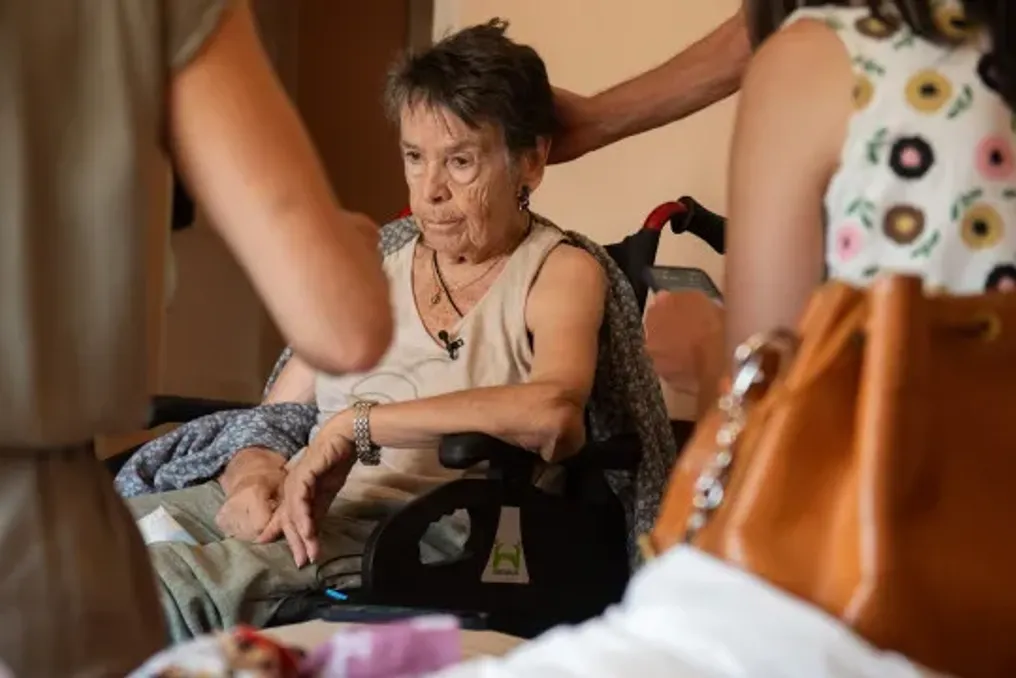
The United Nations (UN) stated that Spain infringed international commitments by carrying out the eviction of Maricarmen. Koldo Casla, in an interview with the Spanish agency EFE, argued that the act placed Spain in an unsustainable situation to fulfill its human rights obligations.
Casla detailed that with the eviction of the elderly Maricarmen, 87 years old and 50% disabled, which occurred on September 23, Spain disregarded a precautionary measure issued in June by the UN Committee on Economic, Social and Cultural Rights (CESCR). This measure mandated the suspension of the eviction until the main issue of the case was resolved.
The expert emphasized that although it is common in judicial processes for judges, courts, or committees to order provisional precautionary measures, the violation of these determinations is not usual, and this is the case.
Additionally, Casla recalled that the right to housing is recognized in International Human Rights Law through various international treaties that the country has signed and ratified. He stressed that there are binding agreements for Spain, which were formalized through the exercise of its sovereignty, even if it was not an initial obligation.
The rapporteur highlighted that although no one forced Spain to adopt this mechanism, the country agreed to it. Therefore, since Maricarmen has already been evicted, Spain cannot honor the precautionary order, resulting in a treaty violation.
Casla also pointed out that ratified treaties are part of the Spanish legal system, as established by Articles 10 and 96 of the Constitution.
Considering that the damage is irreparable, especially for Maricarmen, who lost her residence, Casla suggested several actions to prevent such occurrences structurally. Firstly, he indicated that the possibility of the judge proceeding with the eviction despite the CESCR's precautionary measures suggests the need to amend the Organic Law of the Judiciary, which is the fundamental legislation used by magistrates.
The UN rapporteur also stressed the importance of observing the conditions of the right to housing before any eviction. For Casla, it was evident that there was no proportionality analysis, as it is difficult to justify how a company's profit could outweigh the housing rights of an 87-year-old woman who receives a pension of 1,300 euros and has lived there for 70 years.
Another essential requirement for an eviction is the guarantee of alternative housing. The UN rapporteur considered that the nursing home offered to Maricarmen is inadequate, regardless of the economic cost, given that she is a self-sufficient woman who spent her life in that residence.
Finally, he mentioned the need for rigorous regulation of rental companies.
In parallel, the Spanish Prime Minister guaranteed that the executive branch is working to present a housing decree to the Council of Ministers on Tuesday. This decree aims to alleviate the housing crisis affecting millions of Spanish citizens. This statement was made on a day when hundreds of people were camped in the Porta do Sol square in the center of Madrid, demanding solutions to the real estate crisis and seeking to ensure the continuity of protests.