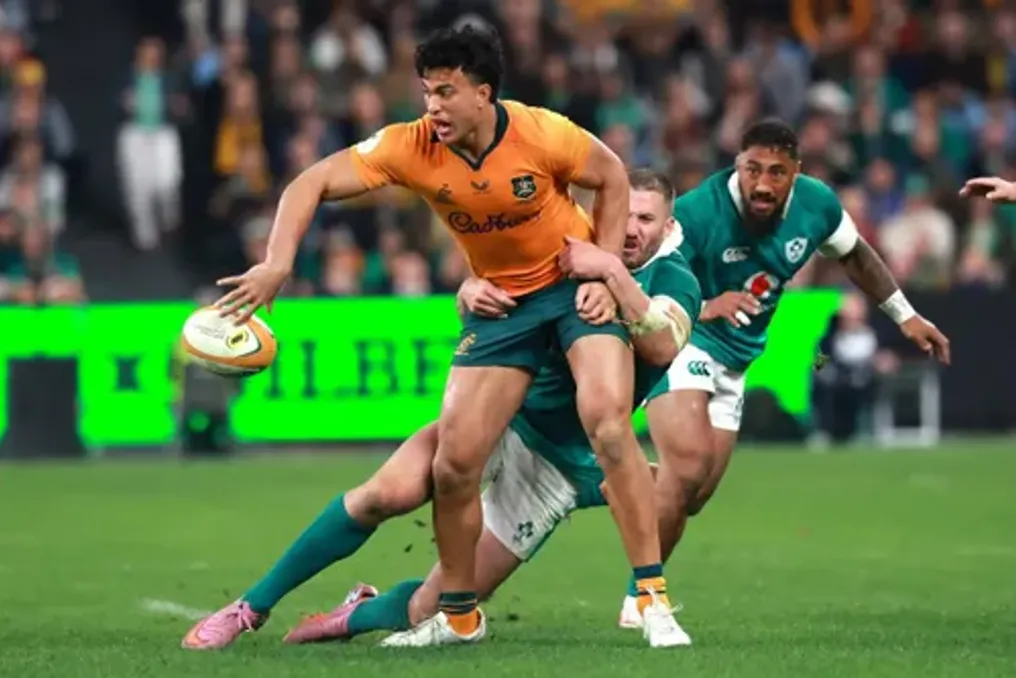
Wallabies defeat Springboks 42:38 in Perth, repeating success at Ellis Park
Read more
IOL
iol.co.za

Wallabies defeat Springboks 42:38 in Perth, repeating success at Ellis Park

The Wallabies team once again demonstrated outstanding play in Perth, defeating the Springboks with a score of 42:38. This match reminded everyone of the impressive performance of the Wallabies in the second half at Ellis Park stadium in 2025, which allowed them to win the Nelson Mandela Cup.

Initially, the home team Wallabies led 42:17 with about ten minutes left in the match, which seemed sufficient to secure the victory. However, similar to how they managed to come back from a 22:0 deficit in Johannesburg, the Springboks managed a strong comeback after prolonged pressure led to the hosts receiving four yellow cards.

As a result, Australia found itself with only 11 players remaining, and the familiar struggle from the Boks almost allowed them to achieve a comeback victory. Nevertheless, an error related to an obstruction by captain Andre Esterhuizen and the substitution of Juan Horn during the last attack from their own half completed the game, and this mistake may have reflected the overall picture of the match for the world champions for most of the time.

Despite receiving yellow cards, Australia fully justified its efforts in Perth at Optus Stadium. The team dominated territorial aspects and ball possession from the start, capitalized on opportunities, and ultimately achieved a deserved victory.

Although the yellow cards and communication issues between the referee and the TMO added drama to the game, without errors, discipline, and a cohesive first half performance, the outcome could have been different.

Head coach Rassie Erasmus made numerous changes to the squad that won the match in Baltimore against the All Blacks two weeks ago. A new midfield combination featuring Herschel Jantjes and Hendrie Pollard was formed, and a young defensive line consisting of Zachary Porten, Johan Grobbelaar, and Jan-Hendrik Vessels got the chance to play.

Furthermore, three defenders, Afelele Fassi, Ethan Hooker, and Edwin van der Merwe, played in an international match for the first time. The unfamiliarity among these combinations apparently affected the Boks' ability to maintain a steady rhythm. There was no forward progress in the scrums—it only appeared late in the second half, forcing momentum generation in other areas.
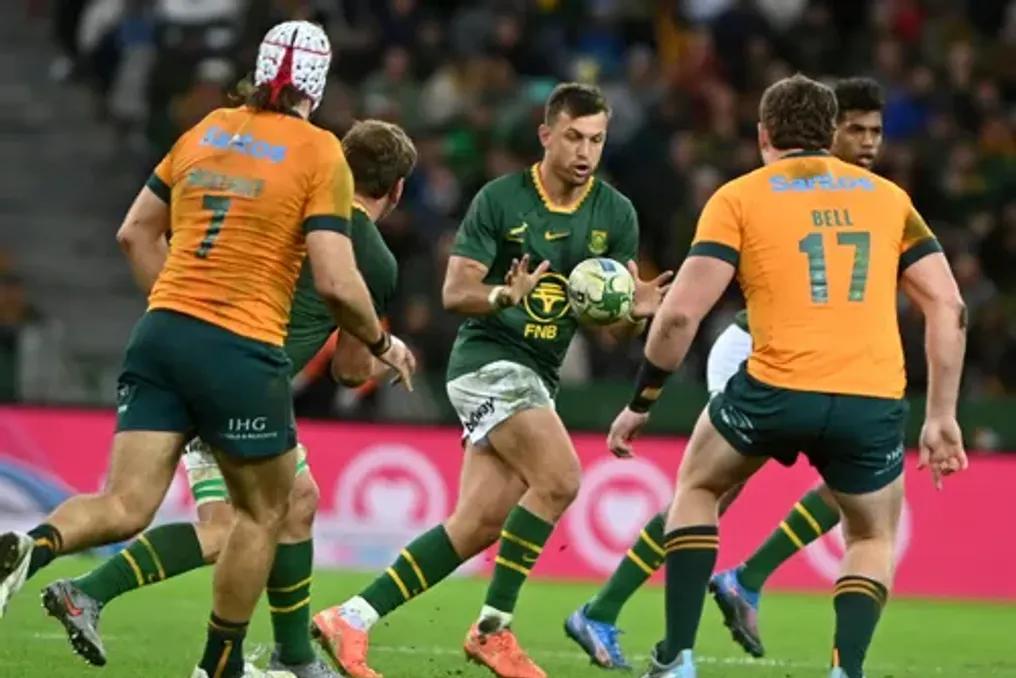

Similar stories

Lessons of defeat at Ellis Park: how the Springboks are preparing for the match against the Wallabies
Read more
iol.co.za

Lessons of defeat at Ellis Park: how the Springboks are preparing for the match against the Wallabies

The Springboks will focus on Handre Pollard's approach regarding tactics to counter the Wallabies at Ellis Park. Although the team is preparing to face the Wallabies at Optus Stadium in Perth on Sunday, the shadow of the nightmare second half from last year at Ellis Park still looms over them.

This episode remains one of the most instructive moments in recent South African rugby history: a 22-point lead was lost in Johannesburg, leading to a heavy 38-22 defeat as the Wallabies scored 38 consecutive points.

For Rassie Erasmus and his team, the lessons learned from this second-half collapse are not just historical notes; they represent a precise action plan of what must be avoided in Australia this weekend.

The danger of overplaying and forcing situations

The first nineteen minutes in Johannesburg saw the Springboks appear invincible. Thanks to fast play and the midfield duo of Manie Libbok and Grant Williams, the attack quickly gained momentum, easily breaking down the Australian defense.

However, once the initial onslaught slowed, the Boks fell into the trap of overplaying. Instead of controlling the game's flow, South Africa continued to force passes in high-risk areas.

The disciplined Wallabies successfully contained the pressure, made turnovers, and waited for mistakes. The turning point was a turnover by Libbok, which opened the floodgates for Australian counterattacks, completely changing the dynamic of the game.

Ball security under pressure

Dry statistics from Ellis Park paint a grim picture: 17 turnovers were committed in 80 minutes. When the Springboks attempt an expansive, multi-phase game without ensuring security on the ruck, elite opponents will punish them.

The Wallabies capitalized on loose balls and errors, using sharp transitions after turnovers to strike where the Boks were most vulnerable. The primary priorities for the Springboks coaching staff will be improving ruck work and enhancing decision-making quality under pressure.

Dominance in possession is the foundation of success

Perhaps the least characteristic aspect of the Ellis Park defeat was the Springboks' execution in possession. The lineout, traditionally South Africa's main platform for initiating attacks and organizing powerful mauls, faltered significantly throughout the second half.

Losing primary possession deprived the Boks of their 'safety valve' when the game started to spiral out of control. To win in Perth, the South African team must dominate the lineout and the breakdown battle to control the pace of the match.

The task in Perth

As the Wallabies aim to replicate this tactical success on home soil, the Springboks cannot afford another lapse in composure.

If South Africa can combine its explosive attacking threats with the relentless control of possession and ruck security that defined their recent victories over the All Blacks, they can confidently exorcise the ghosts of Johannesburg. Otherwise, the Wallabies will be ready to strike again.

Wallabies bet on youth ahead of match against Springboks in Perth
Read more
iol.co.za

Wallabies bet on youth ahead of match against Springboks in Perth

The new Wallabies coach, Les Kiss, plans to combine experience and youth in the team lineup as they prepare for the clash with the Springboks next Sunday in Perth.

The Wallabies intend to utilize their young players at the vice-flyhalf position against the Springboks, who are expected to exert intense pressure from the world champions during the meeting in Perth next Sunday. New coach Les Kiss and his team will face the Boks at Optus Stadium after South Africa secured a 3-1 series victory over the All Blacks in the greatest rugby rivalry.

Kiss noted that while experience remains an important part of his squad, he supports young players in the central vice-flyhalf role. Considering the physical confrontation between South Africa and New Zealand over four matches, the Wallabies are preparing for battles in scrums and utilizing the visitors' rolling maul.

Since experienced Bernard Foley and James O'Connor have been excluded from the squad, Kiss will give young players a chance to demonstrate their abilities against the Boks. Previously, O'Connor was a key figure in the victory over South Africa at Ellis Park in the first match of last season's Rugby Championship. Nevertheless, Kiss stated that they know their veterans.

He told rugby.com.au: 'We know that experience means a great deal, without a doubt. We would like to see how our experienced players (Foley and O'Connor) play, and they will have many opportunities. You can bring them on at any time, and they will immediately enter the game. We know what to expect from them. We had some tense matches, but we are definitely moving up a level when we face the Springboks in two weeks. We are aware of this. We know that we must improve in certain areas, and we are working hard to ensure improvement. But they are on our turf, so we are ready for the fight.'

At present, the Wallabies' first coach is betting on youth rather than experience. This may serve as a signal of intent to the Boks before the upcoming Bledisloe Cup matches against the All Blacks. He has brought in 22-year-old Reds vice-flyhalf Harry McLaughlin-Phillips, and 27-year-old Ben Donaldson is expected to start at number 10 in the absence of injured Carter Gordon.

Kiss added: 'Getting the opportunity to let Harry McLaughlin-Phillips join us and see how we work, and Dono (Donaldson) already has about 20 Tests under his belt, so he is gaining experience. We have young Declan Meredith, who has been demonstrating excellent form for the Brumbies all year, and he performed excellently for us over the last four weeks, playing three Tests. We are trying to develop these young guys to understand how they can lead and drive the game forward.'

Springboks demonstrate growing superiority over All Blacks in series of matches
Read more
iol.co.za

Springboks demonstrate growing superiority over All Blacks in series of matches

Springboks captain Siya Kolisi and his teammates achieved an impressive result against the All Blacks led by Russell Erasmus, further solidifying the team's dominance over their arch-rival.

The triumphant series for the Springboks, with a score of 3:1 against the All Blacks, revealed a significant gap between these two Southern Hemisphere giants. After the fourth test in the greatest rugby rivalry in Baltimore, where the world champions won 43:28 and secured their first trophy, it is becoming increasingly difficult to claim that these two teams are evenly matched.

The Boks are now operating at a different level, and even the mighty representatives of New Zealand are struggling to keep up. To win three consecutive matches against the All Blacks requires a special team, and this is exactly what the Boks did, concluding the series after a loss in the first match at Ellis Park in August. However, three dominant performances, backed by immense squad depth, allowed them to defeat their bitter rivals.

Squad depth is the defining advantage of the Springboks

What makes the defeat of the world's second-ranked team even more significant is that in the last 10 encounters, the Springboks have won eight times, while the All Blacks have managed only two victories—one in Auckland and one in Ellis Park.

Meanwhile, the Boks have dominated them, especially in the match where they crushed the team 35:7 in Twickenham, the 43:10 victory in Wellington, and the latest win in Baltimore. This indicates that the evolution of the Springboks machine has surpassed the development of the mighty black team, and they are currently dominating their competitors. It is almost unheard of for the New Zealanders to lose three consecutive matches to the same team, let alone eight out of the last ten meetings against them.

However, this is the current situation between the two sides. And the most worrying thing is that in none of the Greatest Rivalry matches were the Boks playing at their best level. Issues such as lineup changes due to injuries, uncharacteristic errors, inability to convert numerous attacks in the 22-meter zone into points, and a high number of penalties slowed down the Springboks at various times. Nevertheless, even making these mistakes, the world champions find a way to win.

This is what currently distinguishes the teams: the depth of the Boks' squad, the ability of all players to fulfill any role, and the quality of that depth. New Zealand has failed to catch up over four tests, and injuries have severely undermined them, with the loss of captain Ardie Savea in the third match likely being the most significant. South Africa has shown them how to cope and win despite various changes, and this kind of depth is currently unprecedented in world rugby. The task now is to continue moving in this direction. Erasmus has demonstrated that they can change tactics and still beat the best in the world.

A warning for the 2027 World Cup

Before the matches against the Wallabies and Italy, before they meet France and Ireland in the Nations Cup, opportunities open up for further squad experimentation from Erasmus and his management. If they manage to include players such as Paul de Villiers, Cameron Hanekom, Johan Grobbelaar, Jan-Hendrik Vessels, Morne van den Berg, Ntutuku Mchunu, Zack Porten, Ben-Jason Dixon, Ethan Hooker, and Edwill van der Merwe, it will put the Boks in an even stronger position ahead of the 2027 Rugby World Cup.

The Boks have already won the World Cup, defeated the All Blacks on home soil, dominated them in South Africa, and crushed them on neutral ground. More importantly, they did this with different combinations, different players, and under different circumstances. Perhaps this is the biggest wake-up call for the rest of the world: this Springboks team is not just beating the All Blacks—it is building sustainable dominance over them, making it a dangerous contender. Currently, the New Zealanders are chasing the world champions, and Erasmus and his management will want to maintain this state for many years to come.

Popular