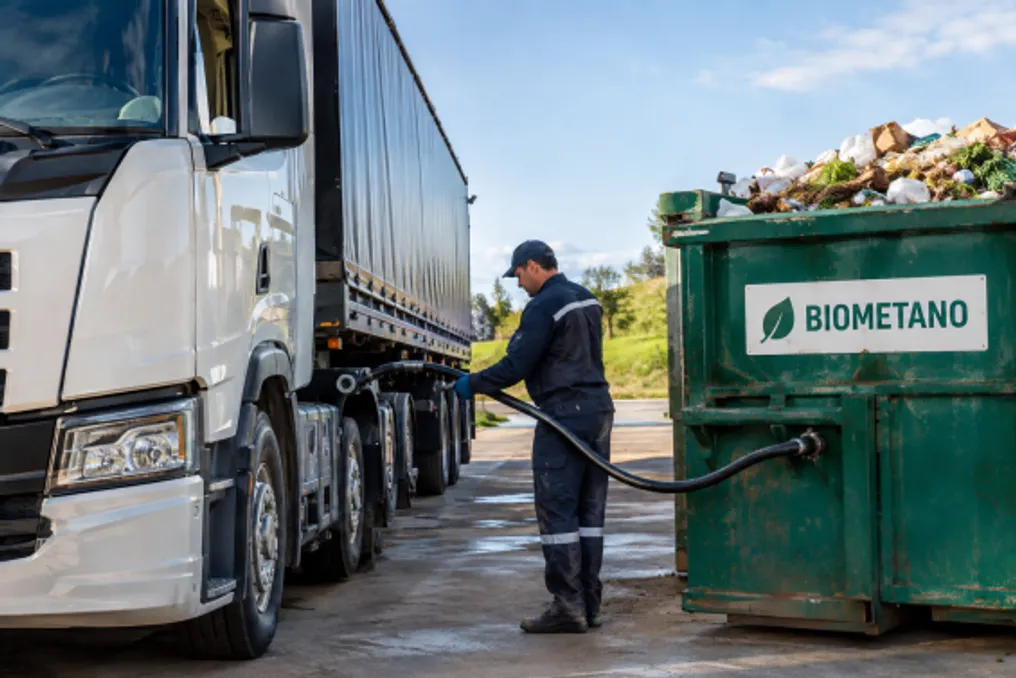
Brazil has a strong dependence on diesel fuel, a petroleum-derived fuel essential for production, transportation, and public education in the country. However, high costs and difficulty in meeting the entire national demand represent significant challenges.
A potential solution is found in the organic waste discarded in landfills, which can be converted into biomethane. In 2025, Brazilian diesel consumption reached approximately 50.5 billion liters, equivalent to over 138 million liters daily. Domestic production is not sufficient to cover this need.
According to ANP data, in 2025, net diesel imports totaled 16.3 billion liters, representing 27.3% of domestic demand. This external dependence generates economic effects because imported fuel is subject to fluctuations in international oil prices, exchange rates, freight costs, and global market conditions. The Central Bank recorded that, in 2025, diesel accounted for 61% of the value of imported petroleum derivatives.
Additionally, the country is vulnerable to distribution instabilities caused by international conflicts, such as the wars between Russia and Ukraine, and between the United States and Iran. Reductions in supply result in price spikes, creating a cascading effect: the increase in refinery price is passed on to the final consumer, raising costs across the entire logistics chain.
Beyond the financial impact, there is a serious environmental consequence. Diesel is highly polluting, releasing large amounts of carbon dioxide (CO2) and other harmful gases, contributing to the greenhouse effect and global warming. Many market demands pressure industries to adopt cleaner energy solutions.
In this context, biomethane emerges not only as an ecological option but also as a strategic alternative. Brazil has great potential for the production and use of this gas, which is generated by purifying biogas resulting from the decomposition of organic matter.
The raw material for biomethane can be obtained from sanitary landfills, urban waste, animal manure, agricultural activities, and industrial byproducts. By treating waste as an energy input, instead of just a disposal problem, it is possible to obtain part of the energy needed for local production and transport.
A study by the Energy Research Company (EPE), within the Ten-Year Energy Expansion Plan 2035, projects that the total utilization of residual biomass mapped in the country could generate more than 170 billion normal cubic meters (Nm³) of biomethane. Although this is a technical potential, a feasible volume of 35 billion Nm³ is projected for 2035, which could meet about 50% of the national diesel demand at the end of the decade, mitigating the need for imports.
Bruno Baeta, a researcher at the Federal University of Ouro Preto, specializing in waste and biomethane for over 15 years, considers the gas a viable solution for the environmental and economic problems of diesel. He emphasizes that if all waste is utilized, there will be a 'comfortable energy security,' given the strong Brazilian agricultural industry.
Interest in biogas has driven investments in infrastructure and technology, with existing regulated markets and legal security. Companies such as Gasmig and Comgás are already operating in the biogas production and distribution chain.
Davi Lopes, Head of GWM Hydrogen and PhD in energy planning, explains that biomethane is advantageous due to its molecular composition. Unlike fuels with long carbon chains (such as 16 to 20 carbon diesel), methane (CH4), the main component of natural gas, has only one carbon and four hydrogens, resulting in a proportional decrease in carbon and an increase in hydrogen, which aligns with the Brazilian reality.
The production process involves generating gas through bacterial action on organic waste, which is deposited in composting silos for biogas capture. After filtration, it becomes biomethane. Baeta adds that the process is continuous, with a gas production time of 30 days per batch, and the final residue can be used as fertilizer.
To optimize production, especially in the agricultural sector, Baeta recommends better sorting of the material, separating organic waste from industrial residue, which would reduce costs and increase efficiency.
Biomethane has energy efficiency similar to CNG. The Future Fuel Law (Law No. 14.993/2024) established the PNDG, setting emission reduction goals and obligating the inclusion of renewable fuel in the market, with an initial target of 0.5% biomethane mixed with CNG this year.
The program foresees the gradual expansion of gas use, either in pipeline networks or at refueling points via 'virtual pipeline' (pressurized truck transport). Cities like São Paulo and Goiânia already have vehicles powered by biomethane, and manufacturers like MWM have offered adaptable engines for biomethane use since 2019.
Thiago Brito, Sales and Biofuel Solutions Manager at MWM, highlights that Brazil has a competitive advantage due to biofuels, with biomethane production potential reaching 70% of total diesel consumption and the capacity to reduce CO2 emissions by over 90%.
Refordiesel, in Contagem (MG), has also adopted biomethane. Edmar Bergamini, the company's partner, performs conversions from diesel to biomethane, removing injectors and installing components for gas, allowing the engine to run under the Otto cycle without loss of power or torque. The average cost of this conversion is R$ 100 thousand, serving as a way to decarbonize without changing the vehicle.
Large logistics and industry companies, such as ReiterLog and Mercado Livre, are replacing fleets with biomethane trucks, in collaboration with Ambev and Natura. Toyota demonstrated a prototype of the biomethane-powered Hilux at Agrishow 2025, as part of its emission reduction strategy, although the project is still under development.