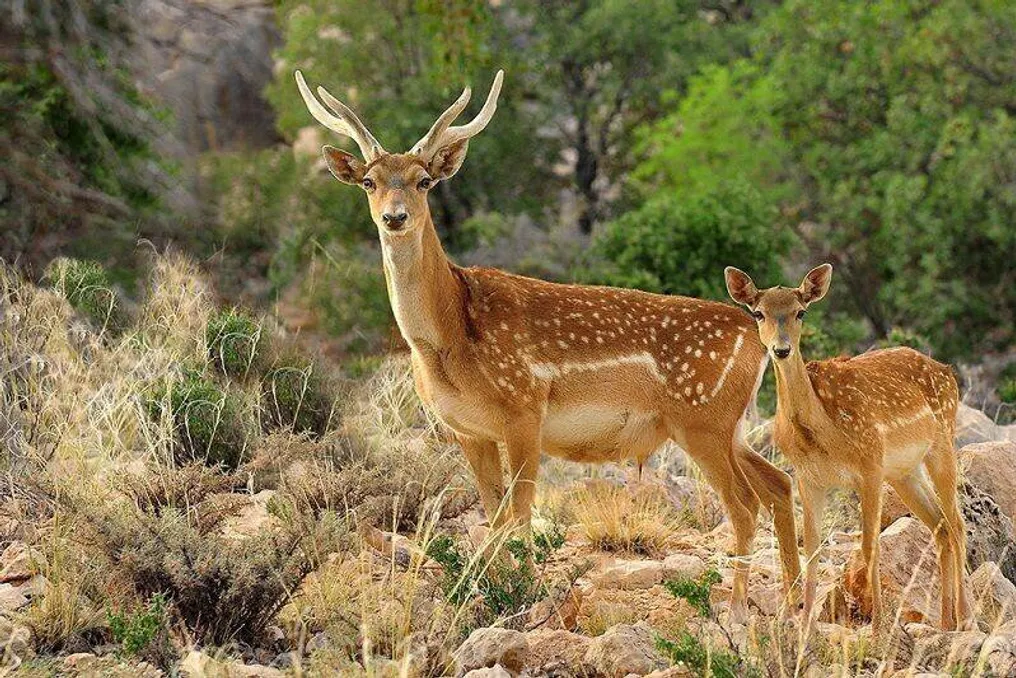
The Department of Environment (DOE) is conducting research, conservation programs, and breeding initiatives aimed at restoring the population of the Persian Fallow Deer in designated natural habitats and wildlife breeding centers across the country.
Efforts to conserve this endangered species are being implemented through two complementary approaches: in-situ conservation in natural habitats and ex-situ conservation in managed conditions, according to Mohammad Nosrati, an DOE employee, based on IRNA reports.
As part of measures to strengthen the numbers of the Persian Fallow Deer and improve its recovery, the DOE has allocated funding for monitoring and assessing the population of the species introduced in the provinces of Isfahan, Khuzestan, Fars, and Yazd. The goal of these efforts is to study population dynamics, identify threats, assess habitat suitability, and determine the species' conservation status.
Regarding ex-situ conservation measures, Nosrati noted that the DOE organizes deer breeding centers in various locations such as Azadi, Arsanjan, Miyankotal, Dasht-e Naz, Rashkan, Bagh-e Shadi, Mahour Dasht-Yafteh, Karoun Agroindustry, and Fandoklu. The objectives here include population management, relocating Persian deer to natural habitats, and assessing the genetic purity of the species.
According to the International Union for Conservation of Nature (IUCN) Red List, the Iranian yellow deer is classified as an endangered species. Nearly half a century ago, it was believed that this species had become extinct globally. However, about 50 years ago, four yellow deer were sighted in the forests of Dez and Karkeh, and they were subsequently released in different regions of Iran to improve reproduction.
Thanks to the effective implementation of the conservation program, the population of the Persian Fallow Deer has increased from 5 individuals in the Iranian year 1398 (2019–2020) to 19 individuals in the current year.
The DOE is working on creating a genetic map of endangered wildlife species to increase their chances of survival, develop breeding plans, manage populations, and address the challenges they face in the wild. Experts emphasize that effective conservation is nearly unattainable without a precise understanding of population genetics.
In this regard, genetic and molecular studies of key wildlife species in the country have been planned to ensure that management decisions are based on accurate scientific data, reported Leila Ezzeddinlou, head of the National Museum of Natural History and Genetic Resources, according to IRNA.
The main goals of these studies are to preserve genetic diversity within and between populations, prevent a decline in effective population size, avoid inbreeding and genetic erosion, conserve genes adapted to different environmental conditions, and provide genetic resources for species restoration, breeding, and reintroduction programs.
Under three research agreements signed between the DOE, the College of Agricultural and Natural Resources of Tehran University, and the University of Gorgan, an official representative stated that cooperation includes a project to study the genomic diversity and phylogeny of Levant viper and Latifi viper populations using conservative and therapeutic approaches based on genomic markers.
Furthermore, the development of genetic profiles and maps for Asian cheetahs, black bears, and the Persian Fallow Deer as keystone and endangered species has begun. Another part of the agreements focuses on assessing genetic diversity, inbreeding, and kinship in the Persian zebra population, which is conducted jointly with the provincial DOE department of Yazd.
Despite alarming data on the rate of species extinction, there is good news that endangered species are recovering, highlighting the role of conservation efforts in preventing extinction and assisting vulnerable wildlife in recovery.
According to the latest IUCN Red List report, about 154 vertebrate species and approximately 25 percent of plant species in the country are threatened, with 117 species classified as critically endangered on the national list. Among the threatened animals are the Persian zebra, Asian cheetah, black bear, great thrush, and yellow deer.
Among extinct animals are the Girghan tiger and the Persian lion—two feline species that have permanently disappeared from the country. Fortunately, the Persian zebra and the Persian Fallow Deer serve as examples of successful conservation efforts, where scientific measures and community involvement have led to species recovery, noted Hamid Zohrabee, an DOE employee, according to doe.ir.
Speaking about stories of successful species recovery in Iran, Zohrabee recalled that for years, the yellow deer was considered extinct worldwide. However, about 65 years ago, some yellow deer were sighted in the forests of Dez and Karkeh. Their conservation program immediately began with captive breeding and subsequent relocation to natural habitats for better reproduction.
The birth of the first Persian Fallow Deer in the current Iranian year, which began on March 21st, in the Karkeh National Park, southwest province of Khuzestan, offers hope for the revival of this unique animal. The Persian zebra is a subspecies of antelope that is critically endangered. The birth of a foal in Yazd province estimates the current Persian zebra population to be over 50 individuals, indicating improved habitat conditions and effective management of the protected species.
Conservation activities include a field program that covers strengthening natural infrastructure and promoting ecological sustainability, such as water resource monitoring. According to the DOE, the total number of Asian cheetahs in the country's protected areas is 27, while five other cheetahs live in breeding facilities, and six are in captivity.
In September 2025, the DOE resumed the implementation of the national project to protect Asian cheetahs after a six-year hiatus. An official representative emphasized that a specific action plan has been developed for every endangered species, and a specialized committee, in collaboration with universities and scientific organizations, is working on protecting and restoring species based on scientific data and research.
Over 337 protected areas are under the supervision of the DOE; the country has 13 biosphere reserves and 226 wetlands, 26 of which are included in the Ramsar Convention list of international importance. Currently, the country has prepared conservation plans for 25 endangered species, including the Persian cheetah, zebra, Asian black bear, yellow deer, small white-browed goose, white-headed duck, Persian salamander, blind cave fish, and Luristanica Sorbus (a rare plant species found in Iran). DOE is preparing another thirteen plans.
_