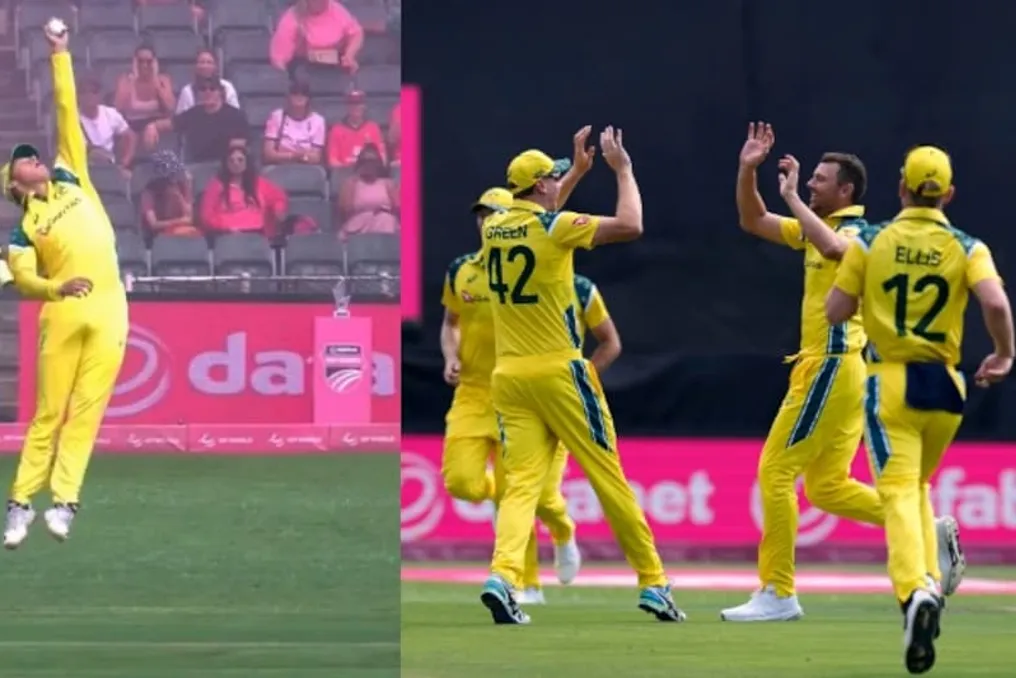
Cooper Connolly catches impressive ball in air in match between South Africa and Australia
Read more
Aaj Tak
www.aajtak.in

Cooper Connolly catches impressive ball in air in match between South Africa and Australia

During the second one-day format match between South Africa and Australia, held at Wanderers Stadium in Johannesburg, an incredible moment was demonstrated. Australian captain Mitchell Marsh decided to win the toss and start the game with a ball throw.

On the very first serve, Josh Hazlewood threw a short ball outside the off stump, which quickly flew towards Aiden Markram. Cooper Connolly, positioned at cover point, jumped to the left and caught this stunning ball with one hand, astonishing everyone present.

Thus, the first player for South Africa was dismissed without scoring any runs, and the atmosphere at Wanderers Stadium instantly quieted down. Cooper Connolly, who caught the ball, impressed the bowler himself, Markram.

For Aiden Markram, returning to the field, this match turned out to be extremely unsuccessful. It was the first time in his ODI career that he was dismissed on the very first ball. Thanks to this 'golden duck', he became the sixth South African player dismissed on the first ball in ODI cricket.

The Australian team started this match very strongly, which helped them try to make up for lost ground as they were trailing in the series. In this match, Mitchell Starc rested, and Javier Bartlett was included in the squad instead.

South Africa had previously won the first ODI match by a margin of 67 runs, and now their goal is to win the entire series. However, Cooper Connolly's impressive delivery at the start of the match gave this game new energy.

Similar stories

Captain Shreyas Iyer clashed with the umpire during India vs Japan match
Read more
www.aajtak.in

Captain Shreyas Iyer clashed with the umpire during India vs Japan match

The T20 match between India and Japan in Sano turned out to be much more exciting than expected. Due to rain, the game was shortened to five overs, and India, batting first, scored only 32 runs.

After this, the Japanese team managed to create serious problems for the Indians, and the match went down to the final over. It was in this decisive moment that a tense drama unfolded, leaving everyone in attendance holding their breath.

The situation reached its peak tension in the final over. Japan needed only a few runs to win, and the pressure on the field was immense. Akshar Patel was bowling when umpire Chris Thorpe ruled that one of Akshar's balls was a wide.

The series of wides was already causing difficulties for the Indian team, and the umpire's decision caused strong disappointment for bowler Akshar Patel. However, the situation did not end there. Indian captain Shreyas Iyer lost his composure and immediately walked towards the umpire.

It was evident from the broadcast how angry Iyer was about the decision, and he expressed his dissatisfaction in a very aggressive manner. At such a critical moment in the game, awarding an extra run could have been fatal for India, and Iyer's anger was caused by this.

Considering the anger of the Indian team's captain and the pressure from the players, field umpires Chris Thorpe and Chris Brown held a discussion. Following this, a dramatic turn occurred: the umpires changed their initial decision and ruled the ball as valid. This review fundamentally changed the course of the match.

In this thrilling game, the Indian team maintained psychological resilience after the drama and managed to stop the runs scored in the last balls, thereby preventing Japan from winning. Ultimately, India won this intense confrontation by a margin of two runs. In the five-over match, India scored 32/4, while the Japanese team managed only 30/3.

Triple Series in ODI: The Rise and Fall of a Golden Era
Read more
www.aajtak.in

Triple Series in ODI: The Rise and Fall of a Golden Era

At one time, the ODI (One Day International) itself was synonymous with a major event. Although the World Cup is held every four years, between these tournaments, there were other significant competitions for fans, among which triple series held a special place. These tournaments involved a competition between three teams with a league stage, a leaderboard, a fight for the final, and constantly changing dynamics in every match.

The popularity of these series was so great that the excitement was not limited to the action on the field. Spectators watched which teams would reach the final, how many wins each team would need, and under what conditions the pace of the game would be decisive.

In modern realities, where Test cricket has gained the goal of a Test World Cup, and T20 cricket has captured a huge market thanks to franchise leagues, ODI is trying to find its place between them. At such a time, memories of old triple series are particularly interesting, as 50-over cricket did not need external stimuli then.

Kerry Packer is often mentioned in the history of triple series. A dispute arose between media magnate Packer and Cricket Australia regarding television rights. Following this, Packer launched World Series Cricket. To make this league successful, Packer needed the best cricketers in the world. At that time, the West Indies were the strongest team, and Packer's team attracted many of their star players.

After this, triple series were held between Australia, the West Indies, and World XI. Matches concluded in a single day. Bright uniforms and white balls were used, and the television coverage was much more modern than before. The quality of the cricket was also outstanding. The West Indies participated in four of the first six Australian seasons and were champions every time. Even after Packer and the Australian board reached an agreement, this format continued to be held within Australia's domestic cricket calendar.

When this model, popular in Australia, reached South Asia, its influence grew. In 1983, the then Chairman of the Indian Cricket Control Board (BCCI), N.K.P. Salve, began working on organizing the World Cup in India. He was joined by Nur Khan from Pakistan and Gamini Dissanayake from Sri Lanka. During this process, the Asian Cricket Council (ACC) was founded on September 19, 1983. Then, in 1984, India, Pakistan, and Sri Lanka held the first Asian Cup in Sharjah. This event marked the beginning of multinational cricket in Asia. Gradually, Sharjah transformed into not only a venue for the Asian Cup but also a major center for ODI cricket.

In the 1990s, the influence of English cricket began to spread to the Indian subcontinent, and Sharjah became the focal point of these changes. Major players from India, Pakistan, and other countries regularly played here. Celebrities attended the matches, and the popularity of the games on television steadily increased. Long before the era of franchise cricket, Sharjah turned cricket into a large-scale spectacle. By the end of 1992, 29 ODI tournaments involving three or four countries had been held. Of these, 15 took place in Australia, and nine in Sharjah. Thus, the history of triple series in ODI is mainly linked to two locations: Australia and Sharjah.

In the 1990s, international cricket from South Africa returned, and Sri Lanka also quickly became one of the strong global teams. In 1996, Sri Lanka became the World Champion. The number of strong ODI teams in international cricket increased. This directly benefited the triple series. From 1996 to 2008, full member teams held three-nation ODI tournaments in Singapore, Morocco, Netherlands, Malaysia, Ireland, Scotland, and Canada. The four-year interval between World Cups and the limited popularity of the World Cup also made these tournaments important. It was the main way to watch ODI cricket between strong teams throughout the year.

These tournaments saw not only trophies won but also events that influenced rules, tactics, and thinking in cricket. In 1979, in Sydney, the England team had to save three runs on the last ball. Captain Mike Brearley positioned almost all his fielders near the boundary. A year later, New Zealand needed to score seven runs off one ball. Greg Chappell from Australia asked his brother Trevor to throw the ball underhand. This incident caused a big controversy in cricket. In 1982-83, Lance Cairns hit six sixes at the MCG (Melbourne Cricket Ground) using a specially prepared bat. In the 1980s, Javed Miandad took advantage of the conditions at the WACA Ground in Perth and scored an unbeaten 59 against the West Indies, including 45 singles and no fours or sixes. In 1986, Gus Logie from the West Indies was named 'Player of the Match' for his fielding performance in Sharjah. This in itself was an exceptional event.

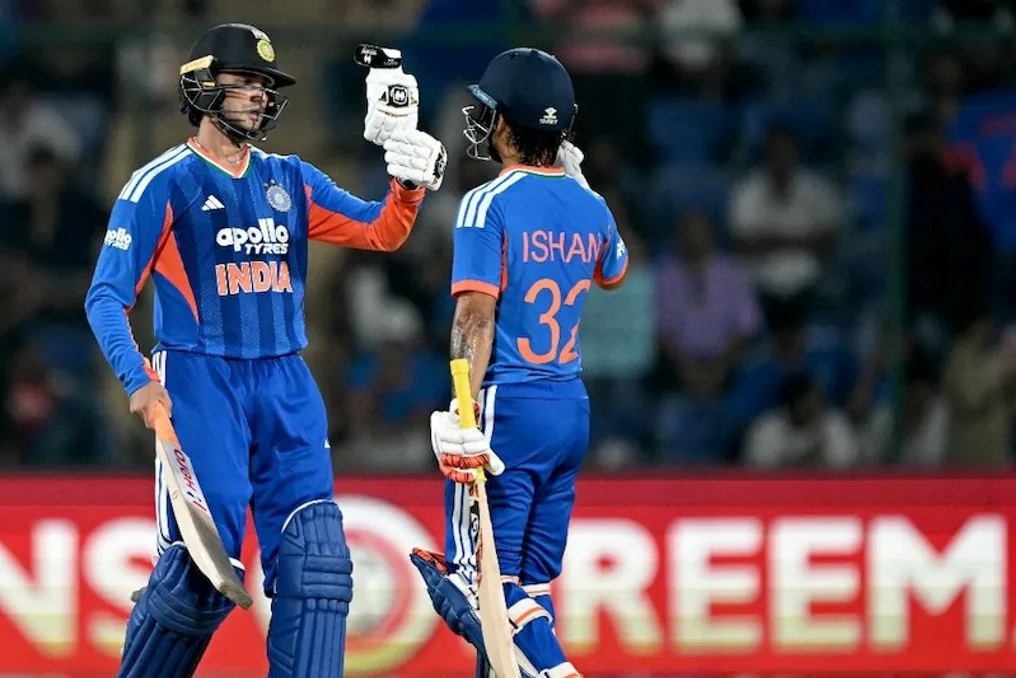
Abhishek Sharma Overtakes Pakistani Player in ICC T20 Rankings; Ishan Kishan Retains First Place
Read more
www.aajtak.in

Abhishek Sharma Overtakes Pakistani Player in ICC T20 Rankings; Ishan Kishan Retains First Place

During the current T20 series against Afghanistan, Indian batsman Abhishek Sharma demonstrated outstanding performance, allowing him to significantly improve his position in the ICC world rankings. Thanks to his strong batting, he surpassed Pakistani player Sahibzada Farhan and secured second place in the ICC T20 batsmen rankings.

Thus, both top spots in the T20 rankings are held by players from India, as vice-captain Ishan Kishan continues to hold the number one spot. This means that the two best T20 batsmen in the world are now associated with India.

In the first two matches against Afghanistan, Abhishek Sharma impressed his opponents with powerful innings. In the first match, he scored an impressive 82 runs off just 32 balls, leading India to an easy victory. Following this, in the second match, he played a rapid innings of 39 runs off only 19 balls. It was this excellent form that helped him climb the rankings, pushing Sahibzada Farhan to second place.

Not only batsmen but also Indian bowlers have gained recognition in the new ICC rankings. Varun Chakravarthy moved up two places to take fifth position. Star bowler Jasprit Bumrah made a significant leap into the top 10, securing tenth place. Additionally, Arshdeep Singh (14th place) and Axar Patel (27th place) also achieved good progress in the rankings.

India has already taken the lead over Afghanistan with a score of 2-0 in the first two matches of the series. The third and final match of the series will take place tomorrow, September 17, in Delhi, where the Indian team aims for a complete rout of their opponent.

Popular