Tourism promotes the connection between people, places, and cultures, creating opportunities for communities, supporting livelihoods, and making a significant contribution to economic development. In 2024, travel and tourism generated $10.9 trillion, accounting for 10% of global GDP, providing jobs for 357 million people and generating $1.9 trillion in revenue from international visitors.
However, the way destinations are chosen is changing, and increasingly, the journey begins before the trip itself, inside a smartphone. As part of the celebration of World Tourism Day in 2026, observed on September 27th, the global tourism sector is discussing how digital technologies and artificial intelligence can transform the industry.
India is participating in these discussions amid exceptional growth: according to the Ministry of Tourism, domestic tourist visits reached 428.55 crore in 2025 (compared to 67.7 crore in 2021), and the number of foreign tourists increased from 0.1 crore to 2.53 crore. Furthermore, foreign exchange earnings from tourism grew from 63,978 crore to 276,831 crore over the same period.
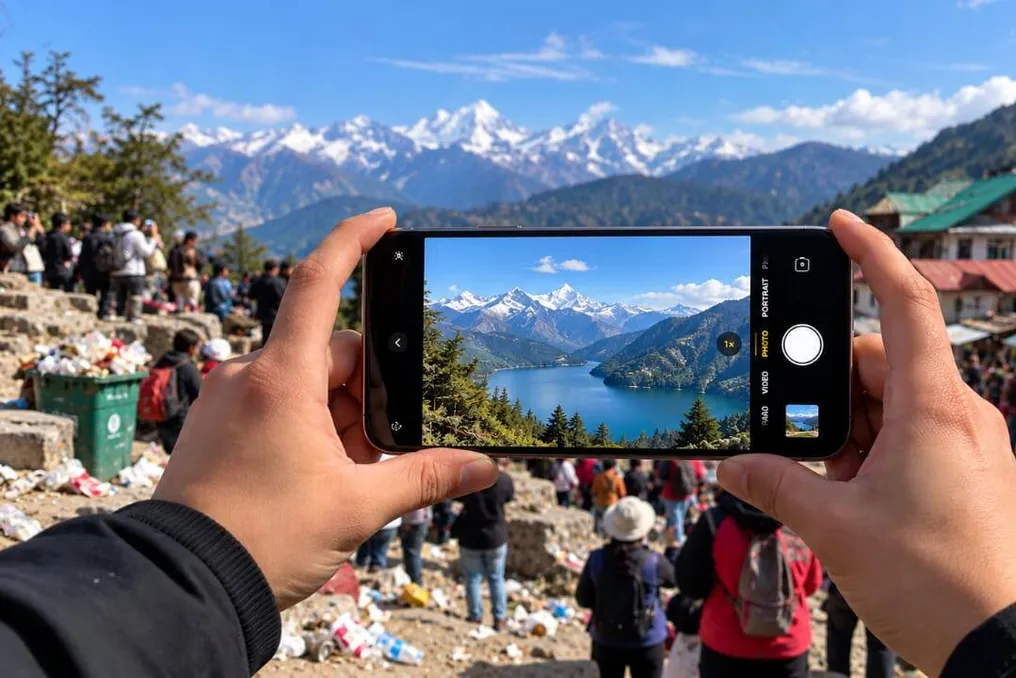
The opportunities are vast, but destinations face a growing question: what happens when a beautiful place becomes more famous online than it can actually sustain? This is the emerging problem of 'Instagrammable' destinations.
From Guidebook to Visual Trigger
Instagram Reels have radically changed the process of discovering new travel destinations. A 20-second video can fit a mountain road, a turquoise lake, a cafe, a waterfall, or a village into an irresistible sequence of drone shots, set to music, with transitions and carefully selected angles.
The Government of India has recognized the growing role of social media in tourism. The Ministry of Tourism conducted a study titled 'Social Media as an Influencing Factor Among Foreign Tourists Visiting India' through the Indian Institute of Tourism and Travel Management. The Ministry subsequently highlighted the importance of Instagram, YouTube, influencers, vloggers, and user-generated content for promoting tourism.
Tourism policy expert Hemant Joshi, CEO of Atithi Foundation, believes that the complexity lies in the fact that tourist demand can grow much faster than the destination's infrastructure, capacity, and local ecosystem can handle. He noted: 'We are increasingly seeing this in fragile mountainous and rural areas, where a viral post can almost instantly turn into traffic, pollution, pressure on water resources and other local infrastructure, as well as disruption to community life. Recent experiences in places like Manali, Ladakh, and Nilgiris serve as a reminder of this gap.'
Algorithms Prefer Photogenic
The problem is not that social media encourages people to travel; inspiration for travel has always existed. The difference lies in scale, speed, and concentration. Algorithms reward attention-grabbing content, and visually dramatic places naturally suit short videos. This creates a feedback loop: beautiful attraction $ ightarrow$ engaging Reel $ ightarrow$ high views $ ightarrow$ more creators $ ightarrow$ more travelers $ ightarrow$ more content $ ightarrow$ even greater visibility.
Nitish Srivastava, a travel enthusiast and hotel manager working in Gurgaon and creating travel content, asserts that algorithms favor what already attracts the eye. He added: 'Thus, creators can repeatedly visit the same popular spots because they know the audience will react.'
He also emphasized that a creator can showcase the experience of a fragile place without turning its exact location into instructions for mass tourism. Nitish stated: 'You can still share the experience without turning it into a trend like 'visit here before everyone knows'. For me, protecting the place is more important than getting a couple of extra views.'
Traveler Harsh Shivam from Delhi, who enjoys sharing travel-related content on social media, similarly argues that creators should be cautious when revealing particularly fragile or previously less crowded places. He said: 'The location is obviously an important part of travel content, but there is a difference between telling people the approximate location and giving them precise directions to a place that may not cope with a sudden influx of visitors.' He also points out the flip side: 'Increased tourism can create opportunities for local businesses and communities.'
This is the central paradox: visibility can lead to economic development, but the same visibility can result in environmental pressure.
When the Road Becomes a Bottleneck
India's tourism figures make this problem increasingly relevant. Official statistics from the state of Uttarakhand show how sharply visitors can concentrate in specific locations. Kedarnath received 243,012 visitors in 2021, which rose to 1,564,248 in 2022 and 1,958,863 in 2023. Badrinath increased from 199,409 in 2021 to 1,780,429 in 2023. According to Uttarakhand Tourism, more than 3.76 million tourist visits were registered in Tehri in 2023.
The core issue is not just the number of people entering the state, but where they go upon arrival and whether the local infrastructure can handle this concentration. Roads, parking lots, public toilets, accommodation, drinking water, sewage systems, emergency services, and waste collection—all have finite capacities. When tourism growth outpaces infrastructure development, the first visible sign may not be a tourism statistic, but a traffic jam.
The Environmental Bill Comes Later
Government studies demonstrate that environmental consequences are not theoretical. A report by the Ministry of Environment, Forests and Climate Change presented to the National Green Tribunal documented significant waste loads associated with tourism in Uttarakhand. A study cited in the report in January 2025 showed that 71% of the total solid waste generated in the Valley of Flowers was produced in just 37 days. Estimated waste generation was approximately 364 grams per visitor per day on the Gomukh trek and 580 grams per visitor per day on the Kedarkantha trek.
These figures highlight an important characteristic of tourism pollution: seasonality and concentration matter. A place might handle a relatively modest number of visitors most of the year but still experience intense pressure during a short viral or peak tourist period.
Ladakh presents another striking example. A capacity study conducted by the Himalayan Regional Environment Institute GB Pant examined tourism pressure in the Leh city complex. The study recorded rapid growth in accommodation, air traffic, and tourist influx alongside concerns about waste generation and disposal. Ladakh's ecological vulnerability makes this situation particularly sensitive. Water, wastewater treatment, roads, and energy cannot expand indefinitely just because Instagram demand is rising.
According to data from Kedarnath Nagar Panchayat obtained through RTI, Kedarnath generated 50.30 metric tons of waste from April to August 2026, more than 2.5 times the total volume for 2025.
Water is Also Part of the Tourism Footprint
The environmental footprint of tourism is also much broader than just trash. A Niti Aayog study on sustainable tourism in the Himalayan region of India highlights issues related to water consumption, groundwater extraction, energy, accommodation, transport, and solid waste. This is why a 'hidden gem' does not necessarily mean a 'sustainable destination.'
A small community might have beautiful landscapes but limited wastewater treatment systems, parking, waste collection, medical facilities, or water supply. Goa demonstrates that even beaches have limits. According to the state tourism department, 10.8 million tourist arrivals were registered in Goa in 2025.
An assessment presented to the National Green Tribunal showed that the capacity was exceeded on beaches, including Palolem, Agonda, Siridao, Vagator, and Coco Beach, based on the criterion of 10 square meters per visitor. Thus, the problem is not 'Instagram versus tourism,' but the growth of tourism relative to the destination's carrying capacity.
Local Population Economy: Gains and Losses
It would be an oversimplification to portray viral tourism as entirely destructive. A previously unnoticed destination, gaining attention, can mean more customers for homestays, restaurants, taxis, guides, artisans, and small retailers. However, benefits are not distributed automatically or evenly.
If the number of visitors grows faster than the local capacity, residents may face overcrowding, pollution, water shortages, rising prices, and disruption to daily life. At the same time, businesses may become increasingly dependent on a tourism boom they did not necessarily create or control.
From Viral Tourism to Responsible Discovery
Therefore, the challenge for Indian tourism is no longer just attracting visitors, but distributing them wisely. As Joshi notes, 'digital platforms can be used to distribute demand by ensuring the availability of credible, attractive alternatives, instead of concentrating everyone in a few places.'
He argues that destinations must plan for demand, not chase it. 'The goal is not to make destinations less popular, but to make tourism growth more manageable, more geographically distributed, and more valuable to host communities.'