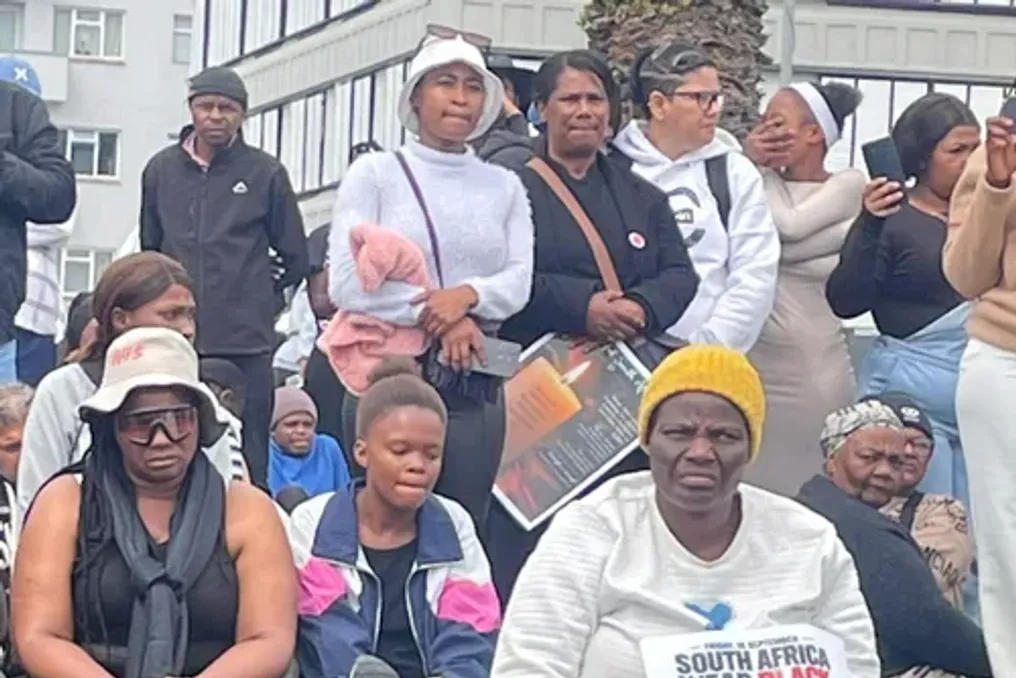
Women from South Africa are forced to bear significant financial and emotional costs to protect themselves from gender-based violence. These expenses include the use of panic buttons, attending self-defense courses, and using safer modes of transport.
For millions of women in South Africa, ensuring personal safety goes beyond simply locking the front door or parking the car in a well-lit area. Necessary safety measures include panic buttons, personal safety apps, pepper spray, self-defense classes, stun guns, as well as extra funds spent on safer transportation and security services. Even if each expense item seems manageable individually, collectively they paint a serious picture of what it can cost a woman just to have a chance of getting home safely.
Specific examples of costs include: emergency assistance subscription—49 rand per month; panic tracker—R2,499 upfront plus R99 monthly; self-defense class—R600; pepper spray—about R160; and stun gun—about R380. Calculating a conservative illustrative basket, including one panic tracker, an annual safety subscription fee, one monthly self-defense class, pepper spray, and a stun gun, a woman could spend thousands of rand in the first year of self-defense attempts. This amount does not account for costs related to safer transport, private security, insurance, home safety measures, or changing travel routes and times.
This is an invisible bill attached to the life of a woman in a country where the fear of violence can accompany her on the streets, in public transport, at work, and even in her own neighborhood.
Daily Safety Expenses
Women are often advised to avoid walking alone, running, or using isolated routes. They are recommended to share their location, carry protective items, remain vigilant, and have emergency service numbers handy. However, each such measure requires a certain price—whether financial, emotional, or both.
While some women try to figure out if they can afford another level of protection, families mourn other women whose lives have already been cut short. Recent cases of women's deaths in eKhuruleni have drawn intense attention to this fear: according to the government's Interdepartmental Committee on Gender-Based Violence and Femicide, nine female bodies were found in different areas between July and September.
These deaths have once again raised questions about women's safety, the responsibilities of the state and society, and whether women should spend their lives waiting for violence before they can move freely in their communities.
When Disappearance Becomes a Lifelong Trauma for the Family
For Ian Cameron, a DA MP and Chairman of the Parliamentary Portfolio Committee on Police, the human cost of violence is familiar. He recalled the case of Clio Diko, a mother of three, who went missing in October 2022. 'I still think about Clio Diko,' he recalls. For three months, her family did not know her whereabouts.
In January 2023, Diko's decomposing body was found hidden under a bed in Mandalay, Cape Town. Cameron reported that there was a rope around her neck, and the body was covered in cement and tiles. She was eventually identified through DNA testing. Cameron noted that his team from Action Society supported Diko's family throughout the entire legal process, observing multiple postponements while the mother dealt with the trauma after finding her daughter's remains. In March 2024, Sandile Jegwa pleaded guilty and was sentenced to 20 years in prison for Clio's murder.
Although the conviction brought justice, Cameron emphasized that it could not erase what the family had gone through up to that point. He stated that 'justice prevailed,' but the period between Diko's disappearance and the verdict was a time of uncertainty and grief that her family had to endure. Diko's story showed that the impact of violence does not end with the discovery of the body or the appearance of the accused in court. It is the 'human cost' of the word 'postponement.'
The case also highlighted another issue in the gender-based violence crisis: what happens to families after a woman disappears or is murdered. For families awaiting answers, any delay means another period of uncertainty, and every postponement prolongs the grief.
A Woman's Dignity Does Not End With Her Death
The Soul City Institute warns that women should not be held responsible for preventing violence committed against them. The organization notes: 'It is deeply disturbing that women are repeatedly found abandoned, injured, partially clothed, and displayed in public places.' Soul City asserts that a woman's dignity does not disappear after her death. 'A woman's body does not lose its dignity because she died. She is not a statistical victim of a crime. She is not a warning. She is not a headline.' She was someone's daughter, mother, sister, partner, friend, and community member. 'She is a person whose dignity must be protected in life and after death.'
Soul City also questioned the approach to giving safety advice to women during police investigations. Police urged women in the Kempston Park area not to walk or run alone, especially in isolated areas, and to travel or exercise in groups. While such precautions may be necessary during an investigation, Soul City believes that women cannot be required to reorganize their lives around the threat of violence. The institute insists: 'The responsibility for violence committed against women cannot be placed on the women themselves.' They argue that safety advice should not turn into another form of victim-blaming, questioning why women should risk being killed just for walking, running, working, or traveling home. 'Women should not have to restructure their entire lives because men decide to commit violence.'
A Crisis Requiring More Than Police
Soul City stated that this crisis cannot be solved by law enforcement alone. The organization called for an urgent coordinated response involving SAPS, municipalities, prosecutors, communities, transport authorities, civil society, and other relevant institutions. Its recommendations include thorough investigation of every death, holding perpetrators accountable, creating safer public spaces, improving lighting and transport safety, as well as adequate oversight and prompt local police patrolling, alongside continuous work with men and boys on issues of power, rights, consent, and healthy masculinity.
Furthermore, the institute called for a survivor and family-centered response that protects privacy, dignity, and emotional well-being, as well as responsible media and social media coverage that does not sensationalize female bodies or disseminate graphic images. Soul City stressed that South Africa must move towards prevention instead of waiting for another woman to die before systems start acting.
The Bill Women Should Never Have Had to Pay
However, for women, the cost of living under the shadow of gender-based violence is already being paid. It is paid through panic buttons and safety subscriptions, self-defense classes, and the use of safer transport. It is paid through the fear that turns a simple walk home into a risk calculation. And for families like Diko's, this bill is paid in years of uncertainty, grief, and the wait for justice. South Africa cannot continue to treat every death as an isolated tragedy while women are forced to bear the financial and emotional burden of self-protection. As Soul City said: 'We must stop normalizing the abnormal.'