For centuries, crossing Iran was a test of endurance as well as a process of discovery. Merchants transported goods between distant markets, pilgrims journeyed to sacred sites, and ordinary travelers followed routes through deserts, mountains, and plains. Between these long stretches of road were caravanserais—places where one could rest, give animals respite, protect cargo, and where strangers could share food, stories, and news.
Today, many of these historical roadside inns offer a different kind of travel experience. They are destinations in themselves, allowing visitors to immerse themselves in the infrastructure of movement that shaped Iran long before the advent of highways, railways, and airports.
The importance of these buildings was officially recognized in 2023 when UNESCO inscribed the Persian Caravanserai on the World Heritage List. This serial monument includes 54 caravanserais selected from a much broader network of centuries-old examples across the country.
Together, they represent more than just individual buildings: they serve as a testament to the roads, trade, pilgrimage, architecture, and human encounters that connected different parts of Iranian land and the wider region.
For modern travelers, this network offers an unusual way to get to know the ancient country. Instead of viewing heritage only in terms of palaces, mosques, or ancient cities, visitors can follow the roads between them and discover places where previous generations stopped along the way.
Architecture Shaped by the Road
Despite numerous differences and similarities among caravanserais across the country, there is no single architectural formula for the Iranian caravanserai. Their design evolved depending on geography, climate, available building materials, safety requirements, and the nature of the routes on which they were situated.
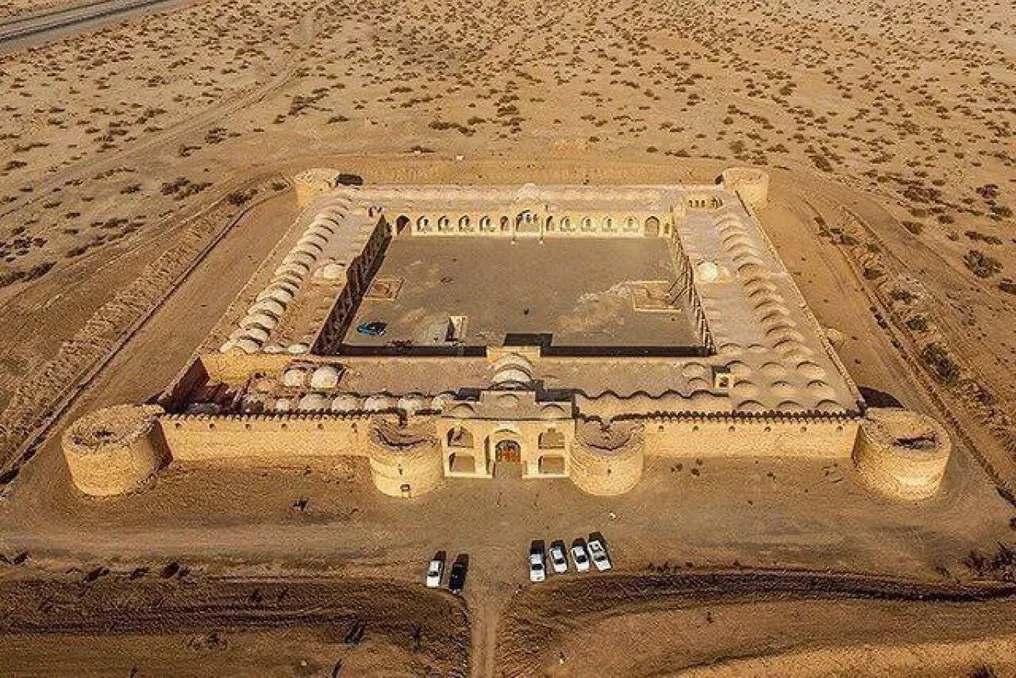
UNESCO's cultural body describes the 54 selected caravanserais as demonstrating a wide range of architectural styles and adaptations to various climatic conditions over thousands of kilometers. Nevertheless, many share a recognizable form and design. A traveler approaching a caravanserai would often first encounter an imposing entrance, sometimes marked by a monumental portal. Behind it lay a central courtyard, around which rooms and service areas were arranged. The courtyard provided an organized space for people, animals, and goods, while the surrounding rooms offered shelter.
The design was practical but rarely devoid of architectural ambition. Brickwork, vaults, domes, arches, geometric patterns, and carefully proportioned courtyards could transform what was essentially roadside infrastructure into an impressive architectural ensemble. In desert regions, thick walls and enclosed courtyards helped mitigate the harsh climate. In other areas, local materials and building traditions gave rise to different forms. The result is a remarkable architectural map of Iran: buildings responding to the same basic human need but reflecting very different landscapes.
UNESCO documentation notes that the location and setting of each caravanserai played a crucial role in shaping its design, particularly concerning climate, water availability, and defensive requirements. This is one reason why visiting a caravanserai can be more instructive than viewing its photographs. Sometimes the relationship between the building and the landscape becomes part of the experience. A caravanserai in the desert tells a different story than one near a mountain pass or an historic city center. The surrounding landscape, distance to other settlements, and water availability help explain why the building was built precisely there.
More Than Just Roadside Inns
The word 'caravanserai' easily conjures the image of merchants stopping overnight with their camels. This picture is not inaccurate, but it is incomplete. These places were part of a much larger social and economic system. They provided shelter, food, and water for caravans, pilgrims, and other travelers. They also facilitated the movement of goods and information between regions. Thus, a caravanserai could function as a small, temporary community.
Merchants from different regions could meet there. Pilgrims could rest alongside traders. People speaking different languages and adhering to different religious traditions could spend the night under one roof. News traveled with the caravans, as did commercial information, cultural practices, and technical knowledge. UNESCO considers this interaction central to the significance of the site. It asserts that caravanserais served as meeting points for people of different ethnic groups, languages, and religions, contributing to the exchange of human values, ideas, and knowledge over centuries.
From this perspective, the caravanserai was not merely a building by the road. It was part of the road itself. The road carried people and goods, and the caravanserai provided the physical infrastructure that made long-distance travel possible. The tradition of Iranian caravanserais is closely linked to the country's position between major cultural and commercial regions. Routes crossing the Iranian plateau connected Mesopotamia, Central Asia, the Caucasus, the Persian Gulf, and the Indian subcontinent, while pilgrimage routes linked important religious centers.
The World Heritage site reflects a tradition that developed over a very long period. UNESCO traces the evolution represented by the selected caravanserais from the Achaemenid period to the Qajar period, with examples reflecting different historical stages and architectural traditions. Consequently, these buildings should not be viewed as belonging to a single dynasty or architectural period. The network reflects successive generations of travelers and builders. Iranian caravanserais were built, modified, and used over centuries as routes changed and economic and political circumstances developed.
The UNESCO nomination documentation defines the historical continuity from the Sasanian and early Islamic periods through the Buyids, Ziyarids, Seljuks, Ilkhanids, Timurids, Safavids, and Qajars, while also accounting for the continuation of historical routes and the evolution of architectural forms. This continuity gives the caravanserais a unique place in Iran's cultural landscape. A palace can reveal how a ruler lived; a fortress can show how territory was defended; a mosque can reflect religious and artistic traditions. A caravanserai, conversely, reveals something about movement—about how people traveled, where they stayed, and how distant communities remained connected.
From Ancient Shelter to Modern Travel Experience
For contemporary visitors, the appeal of the caravanserai partly lies in its ability to alter the rhythm of travel. Iran's main tourist attractions are often concentrated in well-known cities: Isfahan, Shiraz, Yazd, Kashan, and Tehran. However, caravanserais encourage a different itinerary. They invite travelers to leave the main urban centers and follow historical roads into small towns, villages, agricultural areas, deserts, and mountainous landscapes.
A visit can begin with the architecture. The entrance may frame the courtyard like a stage. Arches in the rooms demonstrate the practical organization of the building. Brick vaults and domes show how builders created large covered spaces without modern construction technology. But the surrounding landscape can be equally important. Standing inside a caravanserai in a remote location, a visitor can begin to grasp the scale of past journeys. A road that now takes several hours by car might once have required days of travel. The presence of a caravanserai, therefore, was not accidental. It marked a point where travelers could find water, shelter, and a degree of security.
Perhaps the most expressive space in many caravanserais is the courtyard. Today, it may seem quiet as visitors photograph the arches and brick walls. Historically, however, it was a place of constant activity. Animals arrived after the day's journey. Goods were unloaded. Travelers sought rooms. Food was prepared. Conversations continued between people who might never meet again. The rooms around the courtyard could house travelers, while stables, storage, and other services supported the practical needs of the caravans. This layout allowed the building to function as a compact and controlled environment along a complex route. Thus, this combination of hospitality, logistics, and security was fundamental to the success of long-distance travel before modern transport.
A New Chapter for Old Roads
Inclusion in the UNESCO list also creates an opportunity to rethink how Iranian caravanserais are presented to international visitors. They can be seen as architectural monuments, but they can also serve as gateways to broader cultural landscapes. Visiting a caravanserai can be combined with local cuisine, crafts, agritourism, desert excursions, archaeological sites, or visits to historic cities.
Some of them have already undergone restoration and adaptive reuse. UNESCO has emphasized the need for sustainable approaches that allow modern commercial and hospitality functions to preserve their historical and architectural value. This balance will be crucial. A caravanserai that becomes a hotel, restaurant, or cultural center can gain new economic life. But excessive alteration can weaken the very qualities that make the building valuable. Therefore, preservation must remain at the heart of any tourism strategy.
The task is not simply to make old buildings usable. The task is to allow them to remain understandable as historical sites. UNESCO's management frameworks recognize this issue. The World Heritage Centre notes that components of sites have individual restoration plans, and local communities participate in the management of caravanserais located in or near populated areas.
For the traveler, perhaps the most meaningful way to experience Iranian caravanserais is not to view them as isolated stops. They gain meaning when encountered as part of a journey. A route through Iran can become a journey through layers of history: ancient roads, old bazaars, water systems, villages, and cities where caravanserais mark the places where travelers once rested. The buildings serve as physical evidence of a world where distance dictated daily life, and hospitality was an integral part of travel.
The modern visitor, of course, arrives by car, bus, or other modern transport. Roads are faster, navigation is digital, and overnight stays can be booked thousands of kilometers away. Nevertheless, inside a centuries-old caravanserai, the basic idea remains familiar. The traveler arrives after a journey. The door opens. There is shelter, a place to rest, and a courtyard around which the life of the building gathers. This continuity may be the greatest attraction of Iran's caravanserais.