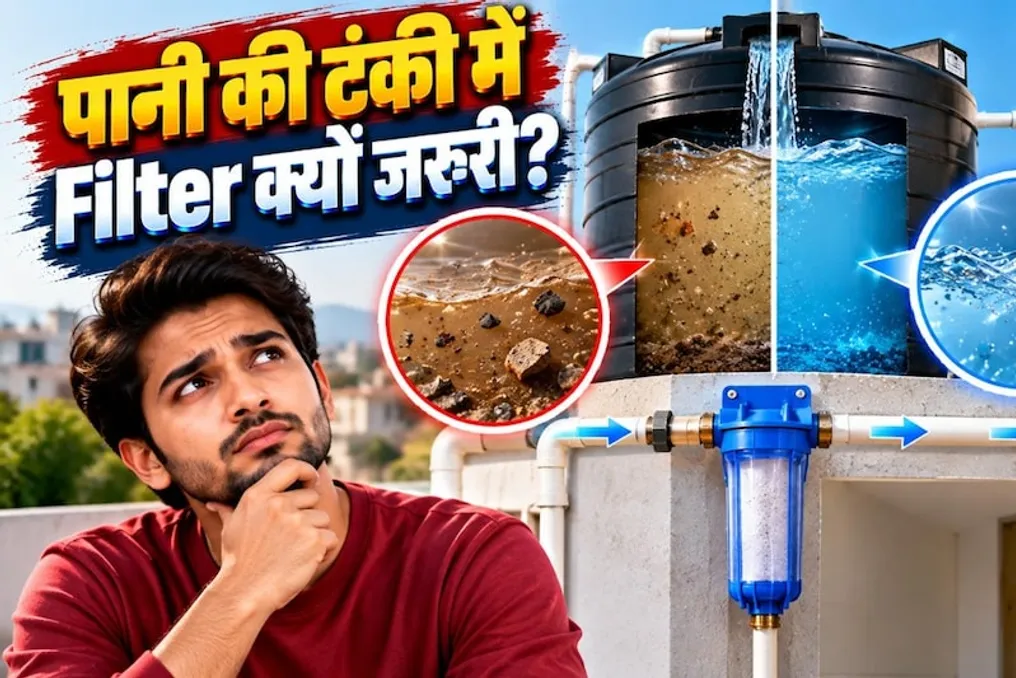
The water tank installed on the roof of a house is an integral part of daily life, as the water from it is used not only for drinking but also for washing dishes, laundry, and cleaning. However, many homeowners do not think about the cleanliness of the water entering the tank. In many residences, dirt, sand, rust, and other impurities coming from outside accumulate in the tank. This is why installing a filter between the water tank and the home plumbing system can be useful, as it helps prevent some particles of dirt from getting further.
Nevertheless, it is important to understand that not all water can be completely purified by a regular filter. If the water contains bacteria, viruses, dissolved chemicals, or high salt content, a specialized water purification system may be required.
Water enters the house through water pipes, and along the way, small particles of dirt, sand, or rust from the pipes can get in. If the water goes directly into the tank, these particles can settle there. The function of the filter is to retain such large particles. This can somewhat reduce the amount of dirt entering the tank. If the water contains fine soil or sand particles, they can reach the household pipes, sometimes accumulating in the fine mesh (aerator) on the tap, which leads to a decrease in water pressure.
The filter is capable of stopping such dirt, but this does not negate the need to clean the tank itself. Over time, sludge, dirt, and other deposits can accumulate in the tank, so regular tank cleaning remains mandatory. Filtration and tank cleaning are two different processes: the filter blocks particles coming with the water, while tank cleaning aims to remove dirt that has already accumulated inside.
Before choosing a filter, it is crucial to determine exactly what water problems exist in your home. If the problem is limited to visible impurities, such as sand or soil, a specific type of filter is used. But if the water contains excess salt, TDS, iron, or other dissolved substances, a simple mesh filter will be insufficient. Therefore, you cannot just install any filter assuming it will completely purify the water.
Maintenance of the filter itself is also important. Since the filter constantly retains dirt, its mesh or cartridge will become clogged over time. If it is not cleaned or replaced in time, the water pressure may drop. Therefore, in addition to installation, maintenance of the filter is necessary. The frequency of cleaning or replacing the cartridge depends on its type and the quality of the water.
A regular filter installed in the tank or pipes can only trap sand, soil, and other large particles. This does not mean that it makes the water potable. To consume it, you must first find out what problems are present in the water and use a purifier that meets those needs.
The main advantage of installing a filter in the tank is that it helps prevent the further spread of solid particles, such as sand and soil, along with the water. This reduces the risk of dirt accumulation in pipes, taps, and other fixtures. However, the filter should not be considered a magic cure for water purification. It is extremely important to regularly clean the tank, check the piping, and choose a suitable filter depending on the water quality. Thus, if there is no filter in the water tank, you should first determine the nature of the contamination in the local water, choose a corresponding filter, and regularly maintain it.