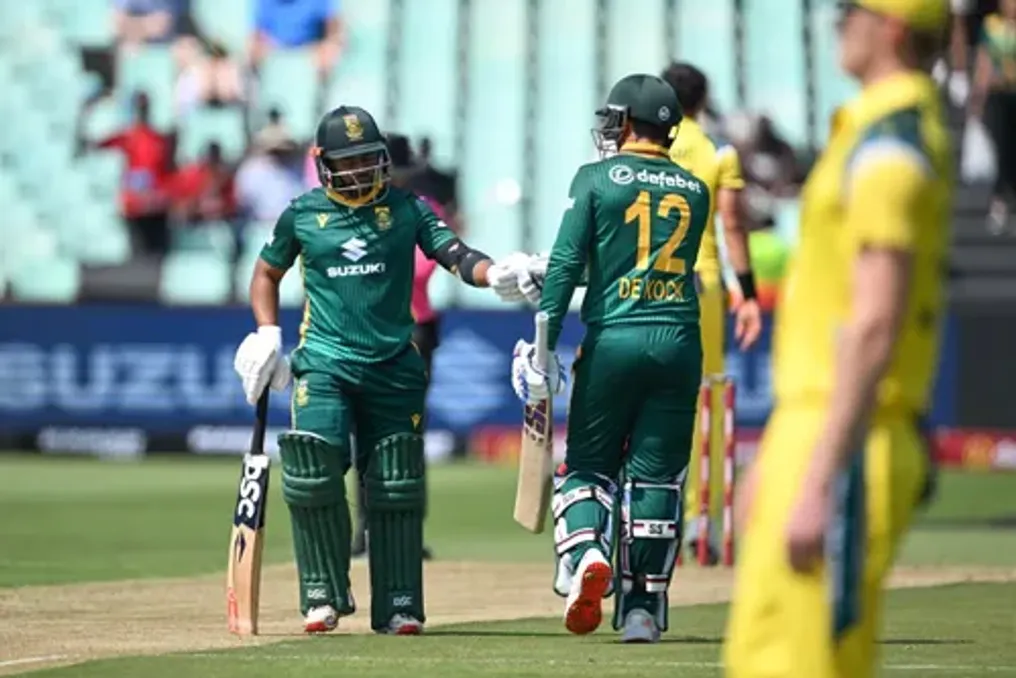
Watching the opening overs of the first ODI match between South Africa and Australia in Durban on Thursday, it became evident that modern fans may be subtly trained to value short formats while overlooking 50-over games.
The constant saturation of the cricket world with T20 content, driven by continuously emerging global leagues and tournaments, makes it difficult for One Day Internationals to maintain relevance outside of World Cup periods.
At the start of the game, the Proteas started slowly, losing six runs in the first three overs, after which Toni de Zorp was dismissed without scoring. Even Quinton de Kock appeared unusually sluggish, scoring only 14 runs off 18 balls. However, Matthew Breitschke played a brilliant, calculated supporting role, ensuring the team scored 112 runs off 106 balls, corresponding to a rate slightly above one run per ball.
Nevertheless, Marco Jansen's thrilling 75 runs off 59 deliveries added adrenaline to the viewing experience. The author noted that instinctively, he began to value Jansen's explosive play more than a patient, deserved century, which contradicts the traditional view of the game.
International cricket began with Tests in 1877 when Australia played against England, and it took nearly a century for the ODI format to debut in 1971. Although alternative innovations like Hong Kong Sixes and The Hundred tested other directions, T20 has established itself as the sport's largest financial driver.
Today, over eight major T20 franchise leagues dominate the global calendar, led by the Indian Premier League (IPL). Even at the domestic level, South Africa's SA20 is expanding exponentially ahead of its fifth season in January.
The career trajectories of Proteas veterans like de Kock and David Miller highlight the growing difficulty in maintaining the unique identity of ODIs. De Kock initially stepped away from ODIs after the 2023 World Cup to focus on global franchise opportunities such as the IPL, but later changed his mind last September, just two years before co-hosting the next 50-over World Cup in South Africa.
With over 7000 runs in 162 ODIs, a player of de Kock's caliber easily returns to the national team. Miller's statistics show an even sharper picture: despite playing 179 ODI matches as a middle-order mainstay, Miller participated in only four 50-over games in the last two years, including the Thursday match against Australia. During the same period, he played in 22 IPL matches and 15 The Hundred matches.
The main reality is that franchise T20 leagues provide the primary financial stability for modern players, and they prepare their physical and tactical conditioning specifically for this format. While Test cricket requires entirely different bowling strategies and radically different batting mechanics, ODIs have significant tactical overlap with T20. Applying T20 thinking to ODIs can often yield winning results, even if game situations sometimes demand tactical restraint.
Ultimately, it comes down to scale: ODIs last 100 overs compared to 40 in T20. The 50-over format inevitably includes long periods of lull—usually between the 15th and 30th overs, when teams consolidate, assess conditions, or recover. T20 simply does not allow room for such breaks.
This dynamic directly clashes with changing viewer behavior. Shorter attention span is not so much a reflection of cricket itself as a byproduct of the digital generation accustomed to watching endless short videos, dedicating only seven to ten seconds of attention to any topic.
Against this backdrop, sports administrators face a difficult task. Trying to attract a new audience to cricket today makes it increasingly difficult to justify the slow narrative of a regular ODI series, except perhaps during the World Cup.