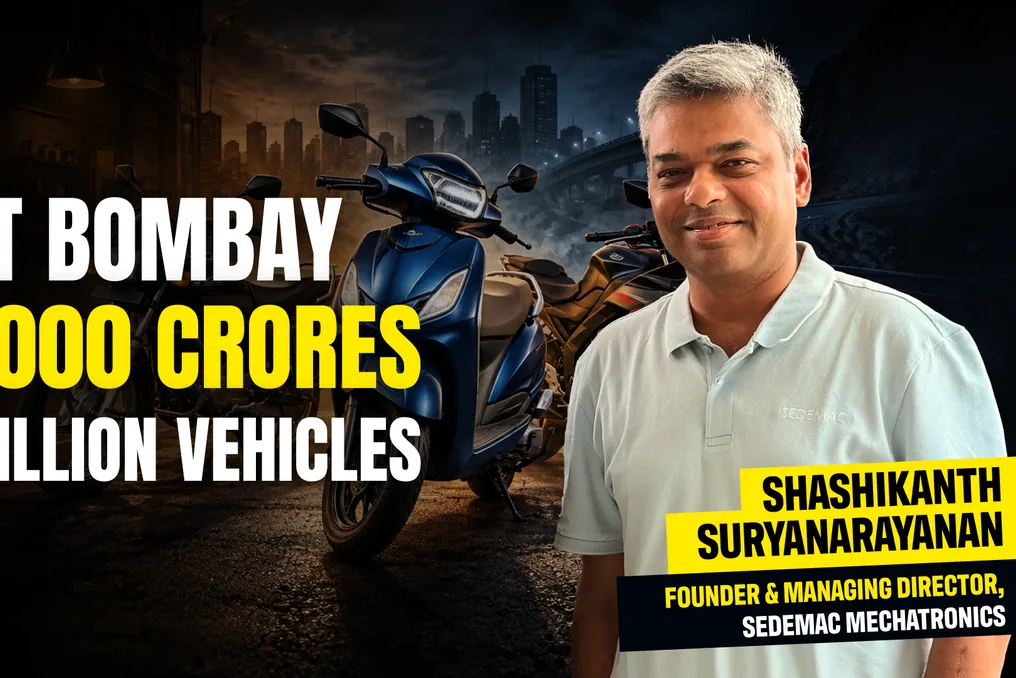
The Indian startup ecosystem has demonstrated a high capacity for rapid company creation. However, Professor Shashikant believes that developing truly new technologies represents an entirely different level of complexity.
About two decades ago, a group of specialists from the IIT Bombay laboratory founded the company Sedemac. Their initial goal was relatively simple: to create new control technologies and achieve their widespread adoption.
Today, Sedemac's financial figures speak to impressive growth. The company has exceeded annual revenue of ₹1000 crore, with EBITDA at approximately ₹200 crore, pre-tax profit at ₹150 crore, and net profit at ₹100 crore. The company demonstrates a Return on Capital Employed (ROCE) of about 40%, supplies one million motor controllers quarterly, and its technologies are integrated into millions of two-wheelers on Indian roads.
However, Shashikant's story goes beyond the growth of one company; it illustrates what happens when engineers tackle problems the market hasn't yet realized it needs.
He asserts: 'Technology creators are market creators. You don't start with the thought: 'Oh, this market will become big.' It becomes big or not because of you.'
A central element of Sedemac's success is the work on motor controllers and sensorless commutation. A motor controller regulates the flow of energy between a power source, such as a battery, and an electric motor. For the motor to run, the controller must determine which coils to activate based on the rotor's position. Traditionally, a physical sensor is used for this.
Sensorless commutation aims to perform this function without such a physical sensor, instead using other data to estimate the rotor's position. While this was understandable for decades at high speeds, physics becomes significantly more complex at zero and low speeds, as one estimation method, back EMF, decreases with speed and disappears at zero.
Shashikant states: 'We are the first company in the world, in the world, to achieve such progress in sensorless commutation as we have.'
Nevertheless, Sedemac did not start in 2007 with the grand plan to solve precisely this problem. The opportunity arose later through work with the two-wheeler industry. Around 2014–2015, while developing the Integrated Starter-Generator (ISG), the team realized the system could be improved through advancements in sensorless commutation.
In 2018, the TVS moped became the first vehicle to use this system. According to Shashikant, this was also the first application of sensorless ISG in the world.
This was followed by not instantaneous success in deep technology. Sedemac estimates that there are currently 12 to 13 million vehicles on Indian roads equipped with ISG. Five out of ten best-selling two-wheeler models in India use Sedemac's ISG in at least one variant, including models from TVS, Bajaj, and Hero.
Another Sedemac technology, according to Shashikant, is already installed in about 50 million vehicles. This scale is significant because Sedemac had to break into a market dominated by huge established suppliers. According to Shashikant, four manufacturers—Honda, Hero, TVS, and Bajaj—account for about 85% of the Indian two-wheeler market. Today, Sedemac supplies products to three of these four leaders.
'You cannot enter and grow very fast if you don't have something special,' he notes.
The company's approach to finding customers remained surprisingly simple: create something new, develop a working demonstration, and approach industry executives directly. 'If something is truly fresh, you usually get some response.'
However, getting a response is only the beginning. The demonstration must work on the client's equipment. Pricing must be justified. The technology must pass the first commercial test. Users must value it. There should be no quality issues. Only then can serious scaling begin.
In the two-wheeler segment, according to Shashikant, the path from demonstration to first implementation can take three to four years if everything goes smoothly. Sometimes, however, timelines can stretch to 'infinity.'
For Shashikant, Sedemac's journey depended most on two factors. The first was 'exceptional technical capability.' The second was the presence of large, complex clients capable of adopting what these engineers create.
Capital mattered, but it ranks below these two factors. In 2008, Nexus invested ₹2 crore in Sedemac. Shashikant admits that without an ecosystem ready to fund engineers without significant personal capital, the company might never have emerged.
But he draws a clear distinction between funding a business and creating it. 'Investors bet on whether the business will succeed,' he says. 'They can never create a business. They can only support it.'
This distinction also shapes his view of India's deep tech ecosystem. Funding can create infrastructure, support experiments, and give engineers time to solve complex problems. But money alone is not enough to create technical excellence. 'You can never produce talent just by throwing money at it.'
Today, Sedemac employs about 250 engineers, and Shashikant estimates that 60–70% of them come from IIT, NIT, and BITS. His philosophy for attracting such specialists is unusually straightforward. 'I believe that most employees, if asked honestly, do not care about your vision.'
Instead, he argues that exceptional technical specialists primarily care about the quality of the work and fair compensation. 'The most important thing is that you must have high-quality work. Otherwise, a high-quality employee won't come.'
Culture comes after these fundamental foundations. At Sedemac, he describes a workplace where argument trumps hierarchy. 'If you say nonsense, people will tell you you are saying nonsense.'
For a technology company, this density of engineers is not just a hiring advantage. It is the driving force that allows the company to constantly create new technologies. As Shashikant says, Sedemac's achievement is not just sensorless commutation. More importantly, 'we built an engine that can create such technologies.'
Sedemac's revenue was about ₹8 crore in 2014, ₹18 crore in 2015, and ₹36 crore in 2016. By the 2026 fiscal year, according to Shashikant, it reached ₹1058 crore, nearly 30 times the revenue of 2016. Since the 2019 fiscal year, ISG has been the largest source of growth, although the company is also exploring opportunities in generators, electric vehicles, and power tools.
Nevertheless, Shashikant particularly emphasizes another set of metrics: profitability and capital efficiency. His argument is provocative. If a company claims to have created a truly differentiated technology, that differentiation must ultimately translate into a competitive advantage and pricing power. 'If you claim to be a successful technology company, how can you not make money?'
He clarifies that this argument applies to companies that have already achieved scale, not to enterprises still investing for establishment. But once significant adoption occurs, he believes the technological advantage must become visible in the economy. 'If you don't have strong EBITDA and good ROCE, you are not a technology company. Period.'
Sedemac's current ROCE is about 40%, according to the discussion. For Shashikant, there are no financial tricks here. 'You cannot financially design your way to this.'
Create something new. Make it valuable enough that customers want it. Gain some pricing power. Control costs and capital expenditure. Profitability and capital efficiency will follow.
Perhaps Shashikant's strongest argument is that India's limitation is not just capital or talent. It is a question of whether enough engineers believe in their ability to create something the world has not yet created.
He compares technology ecosystems to sports. India can produce Virat Kohli because generations of young cricketers can realistically see themselves as world stars. Spain can produce Lionel Messi because there is a similar pyramid around football. For engineering, in his opinion, India still lacks this depth. 'It is impossible to have superiority in an ecosystem if it does not have the best in the world.'
He sees progress. More engineers now have access to capital, more youth are trying to solve complex problems, and there are pockets of serious technical excellence in India. But ecosystems require generations to build. Sedemac itself gives an idea of what this future could look like: a company that started with engineers trying to create 'fresh technologies,' spent years convincing major manufacturers to adopt them, and then those technologies quietly disappeared into the everyday products used by millions of Indians.
The lesson is not that every deep-tech company must follow the Sedemac path. But that original technology often emerges before there is an obvious market to measure, a client requesting a solution, or even confidence that adoption will occur.