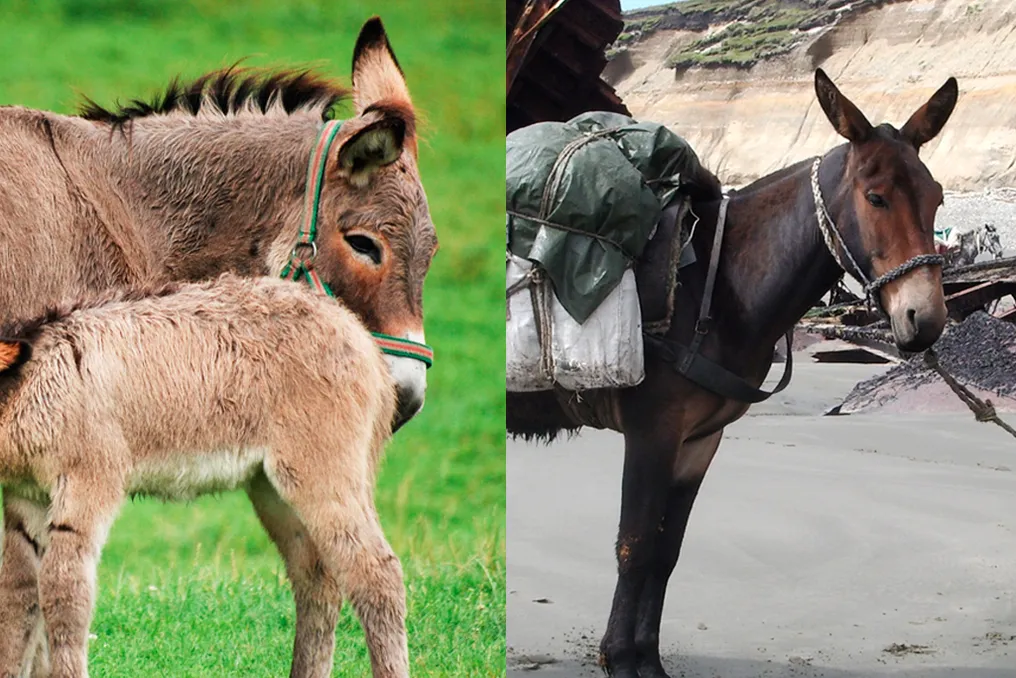
Animals known as donkeys, geldings, or asses belong to the species Equus africanus asinus, a subspecies of Equus africanus that was domesticated approximately seven thousand years ago. These animals are distant relatives of zebras and horses, sharing a common ancestor about two million years ago.
Mules and asses are formed by the crossbreeding of a donkey and a mare. When the offspring of this mating is female, it is called a mule; if it is male, it is called a donkey.
Donkeys were domesticated before horses, whose domestication occurred less than five thousand years ago. Despite being smaller, donkeys demonstrate greater resistance compared to horses. For millennia, they were used as pack, saddle, and draft animals, being extremely useful in heavy agricultural work. On average, they reach a height of 1.30 meters and can weigh up to 400 kilograms.
During the colonial period, donkeys were introduced to Brazil by Europeans and quickly established themselves as the main means of transport for drovers, carrying goods between the coast and the expansion missions inland. In Brazil, donkeys gave rise to three distinct breeds: Brazilian, Pêga, and Nordestino, resulting from centuries of crosses adapted to work needs and regional climate. Currently, Brazilian donkeys are at risk of extinction.
Regardless of sex, mules and asses share physical similarities with mares but inherit the characteristic of strength and resistance from the donkey. Their remarkable balance allows them to traverse steep mountain trails, making them very valuable as pack animals and highly recommended for agricultural activities.
In the past, these animals were celebrated in various forms of art in Brazil. Luiz Gonzaga, in his 1976 song titled 'Apologia ao jumento' (Praise to the Donkey), stated: 'The donkey has always been the greatest developer of the sertão. It helped man in the daily struggle.'
The historical association of asses, donkeys, and mules with negative traits, such as stubbornness and low intelligence, is an old tradition not limited to Portuguese. Expressions in English and Spanish reflect this, such as 'stubborn as a mule' and 'más terco que una mula'. However, this nickname is considered unfair, given that equids—including horses, donkeys, asses, and mules—are, in fact, intelligent. Research has proven that they possess long-term memory, complex social interactions, and the ability to be trained to perform specific tasks.
Chiara Albano, a professor at the School of Veterinary Medicine and Animal Science of the Federal University of Bahia (UFBA), explains that the stigma may be linked to the difficulties in managing these animals. She points out that 'Taming donkeys and asses is more challenging than taming horses, because their natural behaviors are different.' For example, while horses react to predators or dangerous situations by fleeing and observing from a distance, the donkey tends to stop and analyze the situation before taking any action, freezing if it perceives danger or distrust to ensure its safety.
To differentiate each species, one can observe certain physical details. The ears of donkeys are visibly larger than those of mules and asses. In terms of size, mules and asses are usually taller, potentially exceeding 1.50 meters, depending on the size of the mother mare, whereas donkeys remain around 1.30 meters. Finally, the coat of the donkey is denser and more varied (including gray, white, and black tones), while mules and asses have shorter coats, similar to those of a horse.