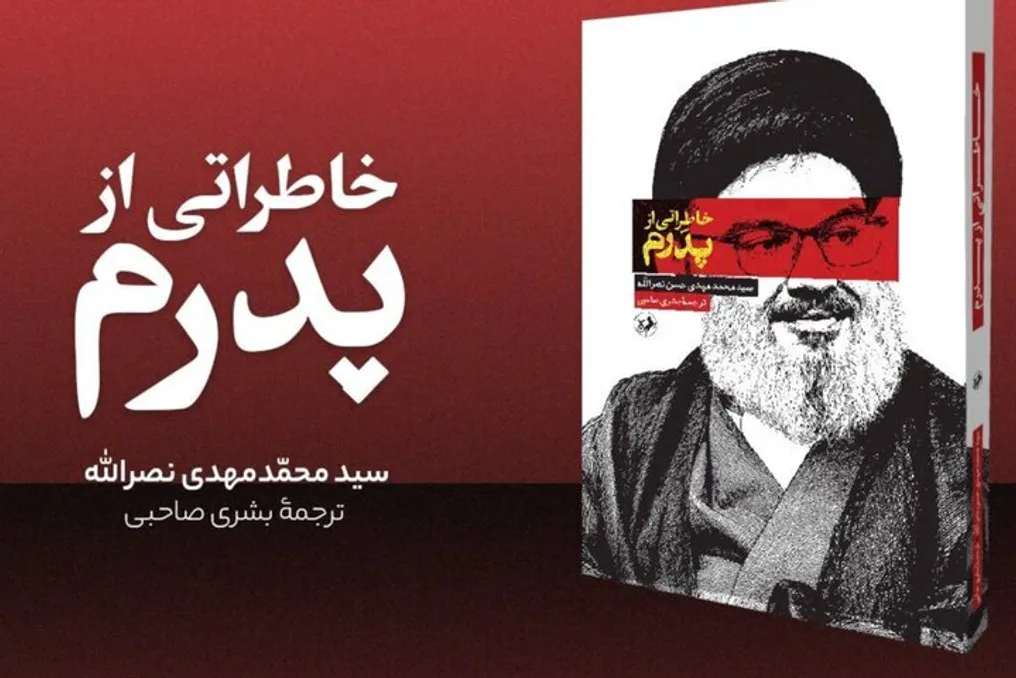
The book titled 'Memories of My Father' offers an intimate portrait of the martyr Sayyed Hassan Nasrallah. The author, Sayyed Mohammed Mahdi Nasrallah, wrote this work, which was translated into Persian by Bushra Sahebi. The book presents the personal, family, and ethical aspects of the life of the martyr Sayyed Hassan Nasrallah, former Secretary-General of Hezbollah in Lebanon.
The Persian edition of the book was recently released by Amirkabir Publications in Tehran. The translation aimed to preserve the original tone and personal characteristics of the author, making the work accessible to Persian readers. The book was published on the second anniversary of Nasrallah's martyrdom and is considered the first official and personal work published by his family that reveals the image of this resistance figure through the lens of his son.
Originally written in Arabic under the title 'Dhikrayati ma‘a Abi,' the book focuses on Nasrallah's private life outside public and political attention, paying attention to his behavior and relationships within the family. The work is divided into two main parts: 'What I Heard from My Father,' based on memories, and 'What I Saw Accompanying Him,' which relies on the author's direct observations.
In 82 narratives, the book describes various aspects of Nasrallah's life, including his attachment to family members, care for raising children, as well as his role as a loving father and grandfather. The theme of his modest lifestyle, approach to reading, and close connection with books is also addressed.
A significant part of the memoirs is dedicated to how Nasrallah coped with difficulties and lived under conditions of complex security, offering readers a glimpse into his daily life, which received relatively little attention.
'Memories of My Father' is intended for readers interested in resistance literature, regional history, and contemporary history. It provides a family perspective on a prominent figure associated with Hezbollah in Lebanon and the broader regional resistance movement.
Sayyed Hassan Nasrallah became the Secretary-General of Hezbollah in 1992 after the assassination of his predecessor, Sayyed Abbas al-Musawi. He led the movement for more than three decades, a period that included the withdrawal of Israeli troops from South Lebanon in 2000 and the 2006 war between Hezbollah and Israel. Under his leadership, Hezbollah transformed into a major political and military force in Lebanon and took on a broader role in regional affairs.
Nasrallah was also widely known for his television appearances, where he addressed supporters and commented on major events in Lebanon and the wider region. Born and raised in Beirut, he came from a family with roots in Bazurieh in Southern Lebanon. Although his public life was closely monitored throughout the region, his private and family life largely remained out of sight.
Tragically, he died at the age of 64 during a series of intense Israeli airstrikes in South Beirut on September 27, 2024. The attack that claimed his life was carried out by Israeli fighters targeting the Hezbollah headquarters, resulting in the martyrdom of several high-ranking Hezbollah commanders and Iranian Revolutionary Guard Lieutenant General Abbas Nilfouroushan, who was present at the scene.
Under Nasrallah's leadership, whose name means 'victory through God,' Hezbollah transformed from a grassroots armed movement into the largest political party in recent Lebanese history. Known for his captivating speeches, Nasrallah attracted attention across West Asia and beyond, establishing himself as a significant figure in the Axis of Resistance, which includes Hezbollah, Palestinian groups Hamas and Islamic Jihad, the Houthis in Yemen, and various Iraqi militia groups.