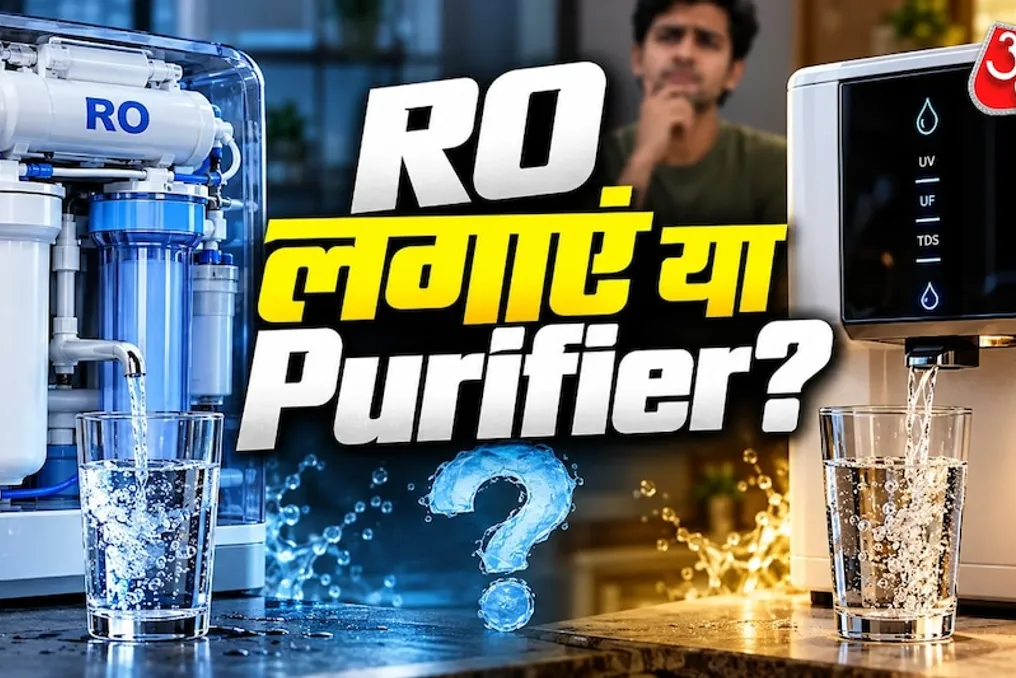
Currently, most people install water purifiers to maintain the purity of drinking water in their homes. However, when purchasing water purifiers, various names such as RO, UV, and UF are often encountered. A common question arises regarding the exact difference between RO and a water purifier, and whether they are the same or perform different functions.
Essentially, RO is a type of water purifier, but the key difference lies in the use of RO technology for water purification. Not every water purifier is necessarily equipped with RO technology; some models use UV, UF, or other types of filters.
RO stands for Reverse Osmosis. In this system, water passes through a very fine membrane. This membrane helps reduce the concentration of many dissolved substances and salts in the water. RO technology is particularly relevant for water with a high TDS level. TDS denotes the total concentration of various dissolved products in water. For example, if water comes from a well or another source and has a high TDS level, using RO may be necessary.
Nevertheless, RO has a drawback: during the purification process, some water is diverted and discharged, which is usually called 'wastewater.' Therefore, when using RO, water loss must be taken into account.
A water purifier is a general term. This term refers to various devices for water purification. An RO system might be installed in one purifier, UV in another, and a combination of RO with UV and UF in a third. Thus, it is incorrect to consider RO and a water purifier as completely different things. This can be compared to how a car is a type of transport, but not all transport is a car. Similarly, RO is a water purification technology, while a water purifier is a general name for the entire machine designed for water purification.
In addition to RO, UV and UF technologies are also used in purifiers. UV, or ultraviolet, helps in inactivating various microorganisms in water using ultraviolet light. UF, or ultrafiltration, uses a very fine filtering membrane that prevents small particles and impurities from entering the water. However, unlike RO, UF does not reduce the amount of dissolved salts and many other dissolved substances in the water.
Just because neighbors use RO does not mean that every home needs RO. First and foremost, it is important to determine the quality of the water supplied to your home. It is also necessary to know the water source and its TDS level. If the TDS in the water is high, RO may be useful. If the water problem is different, UV, UF, or another filter may be required. Consequently, you should not buy a purifier just because it says RO.
Before purchasing a water purifier, it is recommended to have the water in your home tested. Then, you should determine the TDS level and the nature of the problem in the water. Depending on this, you can choose a purifier with RO, UV, UF, or a combination of them. One should not assume that the best purifier is the one with the most filters. It is much more important to choose a purifier with the appropriate technology based on your water's needs. RO is the water purification technology itself, whereas a water purifier is the entire machine for water purification, so they cannot be considered as one thing.