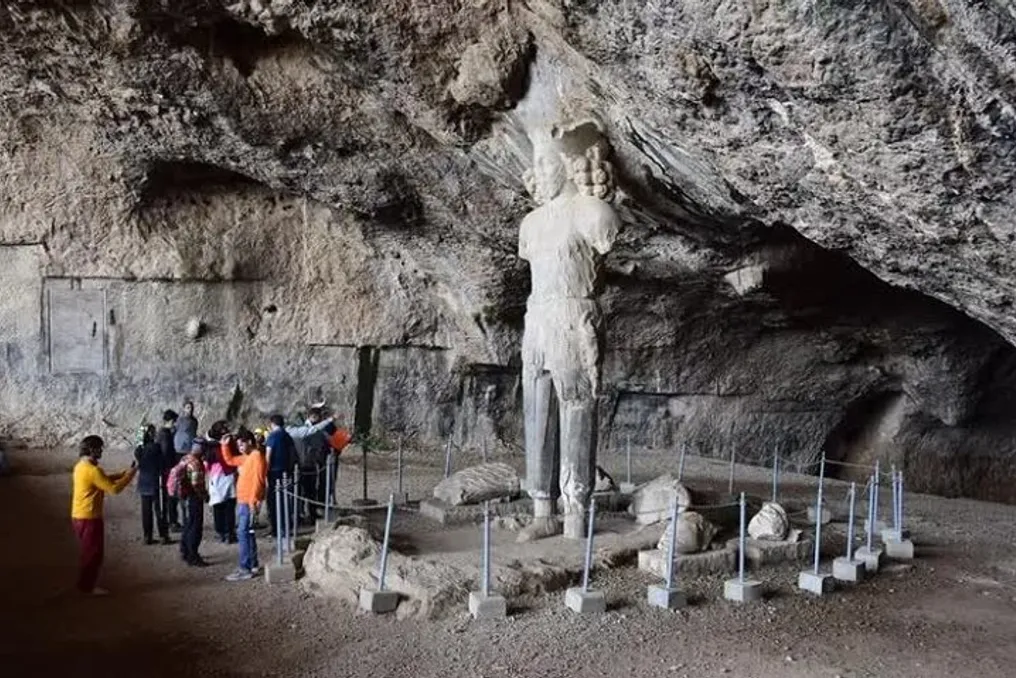
The first stage of a new project to preserve and restore the monumental statue of the Sasanian King Shapur I in the Shapur Cave, near Kazerun in southern Iran, has started, according to the head of the Fars Sasanian Archaeological Landscape.
Afshin Ebrahimi stated on Saturday that this project marks the first major attempt to conserve and restore the statue approximately seven decades after its reinstallation in the early years of the Second Pahlavi era.
Ebrahimi explained that the first stage includes four main activities. The initial step involves detailed scientific documentation of the statue using near and long-range photogrammetry, drones, and cameras. The collected data will serve as the basis for developing a comprehensive conservation plan.
Next, a technical and protective frame, 7 meters high and measuring 4 by 4 meters, will be erected around the statue to ensure safe access to all parts of the monument for conservation and restoration teams.
The project also provides for the installation of a transparent polycarbonate barrier at a safe distance from the statue so that visitors cannot touch it directly or approach too closely.
The fourth activity relates to the organization and conservation of individual fragments of the statue scattered across the monument's area.
According to Ebrahimi, the first stage will take about three months, while the entire project is planned for a period of two to two and a half years. The frame will be dismantled after the completion of the restoration work.
He emphasized the necessity of conducting specialized conservation work, noting that the statue was last reinstalled during the Second Pahlavi era when concrete legs were installed. Since then, no serious restoration measures have been carried out on the monument.
Preliminary assessments indicated that the statue requires urgent technical and specialized intervention, and Ebrahimi described the current stage as the first step toward addressing these needs.
The Shapur Cave is located in the Zagros Mountains, in the Chogan Valley, near Kazerun, and is an important site of Sasanian archaeology. It is part of the Fars Sasanian Archaeological Landscape, which is included in the UNESCO World Heritage List.
The statue, carved from a single stalagmite, is about 7 meters high, has a shoulder width of approximately 2 meters, and arm length reaches approximately 3 meters.
According to sources, after the Muslim conquest of Persia and the collapse of the Sasanian Empire about 1400 years ago, the statue was knocked over, and one of its legs was broken.