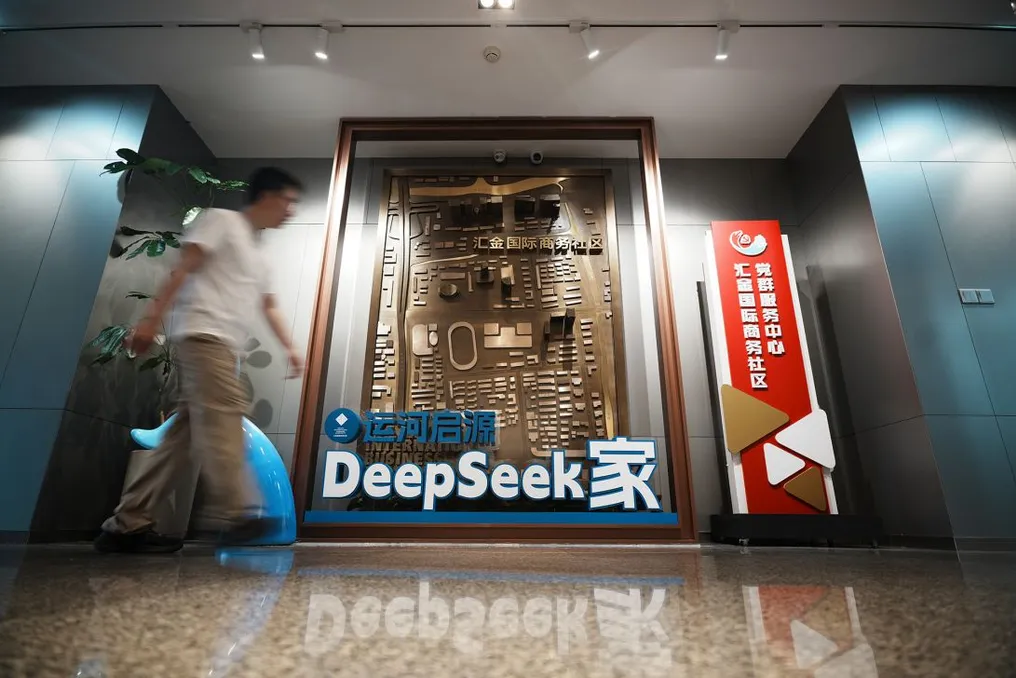
The rapid progress in artificial intelligence achieved by China over the past year has forced Washington to recognize the real possibility that the world's second-largest economy could overtake the United States amid an escalating technological race.
Earlier this month, US President Donald Trump stated: 'We are leading China in AI... and frankly, I want to keep it that way because whoever wins in AI, wins.'
Trump's comments underscore the high stakes in the technological rivalry between the US and China, which is increasingly viewed through an existential lens.
The United States possesses a clear advantage due to advanced AI laboratories, state-of-the-art chips, and generous investors. Leveraging this dominance, Washington is pressuring countries worldwide to take sides.
However, China has a vision that may prove more compelling to many. Despite lagging behind the US in cutting-edge AI models, China is rapidly closing the technological gap by promoting a more open ecosystem focused on accessibility and lower cost.
In July, Chinese leader Xi Jinping established the Artificial Intelligence Cooperation Organization, a competitor group to the Pax Silica alliance created by Trump last year to reduce dependence on China in AI supply chains. While over two dozen countries and the European Union joined Trump's Pax Silica, Xi Jinping attracted 29 nations, including Russia, Indonesia, and Pakistan, to his alternative vision of open models. These models allow users to freely download, customize, and run them without having to pay large sums to American firms such as Anthropic and OpenAI.
According to Eric Olander, editor-in-chief of the research agency The China-Global South Project, for developers in the Global South, a low-cost Chinese AI model from DeepSeek or Moonshot might be more useful than a slightly more advanced system requiring an expensive subscription and access to a foreign cloud provider.
Amid concerns about the potential threat of AI to humanity and growing calls for a global oversight body, this technology became a central theme of the Trump-Xi summit this week. During the meetings, Xi stated that the right approach to AI is to 'use each other's strengths, not defend against each other,' referencing Beijing's concerns about containment by the US, whether through existing export controls on technology or potential AI restrictions.
He added that 'both sides can continue the dialogue on AI, exchange views on its risks and benefits, and jointly prevent the misuse and abuse of AI.' However, the summit yielded little significant progress in AI, beyond formal dialogue and the establishment of a bilateral communication channel discussed before the leaders' meeting, highlighting deep mutual distrust amidst opposing views on AI.
China's adoption of open systems was not always a top-down strategy from Beijing. Restrictions on access to the most advanced chips due to US export controls, combined with smaller capital markets, pushed Chinese developers to use open models as a way to compete with leading proprietary US systems. This shift has proven effective.
In one year, global usage of Chinese models has soared from less than 15% to over 54% last week, according to the AI ranking table from OpenRouter, a model marketplace, with DeepSeek leading. Even American companies like Airbnb, DoorDash, and Shopify have begun using Chinese models, benefiting from the advantages of open systems, including reduced costs and greater customization flexibility.
Olander noted that instead of choosing a side, companies—American or otherwise—generally prefer to diversify their technology suppliers. Chinese AI can spread through existing telecommunications, cloud, and hardware networks, especially in developing markets where Chinese companies already have significant distribution networks.
Olander suggested: 'DeepSeek or Moonshot might not make much money, but the companies around them—Huawei, ZTE, others providing support, technology, all services around AI—could thrive.' He also observed that the meaning of winning the AI race is poorly defined, as different metrics, from profitability to market share, can yield different results; for example, he compared it to Apple, where the company captures 90% of profits, even though its products are not used by everyone.
Experts believe that as AI capabilities develop, the differences between the most advanced models and less capable systems may become imperceptible to most people and businesses. Some companies may need advanced US models, while others may find Chinese models sufficiently effective for their needs. Chuncheng Feng, co-founder of the consulting firm Hutong Research, concluded that for most people, the question comes down to what compromise they are willing to make: a model that costs ten times more but leads by six months, or a model that costs ten times less but lags by only six months.
Nevertheless, the appeal of Chinese models depends on how accessible they remain without restrictions. At China's flagship AI conference in July, Xi called for greater openness and cooperation in AI while emphasizing the need for regulation to maintain human control. Alex Colville, a technology and security analyst at the Australian Strategic Policy Institute, believes that the more powerful Chinese models become, the less likely Beijing is to leave them unrestricted. He explains that national security is always paramount, and restrictions could be imposed, for instance, on cyber capabilities like Anthropic's Mythos, which could pose a threat to China if misused.
Colville predicts that in the future, we will see a mix of open and closed AI from China, as both options serve the country's national interests. Instead of an outright ban, Beijing might use licensing rules to restrict the use of certain models.
Global developers and some governments have quickly adopted open Chinese models to promote sovereign AI development and avoid taking sides. However, they now have to worry about how long these models will remain open, as China may be forced to limit the deployment of its most powerful open models to 'avoid cyber chaos,' according to Reva Gujon, a director specializing in China at Rhodium Group. She stressed that China's strategy remains attractive to the world only if the models remain accessible and open for adaptation and fine-tuning for domestic and corporate needs.
As Chinese firms present increasingly sophisticated models approaching the performance of the most advanced systems from Anthropic and OpenAI, Washington is intensifying accusations that China is engaged in so-called 'industrial espionage' of American trade secrets. Both companies, Anthropic and OpenAI, have published reports claiming that leading Chinese AI labs trained their models on the output of American systems, a process known as distillation. In a detailed report earlier this month, Anthropic described how DeepSeek and Moonshot redirected some customer queries to Claude for training and improving their own models, with confidential information being exposed in some processes.
Beijing has repeatedly rejected the allegations of distillation. DeepSeek and Moonshot did not respond to CNN's request for comment. Reva Gujon noted that due to the 'very leaky nature of US export controls, including a gaping loophole allowing Chinese AI developers to access US computing power through overseas data centers, it is very difficult to accurately determine how much Chinese AI developers rely on distillation to release these incredibly advanced models.' She asked: 'What will this US administration actually do about it?'
Washington has hypothesized about possible sanctions and other restrictions on open Chinese models. However, Nvidia, Meta, Microsoft, and dozens of other companies issued a warning against 'sweeping restrictions' on open models in an open letter in July, revealing a rift between American tech companies and Washington.
Despite growing calls to prevent the runaway development of AI, the Trump-Xi summit delivered little substantial outcome, contrary to what many experts expected. George Chen, head of digital practice at the consulting firm The Asia Group, noted that due to the low level of trust, cooperation between the two superpowers remains limited. He added that 'Beijing continues to believe that Washington seeks to contain China's growth in AI and other new technologies, and this perception will determine the pace and scale of future interaction between the two countries in AI.'
_