The vehicle that uses exclusively alcohol is not new in Brazil. In the late 1980s, more than 95% of national production consisted of automobiles that used only sugarcane-derived fuel, although today corn can also be used. This predominance also occurred due to the need to reduce dependence on oil, driven by the international crisis that affected global production.
However, the shortage of alcohol in 1989 caused long queues at gas stations and led to the weakening of Pró-Álcool, a program established in 1975 to encourage its use. Only in 2003 did this plan resurface strongly after the development of electronics, which enabled the emergence of the flex engine, capable of using any proportion of gasoline or ethanol, freeing drivers from dependence on alcohol mills.
New policies and tax incentives
Recent data indicates that 70% of flex vehicle drivers opt to refuel with gasoline. In this context, the government, through the Mover plan, introduced the concept of Sustainable Car, offering a reduction in the Industrialized Products Tax (IPI) according to the engine's power. This benefit is zeroed out for engines that operate solely on ethanol, since they emit a maximum of 83 grams of CO2 per kilometer, while flex models with gasoline can reach 100 g/km.
Manufacturers are seeking to take advantage of this tax deduction. GM was the first to implement this change, launching the Onix with a 1.0 turbo 115 hp engine, intended exclusively for alcohol fueling, and managing to reduce its list price thanks to the zeroed IPI. Volkswagen plans to replicate this strategy with the Polo, and Stellantis already has an ethanol engine ready to be launched at the opportune moment, all actions being in compliance with government legislation.
Although the initiative is commendable for reducing emissions and replacing fossil fuels with vegetable ones, it has flaws. A critical point is the fact that it does not capitalize on the high octane rating of ethanol to compensate for its lower energy content compared to gasoline. Additionally, it represents a viable alternative to increase ethanol consumption without forcing drivers to increase the proportion of fuel in gasoline.
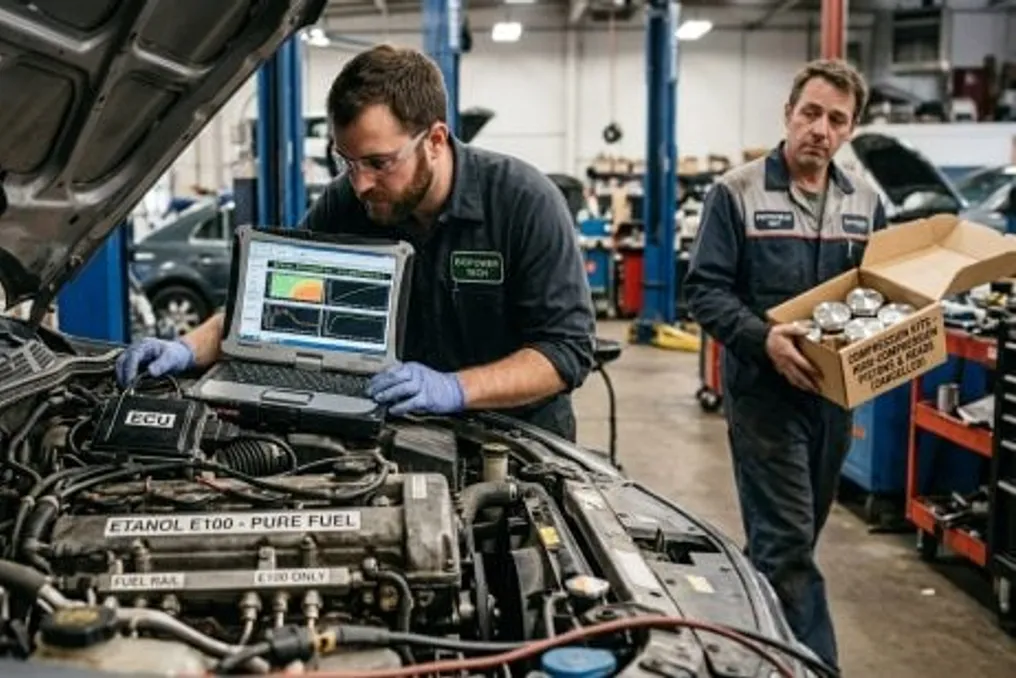
Unfortunately, to qualify for the tax reduction of up to 7.8%, manufacturers are only altering the software of the flex engine to require 100% ethanol in the tank. They adjust the ignition (spark) and injection settings to optimize operation with the biofuel, resulting in inferior performance with gasoline. The gains in consumption reduction and emissions are minimal, going from 10.9 to 11.1 km/liter on the highway. To achieve superior results, it would be necessary to increase the engine's compression ratio. However, this is limited in flex to accommodate ethanol, and increasing it would require major mechanical modifications, such as to cylinder heads and pistons, which demands time and investment.
Besides not maximizing fuel efficiency, this 'alcohol' engine—which is essentially a tuned flex engine—raises a question: the car is sold with a discount to use only ethanol, but wouldn't it be simple for a workshop to modify the electronic control unit chip to return to flex mode and use both fuels?
If the federal government truly wants to promote ethanol consumption, it must indeed offer the tax reduction for these engines, provided that they are specifically designed for the vegetable fuel, presenting clear, visible, and verifiable results.