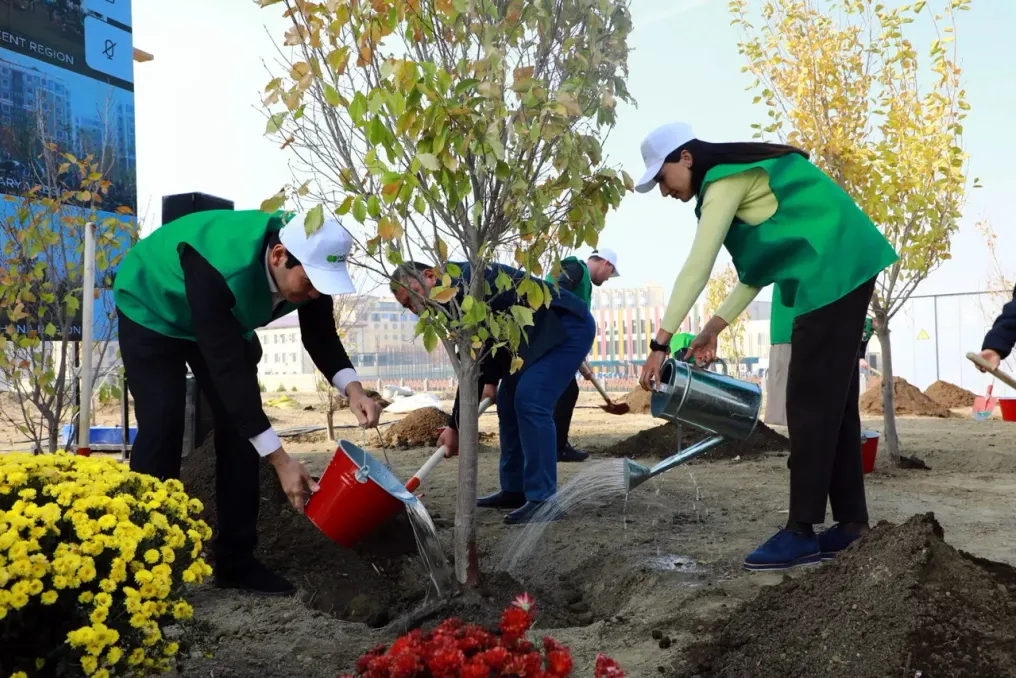
Uzbekistan launches two-month campaign for the improvement of public spaces
Read more
UzDaily
uzdaily.uz

Uzbekistan launches two-month campaign for the improvement of public spaces

Uzbekistan is launching a two-month campaign to improve public areas and conduct sanitary cleaning across the country, starting on October 1, 2026. These activities are stipulated by a presidential decree dedicated to strengthening the role of mahallas in implementing the national project 'Yashil Maqon' and drastically increasing the level of territory greening.

Starting in October, locations for green zones will be determined, land plots will be prepared, and stocks of seedlings and shrubs will be created. The planting season will begin on November 1 in Karakalpakstan and Khorezm region, and on November 5 in Bukhara and Navoi regions. In regions such as Andijan, Jizzakh, Samarkand, Syrdarya, Namangan, Tashkent, and Fergana region, as well as in the city of Tashkent, planting will start on November 10. In Surkhandarya and Kashkadarya regions, the season will begin on November 20.

Starting January 1, 2027, the 'Yashil Mahalla' project will introduce the 'Mahalla Greening' package. The Forestry Service will dispatch forestry mentors to the mahallas. Members of the 'Seven Mahalla' will undergo short training courses before each planting season.

Beginning with the autumn season of 2026, mahallas will start creating micro-forests on small plots of land, between residential buildings, and in school and kindergarten courtyards. The work will be coordinated by the Council of Ministers of Karakalpakstan, the administrations of regional and municipal authorities of Tashkent, together with the Association of Uzbek Mahallas, the Forestry Service, and the Ministry of Construction and Housing and Communal Services.

On plots measuring from 200 to 1000 square meters, a dense multi-layered planting method will be used, which involves planting no less than two tree and shrub seedlings per square meter. In areas where land plots cannot be allocated or where concrete and asphalt surfaces predominate, small public gardens will be established.

Regional and Tashkent city administrations, as well as sponsors, will install large containers for growing plants, while the Forestry Service will provide high-quality seedlings. The mahallas themselves, with the participation of volunteers, will organize the planting and subsequent care for the plants.

Furthermore, starting January 1, 2027, the 'Green Area' system will be launched. This will allow the Committee on Ecology, the Council of Ministers of Karakalpakstan, and the administrations of the regions and the city of Tashkent to grant land plots to individuals and legal entities through agreements for the creation of green gardens and assigning them names. The designated territories may be used exclusively for their intended purpose; they are not subject to transfer into ownership, construction, or installation of structures, nor can they be used for other types of activities; however, public access to common use areas will not be restricted.

Similar stories

Uzbekistan proposes reforming the support system for innovative startups
Read more
uzdaily.uz

Uzbekistan proposes reforming the support system for innovative startups

The Ministry of Higher Education, Science and Innovation of Uzbekistan has prepared a draft reform of the innovative startup support system. This document has been posted on the portal for discussion of normative legal acts projects.

The proposed changes concern approaches to selecting and financing startups. They include evaluating projects according to international criteria, as well as implementing incubation and acceleration programs based on international experience.

The government plans to allocate funding to no less than 50 startups annually, starting from 40 billion soms. Additionally, the plan provides for attracting private investments, venture funds, and companies amounting to $500,000 annually.

Starting from January 1, 2027, it is proposed to fully digitize the procedures for submitting, selecting, and financing startup projects. To achieve this, a specialized platform for working with innovative startups and a register of legal entities engaged in scientific and innovative activities are planned to be launched.

State funding will only be available to startups that have passed incubation or acceleration programs. The Innovation Development Agency will accept project proposals and direct them to relevant programs for participation. To expand funding sources, the platform also includes a crowdfunding function.

The proposed funding amounts will depend on the Technology Readiness Level (TRL) of the project, according to ISO criteria. Incubator and accelerator organizers can receive up to 30 basic calculation units per startup with TRL from 1 to 3, up to 50 basic calculation units for TRL from 4 to 6, and up to 70 basic calculation units for TRL from 7 to 9. These amounts are indicated in the draft as 13.2 million, 22 million, and 30.8 million soms, respectively.

Startups with TRL from 4 to 6, recognized as effective after the programs, may apply for funding of up to 485 basic calculation units, which amounts to 213.4 million soms. For projects with TRL 7 and above, the maximum proposed funding amount reaches 4,500 basic calculation units, or 1.98 billion soms.

Furthermore, state funding is provided on the condition that the startup founder attracts private investment. It is proposed that the Council for Integration of Innovation and Industry approve the budget funding, whose composition will be approved by the Head of the Presidential Administration.

The Startup Support Center will assist funded projects that have undergone incubation or acceleration in advertising and marketing. In addition, the center will present proposals to state bodies and industrial enterprises at least twice a year regarding the implementation of innovative developments. The draft resolution will be open for public discussion until October 2.

Popular