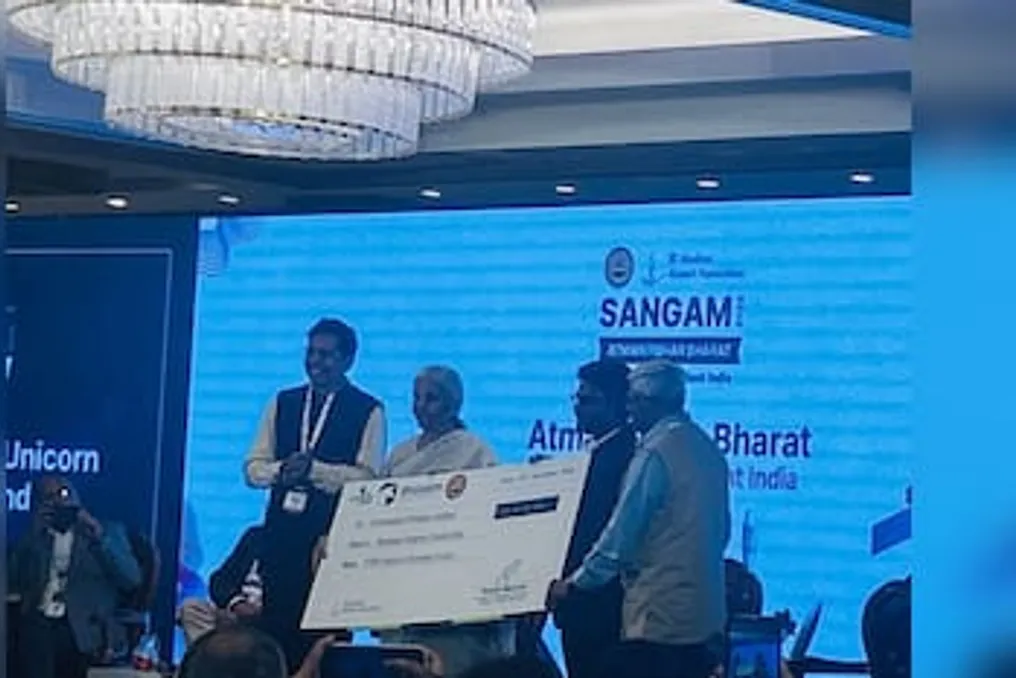
IIT Madras, IIT Madras Research Park, and Unicorn India Ventures announced the achievement of the first funding stage for their deep technology fund, raising ₹450 crore out of a total target of ₹1000 crore. This initial phase was reached three months after receiving approval from the Securities and Exchange Board of India (Sebi), with the final fund closure expected by December 2026.
The announcement was made in the presence of Finance Minister Nirmala Sitharaman. Kamakoti Vignatanandan, Director of IIT Madras, noted that the institute has created an ecosystem that has fostered the growth of several deep technology companies demonstrating stable Technology Readiness Level (TRL) progression.
According to Vignatanandan, through this joint fund with leading deep technology investors like Unicorn India, these companies will gain not only access to long-term capital but also strategic guidance for growth. He added that achieving the first stage in a record three months is a significant success, and they are confident that the fund will provide India with some of its best deep technology startups.
The fund also reported allocating nearly ₹55 crore to support four deep technology startups. These include: Hathor, a Chennai-based startup developing specialized semi-cryogenic and cryogenic rocket engines for small and medium satellite launch companies; Quanstra from Delhi, which focuses on single-photon detection systems and advanced quantum equipment; Triolt Energy, creating high-performance lithium-ion battery cells optimized for drones and fast EV charging; and Carbelim, which develops carbon capture and air purification systems using patented microalgae technology.
The fund will concentrate its efforts on six areas where India holds a structural global advantage. These areas include defense technologies with an emphasis on import substitution, and space technologies, including space-standard compliant hardware at one-tenth the global cost. Another priority is semiconductors, particularly fabless design and intellectual property ownership.
Furthermore, the fund will invest in manufacturing technologies, robotics, and automation, as well as in Artificial Intelligence (AI) infrastructure and generative AI, with a special focus on sovereign enterprise AI. The sixth area is medical technology, aimed at providing healthcare to the least privileged segments of the population. Before capital allocation, each investment will be vetted for potential global export, strategic import substitution, and technological sovereignty advantage.
Bhaskar Majumdar, Managing Partner of Unicorn India Ventures, stated that India is entering a defining decade for deep technology startups, transitioning from the promise stage to scaling. He expressed honor in partnering with IITM and IIT Madras Research Park, which are cornerstones of deep technology innovation in India. Majumdar emphasized that through this partnership, they aim to provide early founders with the capital and strategic support necessary to build globally competitive Indian companies.
Natarajan Maluppillai, CEO of IIT Madras Research Park Incubation Cell and RTBI, noted that India possesses the scientific and engineering talent to create world-class technologies. He highlighted that IIT Madras Research Park and Incubation Cell are pioneers in translational research and innovation for large corporations and nurturers of deep technology startups. Maluppillai stated that the IITM Unicorn Frontier Fund-I will bring long-term capital into the IIT Madras innovation ecosystem, helping to scale IP-based and globally competitive companies.
Following the achievement of the first stage, the fund will continue to invest in IP-focused and heavy engineering startups, aiming to build a portfolio of 25 companies. The fund is supported by prominent IIT Madras alumni and renowned family offices, with final closure planned by the end of the current year, anticipating the addition of institutional investors and banks. Unicorn India Ventures, acting as the fund manager, will also leverage its ability to mobilize capital beyond the core fund size to create a co-investment mechanism, ensuring portfolio companies access to subsequent capital.