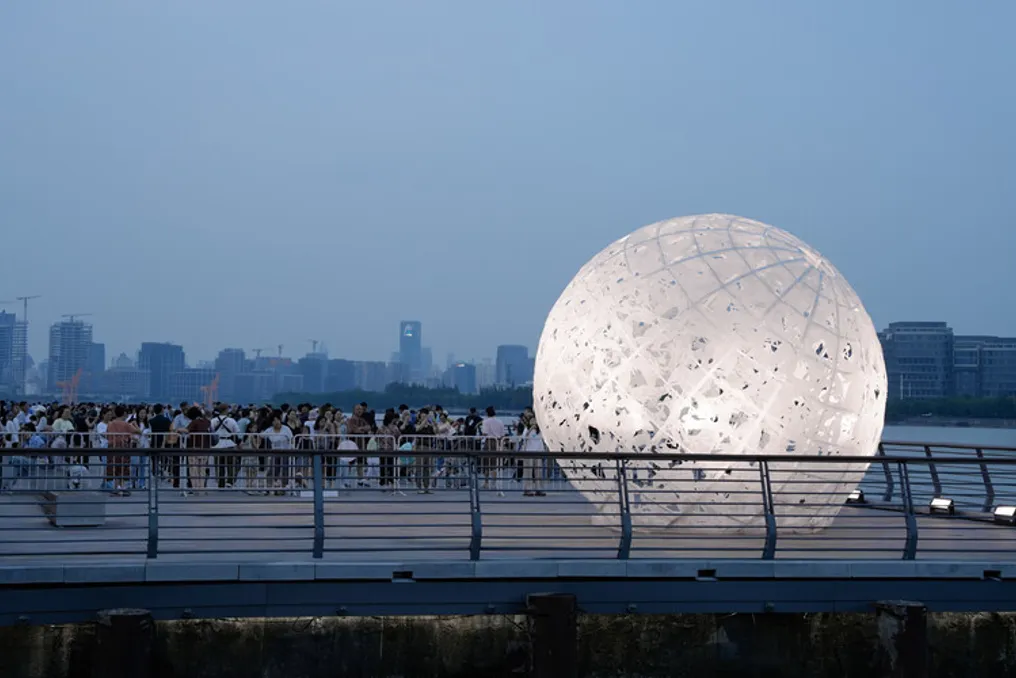
The design studio The Full Moon / SHISUO presented the urban public art installation titled 'The Full Moon,' by invitation of the Power Station of Art (PSA). This work celebrates the Mid-Autumn Festival in the city of Shanghai.
The creation was developed in partnership with Shi Qinling, who is a descendant of the Shanghai-style paper cutting technique. The central theme of the installation addresses the moon, rabbits, and the art of paper cutting. In many cultures, the rabbit holds a special place in the human imagination as one of the few universally appreciated animals.
In classical Chinese folklore associated with the Mid-Autumn Festival, the rabbit is seen as the constant companion of the moon, which symbolizes the cycle of life's rise and fall. Meanwhile, the rabbit metaphorically represents vitality, flourishing, and the growth of all beings.
Shanghai-style paper cutting carries a rich festive tradition, especially linked to the Chinese New Year. Shi Qinling, a guardian of this intangible cultural heritage, uses this traditional art to portray the classic character of the rabbit. She captures the animals in various actions, such as jumping, looking back, standing, playing, or chasing each other.
These multiple postures were organized into the motif known as 'Three Rabbits with Shared Ears,' an ancient pattern originally found on the coffered ceilings of the Dunhuang Murals. SHISUO proposed a creative reinterpretation, employing acrylic panels with a crackled finish as construction material to recreate these paper rabbits, referencing the numerous fantasies of the 'Jade Rabbit on the Moon.'
As visitors walk through the cut 'moon' or stroll calmly along the riverbank, the installation manifests as a theater of lunar phases, displaying the process of 'growing and waning' from different perspectives, echoing the image of the philosophical moon by the river described by ancient poets.
Visitors can find the full moon at any curve of the path, and its fleeting perfection evokes human nostalgia for timeless beauty. The interior of the 'moon' was conceived as a passing dome space, where silhouettes of rabbits in various positions overlap and surround, keeping the top open. The lunar trajectory was calculated with precision: on a clear night during the Mid-Autumn Festival, it is possible to glimpse the full moon through the opening.
Due to August to October being the peak typhoon season in Shanghai, and considering the installation was located on a deck along the Huangpu River, structural safety was the primary concern. The spherical structure, based on longitude and latitude coordinates, presents moderate technical complexity, which facilitated both its assembly and quick disassembly.
The overall structure consists of 30mm diameter square steel tubes, receiving additional reinforcements on the longitudinal elements and arched components near the opening to satisfy the cantilever requirements inherent to the segmented sphere. The rabbit silhouettes, inspired by paper cuttings and made from waterproof acrylic panels, form a cutout pattern across the entire spherical surface. This design allows for the circulation of river winds, efficiently dissipating wind loads and minimizing their impact on the installation.
The exhibition of 'The Full Moon' took place for a limited period of seven days at the West Bund Shipyard Pier in Shanghai, coinciding with the National Day holiday and the Mid-Autumn Festival. The area pavement was temporarily removed, numbered, and preserved. The metallic structure's base was fixed to the concrete beneath the floor, ensuring high resistance to wind against potential typhoon risks. At the end of the show, the floor was restored according to the numbered sections, returning the site to its original state without leaving a trace.
Through 'The Full Moon,' the SHISUO team expresses the Chinese culture's yearning for completeness and unity, while the rabbits chase each other in the sky to form the moon, and on earth, the pure glow of moonlight is shared for kilometers around.