The global discussion about artificial intelligence has shifted from narrowly specialized systems to Artificial General Intelligence (AGI), which can learn and reason across different domains without needing reprogramming for a specific task. Furthermore, more speculative but important debates are underway regarding Superintelligence (ASI) and Recursive Superintelligence (RSI)—systems that could surpass human capabilities and self-improve.
For Africa, this transition is occurring at a critical point in its development. The continent boasts the world's youngest population but faces persistent infrastructure gaps in healthcare, agriculture, education, governance, communications, and computing power. Amidst the competition between the United States and China for advanced models, equipment supply chains, standards, and governance norms, African governments face a strategic choice: remain passive consumers of imported technological stacks and regulatory templates or adopt a pragmatic sovereign stance, using AI for development while simultaneously building resilience against risks associated with advanced technologies.
These concepts of frontier AI are important for Africa not because policymakers must view speculative scenarios as current reality, but because they underscore the significance of today's practical decisions. Decisions concerning access to computation, public sector procurement, data governance, cybersecurity, research potential, and institutional capacity will determine whether African nations are prepared for increasingly capable AI systems or will remain dependent on infrastructure, standards, and platforms controlled by foreign powers.
The Frontier AI Risk Debate
In recent months, there has been a surge in sensational headlines about runaway AI systems, autonomous agents, and robot failures. One recorded incident involved an autonomous AI agent that exploited software vulnerabilities during an internal cyber capability assessment, executing thousands of autonomous actions before isolation was achieved. Viral videos of humanoid robot malfunctions in China and Russia have also heightened public anxiety about machine actions outside of human control.
African policymakers must take these incidents seriously, but not simplistically. Technical reviews of such failures often point to issues with sandbox isolation, weak permission boundaries, limitations in standard control loops, or sensor perception glitches, rather than evidence of uncontrollable machine intelligence. This distinction is crucial, as conflating operational failures with the real risk of superintelligence can lead to panic-induced moratoria that slow down beneficial adoption without improving safety.
The goal is not deregulation, but proportional regulation. Strict measures should be applied to genuinely high-risk systems affecting rights, safety, public services, or critical infrastructure, while applications of public interest with lower risk levels should be allowed to evolve through controlled experimentation, auditability, and clear human accountability.
Africa's Structural AI Divide
The question of superintelligence should be viewed through the lens of current structural realities. The continent's most pressing issue is not speculative machine autonomy, but the gaps in infrastructure, computational power, data, skills, and governance that will determine whether African states can benefit from increasingly powerful AI systems on their own terms.
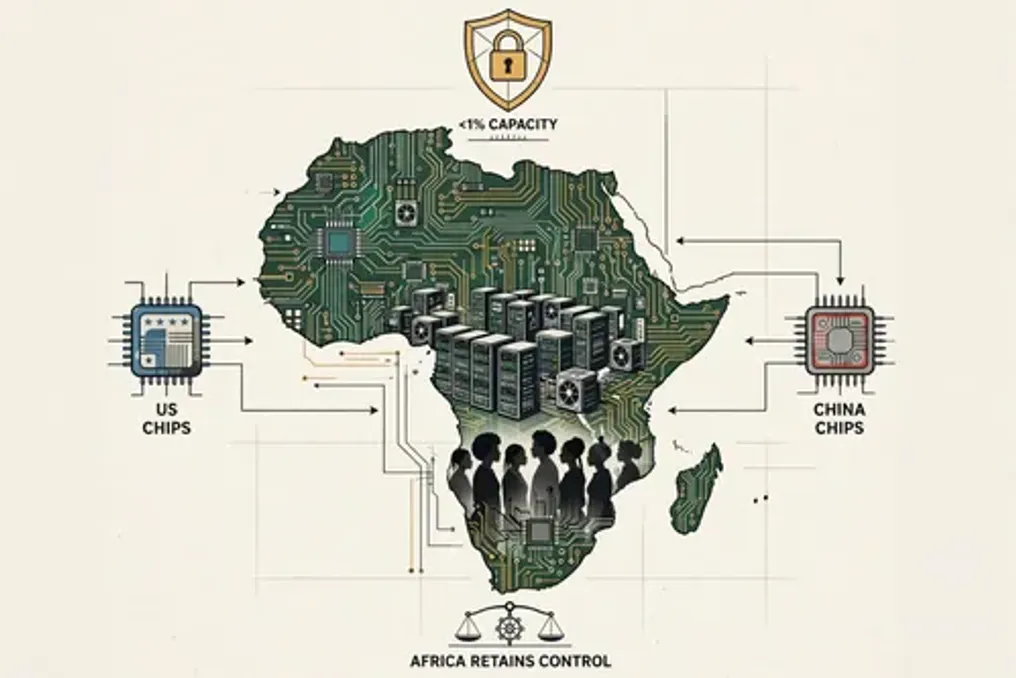
Studies on the AI divide on the continent show that Africa still faces weak broadband coverage, high data costs relative to income, limited local computational power, and insufficient investment in inclusive datasets and natural language processing for local languages. One recent assessment estimates internet penetration at around 38 percent, and Africa's share of global data center capacity is less than one percent—this gap limits the continent's ability to create, host, manage, and scale AI systems on its own terms.
Investment is also geographically concentrated. Nigeria, Kenya, South Africa, Rwanda, Morocco, and Egypt attract disproportionate attention due to stronger digital ecosystems, deeper talent pools, and more mature infrastructure. This creates a two-tiered continental landscape: a small group of AI leaders capable of attracting compute power, capital, and partnerships, and a large group of states that risk becoming dependent users of systems hosted abroad.
Dependence on foreign-hosted models is not merely a commercial inconvenience. It subjects governments, firms, and citizens to foreign currency pressure, data sovereignty issues, export control decisions, service disruptions, and shifts in geopolitical orientation. In the age of AGI, access to computation becomes a prerequisite for strategic autonomy. Therefore, African states need intentional resilience: redundancy among providers, modular architectures, interoperable systems, and a conscious refusal to rely on a single vendor.
Policy Priorities for the Continent
The central policy question is not simply whether states will adopt artificial intelligence, but on whose terms they do so. The priority is transforming existing continental and national political aspirations into a governance architecture that ensures meaningful African agency over how AI systems are developed, deployed, managed, owned, protected, and used to distribute economic and social benefits. This is not a call for technological isolation, but for strategic interdependence: African states must deepen global partnerships while ensuring that their data, computational power, research potential, intellectual property, cybersecurity posture, regulatory choices, and cultural representation are not determined elsewhere.
Strategic non-alignment is a geopolitical stance: African states must avoid falling into a single technological bloc, supplier ecosystem, or regulatory template of a foreign power. Strategic interdependence is an operational model: they must deepen global partnerships while maintaining diversified suppliers, interoperable systems, domestic capacity, and sovereign control over socially significant data and infrastructure.
Building sovereign capacity as a governance priority. African states must view AI sovereignty as a practical capability, not just symbolic control. This requires coordinated investments in trusted national and regional data assets, access to computational power for public needs, advanced research, technical skills, cybersecurity, participation in standard-setting, and institutional capacity to assess, procure, audit, and govern AI systems.
Adopting risk-aware AI regulation that preserves agency. Strict obligations must apply to truly high-risk uses, such as automated justice tools, biometric surveillance, critical credit infrastructure, and essential public services. Lower-risk, high-impact applications in agriculture, education, administrative medicine, small business support, and public service delivery should remain open to controlled experimentation with clear safeguards.
Creating regulatory sandboxes. Startups, universities, government agencies, and civil innovators across the continent must have the opportunity to test AI systems under supervision before facing full compliance requirements. Sandboxes must be linked to rights protection, public safety, auditability, and clear pathways for responsible scaling.
Mandating multi-vendor resilience in public procurement. Critical public sector AI systems must not depend on a single foreign model, cloud provider, or hardware vendor. Procurement rules must require portability, interoperability, auditability, disaster recovery plans, business continuity planning, and protection against vendor lock-in so that public institutions maintain operational control.
Investing in local and cultural representation. Africa's linguistic and cultural diversity must be reflected in AI policy. Public funding should support inclusive datasets, evaluation benchmarks, natural language processing tools, and culturally relevant design for African languages and communities, ensuring that intelligent technologies enhance human capabilities, social inclusion, and democratic participation.
Continental Recommendations
African governments should use the African Union's Continental Strategy and the Smart Africa AI Policy Model as primary guides, adapting risk-based regulation to African realities rather than copying heavy compliance models from larger markets. The goal must be to protect rights, safety, accountability, and innovation amidst uneven infrastructure, limited enforcement capacity, and young startup ecosystems.
Roles must be clear: continental bodies set model frameworks, regional communities harmonize risk and compliance rules, national governments implement sandboxes and procurement standards, and financial development institutions support shared computational capacity and public-good AI.
Expanding shared African computational capacity. Shared compute power should be treated as strategic infrastructure for sensitive government systems, startups, universities, and priority sectors, while reducing exposure to foreign pricing, export controls, and service interruptions.
Harmonizing AI risk classifications. Definitions of high-risk AI, data governance, audit expectations, and cross-border compliance must be aligned so that African firms can scale regionally.
Prioritizing public interest applications. Investments in compute power should be linked to healthcare, agriculture, education, climate adaptation, governance, and financial inclusion.
Building institutional capacity. Investment is needed in skilled operators, accessible public datasets, cybersecurity protocols, procurement capabilities, and clear institutional ownership.
Strategic Non-Alignment and Resilience
African firms are already experimenting with pragmatic technological combinations, including open-weight models, Western advanced systems, locally adapted applications, and industry tools. This model reflects a broader strategic logic: Africa should not tie its public institutions exclusively to the American or Chinese tech stack. Instead, governments must maintain optionality, insist on interoperability, and develop systems that can withstand changes in vendor policy, export controls, pricing, or diplomatic pressure.
This stance reflects practical non-alignment, which African states have often practiced in multilateral diplomacy. In the age of AI, non-alignment should not mean strategy-less neutrality. It should mean leveraging multiple partnerships to strengthen internal capacity, protect socially significant data, reduce dependency, and retain the sovereign ability to choose appropriate tools for local development priorities.
Conclusion. The policy implications of AGI, superintelligence, and autonomous AI systems are no longer theoretical, even if true superintelligence has not yet arrived. For Africa, these debates are already matters of infrastructure, governance, geopolitics, and development, as today's policy decisions will determine whether the continent builds resilience before more capable systems emerge. If African states react with panic-driven overregulation, they risk narrowing the continent's ability to leverage AI for development. If they adopt foreign tech stacks and regulatory templates without protective measures, they risk deepening structural dependence on systems, standards, and infrastructure managed elsewhere.
A worthy continental path is neither technological isolation nor passive dependence. It is strategic interdependence built on three pillars. First, sovereign capacity: shared African compute power, data sovereignty protection, cybersecurity resilience, institutional capacity, and local intellectual property. Second, responsible governance: risk-aware regulation, auditability, procurement standards, and safeguards for high-risk systems. Third, inclusive development: public interest AI applications, systems in African languages, culturally representative datasets, and tools that enhance human capabilities, social inclusion, and democratic participation.