The architecture of the pre-revolutionary period in Tashkent is characterized by its diversity. As noted by Marina Borodina, Academician of the Academy of Arts of Uzbekistan and Professor at Tashkent Architectural and Construction University, during this time, commercial, public, educational, and religious architecture developed simultaneously, each leaving its mark on the city's appearance.
Borodina adds that the preserved buildings are not merely beautiful architectural structures; they allow one to feel the scale of historical changes and understand how the modern look of Tashkent gradually formed.
The Tashkent Real School building (1898) was constructed according to the designs of architects Wilhelm Geinselman and A. P. Maksimov. It is executed in an eclectic style, combining elements of Russian brick architecture and Gothic. It is considered the first building in Tashkent where buttresses were used. The building housed special rooms for physics and chemistry, as well as the Church of Nicholas the Wonderworker.
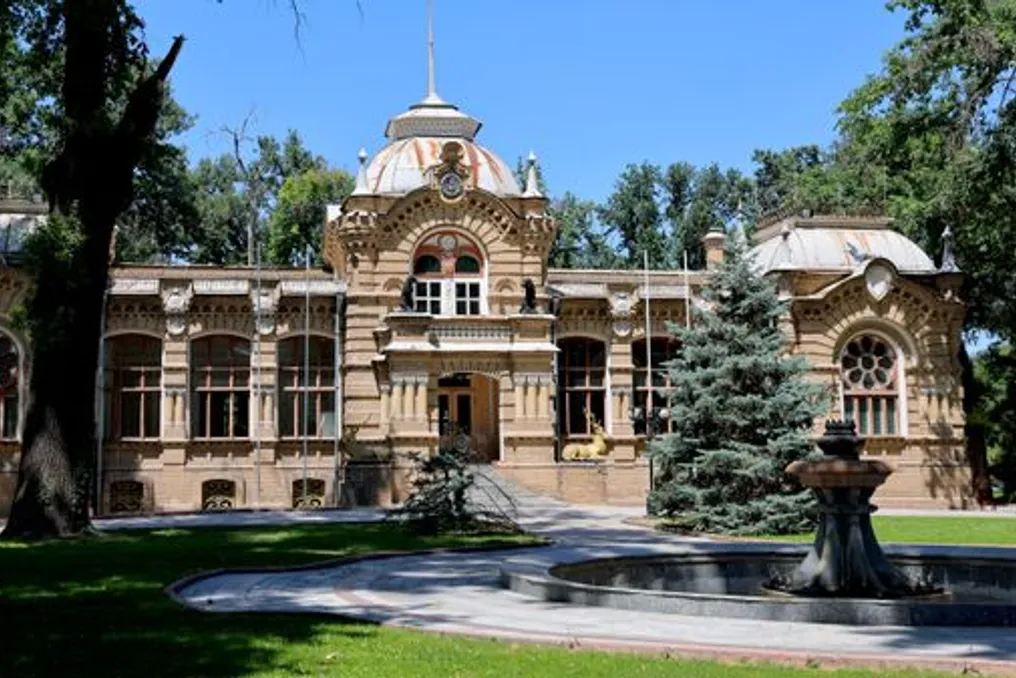
The Palace of Prince N. K. Romanov (1891) was designed by architects V. S. Geinselman and A. L. Benois for Prince Nikolai Konstantinovich. During the Soviet era, the building was used for various institutions and later became the reception area of the Ministry of Foreign Affairs of Uzbekistan. Today, the palace is one of the iconic monuments of Tashkent's historical architecture.
The former State Chamber of Turkestan (1887) was built according to the design of Wilhelm Geinselman. From 1970 to 1980, the Museum of the History of Peoples of Uzbekistan was located here.
The former State Bank building (1895), located in the square, was built by V. S. Geinselman for the branch of the Imperial State Bank. During the Soviet era, the 'Prombank' of Central Asia branch was located here. After reconstruction, the building regained its historical appearance; an old elevator for transporting money has been preserved, and a small museum operates on the second floor. Currently, a branch of 'Uzsanatkurilishbank' operates here.
The German Lutheran Church (1896) was erected in Neo-Gothic style. It was first consecrated on October 3, 1896, and regular services began after re-consecration in 1899. During the Soviet era, the building was used as a warehouse, and later it housed a conservatory-opera studio. In the 1990s, the temple was returned to the faithful.
The Kaplan Pharmacy building (1906) was built by Georgiy Svarichevsky for pharmacist Hieronym Krause in the style of palace Art Nouveau. Later, the trading house 'Philip Kaplan and Sons' was located here. Now, a branch of 'Ipoteka-bank' is in this historic building.
The ODO (Officers' District) building in Tashkent (1885) is a historical architectural monument and currently belongs to Tashkent State Law University.
The Westminster International University building in Tashkent (TVKHU) (1912) was designed by Georgiy Svarichevsky. Initially, it served as a girls' gymnasium.
The children's library building, formerly the House of Soviets and the former Vadyayev House (1893), was built by the Vadyayev brothers under the design of I. A. Markevich. Initially, the complex consisted of two buildings: one housed the Public Hall, the House of Freedom, and the Opera House, while the other housed the Children's Library from 1964. After reconstruction, open public spaces, a coworking space, a laboratory, and a studio were created in the second building, while preserving the historical appearance of the building.
The girls' and boys' gymnasiums (1878–1883) form an architectural ensemble built by military engineer and architect S. K. Glinka-Yanchevsky. The gymnasium buildings are located on both sides of Saiilgoh Street. Initially, they were separate two-story buildings. In 1906, according to the design of G. M. Svarichevsky, additional sections were added between them, uniting them into a single complex, and in the 1930s, they were extended to three stories.
The 'Nuroni' Foundation building, formerly the 'National' Hotel (1912), was designed by I. A. Markevich. During the Civil War, it served as the headquarters of the Turkestan Front. Later, the hotel was renamed 'Tashkent', and then 'Shark'. Today, the Republican 'Nuroni' Foundation, which supports Fakhrists, is located in this historic building.
The Yaushev Traders' House in Tashkent (1913), located at Islom Karimova Street, 11, is also connected to the pre-revolutionary period. It was built by Ivan Markevich and is recognized today as an architectural monument in the National Register of Cultural Heritage of Uzbekistan. It should be distinguished from the Yaushev Passage, located at Mustafa Kamol Ataturk Street, 21.
The Architect G. Svarichevsky's House is a majestic single-story brick building from the 19th century. It is decorated with pilasters in the courtyard, a stained-glass iwan, and a peishvan. After the revolution, it housed the representation of the Danish Red Cross, and later the Ministry of Foreign Affairs of the Uzbek SSR. In the 1990s, the building was used for the activities of the Society of Cultural Relations of Uzbekistan with foreign countries. Today, it is preserved at the intersection of Akhunboboyev and Sulaymonov streets.
The Cathedral of the Most Sacred Heart of Jesus (1912), construction of which began in Tashkent according to the design of Polish architect Ludvig Pancakewicz. Austrians and Hungarians captured in captivity participated in the construction—engineers, stonemasons, and sculptors. During the Soviet era, the unfinished building was used as a dormitory and hospital. In 1992, it was transferred to the Catholic community, after which reconstruction work began. In October 2000, the temple was consecrated, and its interior was finished with marble and granite.
The Brothers Yaushev's Passages (1915) were built in Tashkent and are the last of four passages associated with the Yaushev merchant family. Located near the Yaushev Traders' House, it is one of the most famous buildings associated with this family in the center of Tashkent.