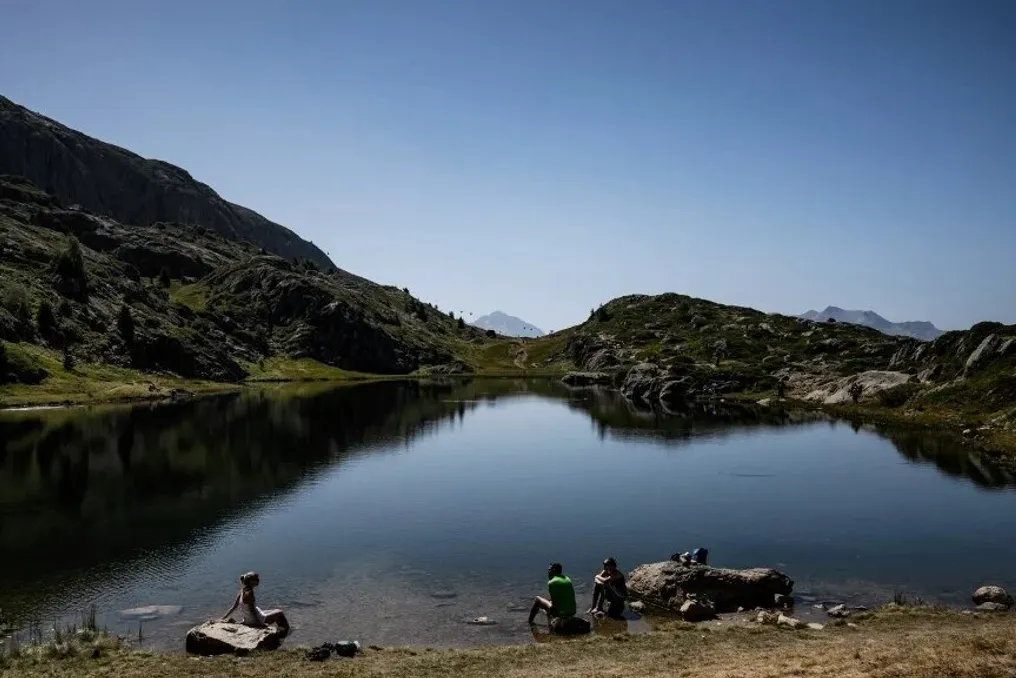
The situation began with a video posted on TikTok in August, where the creator boasted about the lack of tourists from different ethnic groups in the mountains and stated that this space was exclusively for white people.
In the video, which was later deleted, he wrote over a breathtaking Alpine landscape: 'One of the few places in France without Wallah and Gucci caps, where you can feel safe,' using an Arabic interjection that has become slang in France.
The video sparked two waves of reaction on social media. The first was a wave of racist and Islamophobic insults calling for restrictions on the residence of people from the banlieues—France's working-class suburbs, which are often ethnically diverse—in their own neighborhoods. Comments such as 'stay where you belong, in your Islamized neighborhoods' were widespread, alongside accusations of a lack of civilization, such as: 'Nature must remain clean. No urination, no trash, no animalistic screams.'
This was followed by an unexpected counterattack that turned into a viral trend, which had both a humorous and a political character, and which coalesced around the slogan 'Wallah, we’re coming.' Young people, both individually and in groups, women in hijabs, families—all posed in forests, on mountain peaks, on horseback, or while trekking to assert their right to be in places they consider completely legitimate.
Among the participants was Zeinab Allabar, co-founder and creative director of the sports brand Kamak. She joined the movement by filming herself and friends climbing shaded trails or admiring the landscapes. Her caption on the widely commented video read: 'We love nature too,' and Rimk, a well-known Franco-Algerian rapper, added a simple 'thank you.'
Allabar told Middle East Eye: 'I belong to a women's sports group. In the summer, we usually organize events in the mountains. So, when I saw this racist video on TikTok, I decided to respond with humor to show that nature belongs to everyone, including women in hijabs.' She points to the paradox that ethnic minorities constantly call for 'integration' in France, yet are denied access to places and activities that should belong to everyone.
Allabar lives in Switzerland, a country known for its outstanding ski resorts. There, she says, sharing open spaces at high altitudes causes no problems. 'I have never encountered racist remarks in these places or anywhere else, even though I have worn a veil since I was eight,' she said. 'On the contrary, as soon as I arrive in France, people's gazes become heavy and anxious. You feel like you are not welcome here.'
Feeling unwelcome in the mountains
Allabar's experience is not unique. Djumia Alaoui, a 38-year-old mother from Essonne, south of Paris, often goes hiking in the Fontainebleau forest with friends wearing hijabs. 'Some tourists look at us as if our presence is inappropriate. Once a man asked if we were too hot in that attire. We replied that it was none of his business,' she reported.
For Alaoui, the video promoting a 'mountain without Arabs' and the supporting comments perfectly illustrate this rejection and reflect racism that is becoming increasingly unscrupulous and even openly accepted by part of the political class.
Alaoui, a former supermarket cashier who lost her job two years ago after refusing to remove her headscarf, worries about the consequences of this growing hostility. 'If we do not confront this, one day they might not even allow us to leave the house in a hijab,' she told MEE.
Rassemblement National, Marine Le Pen's far-right party, which is currently leading polls before the 2027 presidential elections, intends to ban the hijab in public places if it wins, which heightens concerns among women in hijabs.
Alaoui noted: 'Previously, youth from the banlieues faced racial profiling at nightclub entrances. Now, women in burkinis are harassed in municipal pools and on beaches. Even sports with a hijab are banned,' citing a 2023 ruling by the French highest administrative court that confirmed the right of sports federations to ban the Islamic hijab.
Reflection of society
Léa Sallanav, a geography teacher at the University of Geneva and a specialist in dominance and inequality in Alpine spaces, explains that 'recreational mountain culture was formed by the dominant group, which imposes its norms, creating a feeling that other users do not belong there.'
Her research is based on a set of images, including Alpine resort websites, which 'overwhelmingly showcase people perceived as white.'
In a 2020 study on a municipal program in Grenoble aimed at introducing youth from the banlieues to nature and outdoor activities, Sallanav identified forms of racial identity appropriation—a mechanism of dominance that excludes people by reducing them to their ethnic origin, based on participant testimonies. Some stated that 'the higher they climbed, the whiter the people they met seemed.'
She emphasized: 'I want to show that the mountain is not neutral; it is part of society. And if there is racism, classism, and sexism in our society, we will find it in the mountains too.'
For example, young people from working-class areas reported encountering racist behavior at ski resorts, while mountaineering professionals reported meeting people hostile to the presence of this youth.
Sallanav's observations are confirmed by Samir Souadji, founder and director of Apart, an NGO in Saint-Saint-Denis, one of France's most disadvantaged departments located northeast of Paris, which offers climbs, mountaineering, and outdoor activities to help young people in difficult situations recover their lives. Souadji recalls the obstacles he faced at the beginning, such as securing partnerships with major sports brands. 'When we said we wanted to do mountain activities, I felt we were not taken seriously,' he told MEE.
Later, during trips with groups of young people to familiarize themselves with the French mountain ranges, he also encountered disdainful and racist reactions. 'You are not in your apartment building here—these are not 13-story towers you climb,' one tourist mocked Souadji's group on the way to the base above Chamonix. Subsequently, two tourists laughed and asked if an African congress was planned in the area.
The need to be flawless
Nacira Geneff-Souilamas, a sociologist and anthropologist from the University of Paris VIII, attributes this hostility to a nationalist and exclusionary perception of territory. 'Some users behave as if they are the rightful owners of the mountains and believe that not everyone is allowed to enjoy the beauty of the landscape,' she told MEE.
She explains that this exclusion reflects 'racist stereotypes pressing down on Black and Arab people in France, depriving them of basic rights, including the right to enjoy nature.' She added: 'They are never considered French enough, wherever they go—whether to the mountains or the coast.'
Souadji, who is also a social worker, notes that the people making racist remarks are not necessarily local mountain residents, who are generally welcoming, but rather city dwellers who 'consume the mountains.' 'These are the people we meet every day in the city who cannot stand seeing us there with them,' he said.
According to Geneff-Souilamas, this stigmatization creates a psychological burden for ethnic minority tourists. 'They report constant surveillance, suspicion of disrespect for the environment,' with patronizing remarks about waste recycling, for example. 'They feel forced to be flawless to 'prove' that they are not dangerous or disrespectful.'
Souadji agrees, saying that he is very strict with the behavior of the young people he accompanies in the mountains. 'I tell them that behavior, respect for people and nature is extremely important to break the caricature imposed on us.'
Souadji has organized several expeditions abroad, including Nepal, Kyrgyzstan, Bolivia, and Norway, and asserts that hostility towards ethnic minorities in mountainous areas is primarily a French phenomenon. 'It is strange that everywhere else in the world we are welcomed, except at home.'
Nadir Dendune, a Franco-Algerian writer and sponsor of Apart, argues that contempt and identity appropriation in mountain sports are continuations of ideas inherited from the colonial era. In 2008, he climbed Everest without prior experience. At the summit, he placed a sign with the inscription '93,' the department number of Saint-Saint-Denis. He recounted his extraordinary story in his book A Loser on Top of the World, later adapted into the film The Climb.