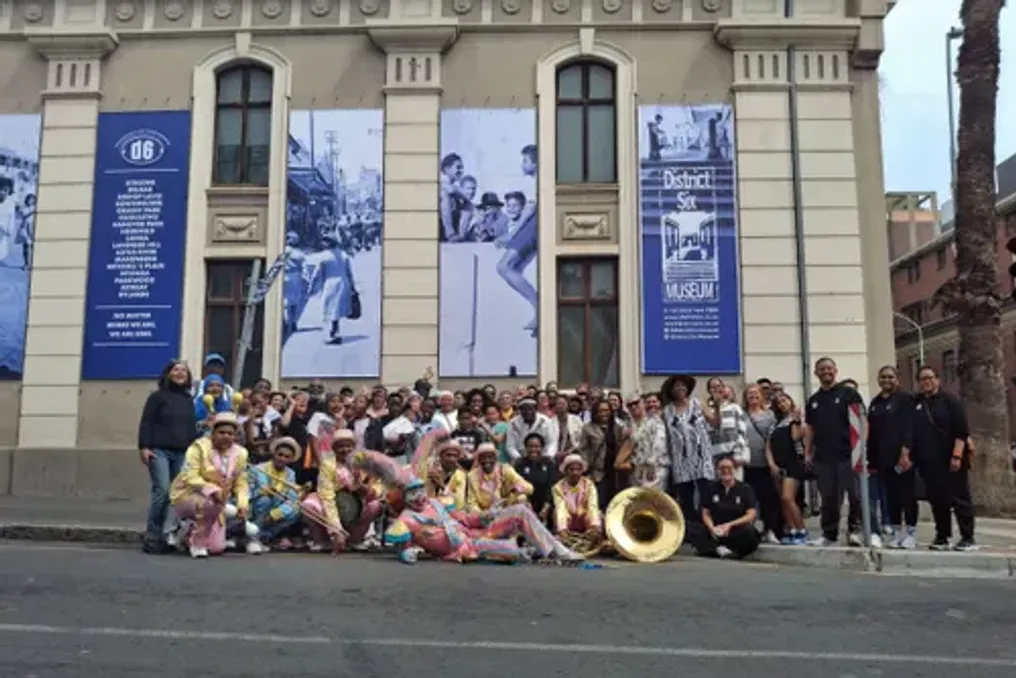
The Six Ward Return Centre decorated the stage with memory stones and images of Klopsie to celebrate Heritage Day. On September 24th, former residents, their descendants, community members, and youth gathered at the Six Ward Return Centre to mark Heritage Day, sharing their own stories in the museum's archive.
This event was an important step in the process that began on February 11, 2026, when the Six Ward Museum unveiled its famous painted floor map, creating a space for active commemoration.
Incorporating Memory into the Archive
In the hall of the Return Centre where the event took place, Heritage Day participants recorded their memories on stones, walls, and printed maps. They documented family names and former addresses to preserve these personal testimonies for future generations.
The blue memory stones were then delivered to the museum to be placed on the Salt Ward floor map, with the first batch of memory stones being preserved until 2027.
Tina Smith, Head of Exhibitions, appealed to the older generation, who holds the physical memory of the ward, urging them to consider not only the archives but also the significance of the heritage they leave for succeeding generations.
Smith asked: 'How do we value our humanity? How do we value our heritage? We will not be here forever, but we want to leave a legacy.' Addressing Uncle Solly, one of the 'wisest,' she added: 'We truly want to honor your presence with us today, and all other elders who found time to come here today.'
A Six Ward Museum education officer, Mandy Sanger, spent the morning conducting one-on-one conversations with visitors as part of the restitution program. She gently guided participants, especially the youth, helping them connect their personal family history with the broader narrative of the Six Ward, ensuring the weight of these memories is passed down to younger generations.
One 86-year-old former resident spoke in detail about her youth: 'I was born in Springfield Terrace in 1938, and when I was growing up, I had twelve sisters and twelve brothers,' she recalled of the thriving community. 'After I was in Springfield Terrace, I lived there for ten years, and then moved to 36 Pontac Street, where I grew up.'
On a yellow note attached to a printed map, one participant wrote: 'Hope to return.' Dozens of other participant notes around this note asserted that the Six Ward belongs to everyone who considers it home, thereby translating national debates on heritage into the personal experience of families awaiting land restitution.
As part of the restitution program led by Mandy Sanger, participants shared their hopes, and one wrote: 'Hope to return,' reflecting a sixty-year wait for restitution.
From the Return Centre to Buitenkant Street
When Education Assistant Ayanda Mpono asked where the relocated residents came from, the displaced residents named remote settlements across Cape Flats. Mpono, who officially took this position in February 2026, had worked with the museum in various roles for over five years.
Voices in the crowd echoed the names of places where they were forcibly relocated: Hanover Park, Manenberg, Bontehull, Heidefeld, Mitchells Plain, Atlon, Belhar, and Lavender Hill, among other areas. Others traveled even further, arriving from settlements where families such as Atlantis on the West Coast, Ocean View in the deep south, and Makassar were relocated.
Smith spoke of Ubuntu as the practical foundation of the Six Ward. She noted: 'No one will go hungry in the Six Ward. You will share a cup of sugar, a cup of oil, and so on.' She emphasized: 'We come from a place of dignity and the spirit of Ubuntu, where we recognize each other.'
Uncle Ikram, born in the Six Ward in 1966, recalled the evictions of the early 1970s. He recounted: 'My grandmother taught me to read and write. And then one day we were forced to leave our home. After that, I went on a journey to find myself, and I found the Six Ward again.'
Lisa Fredericks curates the preservation of these personal testimonies. She is the Collections, Research, and Documentation Manager for the Six Ward Museum Archive. Fredericks began her work at the museum in 2021 as a researcher specializing in oral interviews and podcasts before officially taking her current position in November 2025.
After the oral interview sessions, the blue memory stones and heritage on the stage came alive through the presence of attendees. Smith opened the opportunity for participants to record their dreams for the future. She said: 'For future generations and for the youth, we would like to know what your hopes and dreams are for the future of this ward.'
Residents migrated from Gugulethu to Mitchells Plain, to Hanover Park, gathering for the Heritage Day program—it was a physical reunion of a fractured diaspora.
One participant wrote 'Ubuntu' next to the phrase 'I exist because you exist,' questioning where true heritage lies—in fundamental care and knowledge passed between people. Another participant reflects on the true meaning of Ubuntu, writing 'I am here because of you,' to call upon and honor their ancestors, stating that heritage lies in communal care.
Klopsie leads the way
After preparing the stones, the gathering moved to the street for a procession to the main museum building on Buitenkant Street, led by the Klopsie musicians. The Cape Town minstrel carnival is a working cultural tradition dating back to the 19th century and is historically linked to the celebration of liberation.
Community member Melvin Matthews provided context for the parade, tracing the formal structures of the carnival back to 1907. Matthews explained: 'This tradition has existed since 1907,' emphasizing the generations of musicians who sustained this art amidst forced removals.
Leading the procession is Smouli, a warloper (lead dancer), whose energetic presence embodies the resilience of the Cape Town working class. As the cortege passed, motorists stopped to watch the ghooi, an Afrikaans term for high-stepping carnival dance movements.
At the intersection of Buitenkant Street between the museum and the Cape Town Central Police Station, traffic stopped while drivers watched the ghooi. Smouli performs high-stepping and vibrant movements, which is an uncompromising and bold expression of joy reclaiming the city streets.
Melvin also stressed the importance of this physically demanding role: 'For me, the most important person—okay, everyone is important, but the important person is the warloper. Don't mess with the warloper.'
The procession turned into a live street celebration with group battles, honoring generations of musicians who maintained their traditions amid forced removals. A distinctive feature of the street procession was its spontaneous harmony; the afternoon lacked a general rehearsal, instead, various musical lines simply clashed and merged in real-time on Buitenkant Street.
The bright, rhythmic strumming of Klopsie banjos smoothly intertwined with the deep, resonant brass music of marching bands, creating an unplanned symphony that could only arise in Cape Town on Heritage Day. Adding to this sound of heritage, the daughters of our nation appeared in front of the museum, enchanting the marching crowd with disciplined traditional dances and singing, a powerful display of young women claiming their cultural space and carrying the community's heritage into the future.
Inside the main museum, participants placed their stones on a mixture of sea sand and salt, where the floor map used to be. This new memory layout rests on a bed of sea sand and salt, marking a powerful second presentation of the exhibition since the original floor map was unveiled on February 11.
Smith outlined the next steps of the dynamic commemoration project. By February 11, 2027, the museum plans to deliver these stones to the desert mound near the Cape Peninsula University of Technology (CPUT), which marks the last remnant of Hanover Street. Smith explained: 'It is not a very welcoming place, but we are holding onto it, and I think it will make a rather symbolic statement with all these stones.' The goal is to collect 60,000 stones to symbolically honor every uprooted person.
Sixty years after the announcement of forced removals in 1966, the museum will also launch a proposed digital map. Smith added: 'You will be able to access the map in a more convenient digital format and bring some of these Six Ward stories and memories to life using these new devices.'