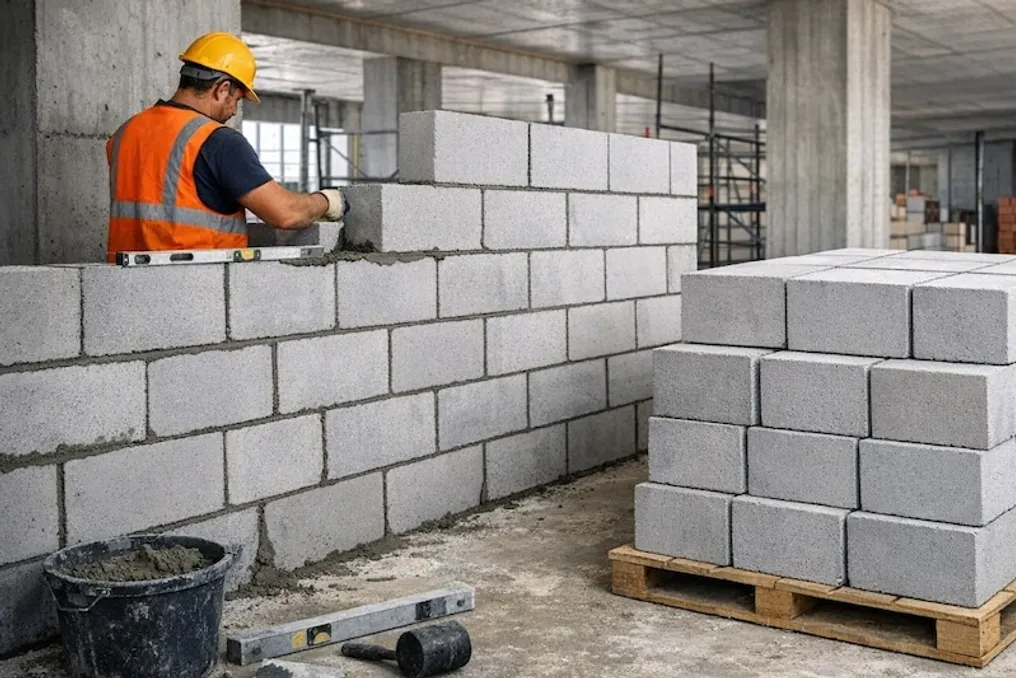
Bricks play a vital role in building structures. Traditionally, fired bricks made in a kiln are used for this purpose. However, various alternatives to these red bricks have recently appeared. Among them is a material that does not require weeks or months to manufacture: it is sufficient to spray foam, and a strong brick is produced. Recently, there has been a growing trend toward using such bricks in residential construction. Let's look at what this brick is, which is ready after spraying foam, and what kind of foam is used.
Bricks obtained by spraying foam are known as foam concrete blocks or cellular lightweight concrete blocks (CLC). This is a modern construction technology that eliminates the need to fire them in a furnace, unlike traditional clay bricks. Since red bricks have become expensive, people are actively using these blocks to build certain parts of houses. This trend is reinforced by the fact that these blocks are larger than ordinary red bricks, and their use requires less cement and sand, making them an economical option.
The process begins with the preparation of a thick solution, or suspension, which is created in a mixing machine by combining cement, water, and fine sand or fly ash. Then, a special foaming agent or synthetic liquid is mixed with water and fed into a machine to generate foam. This machine, using an air compressor, creates a very dense and durable white foam, similar to shaving foam.
The resulting foam is then sprayed through a tube or nozzle directly into the cement solution mixer. The mixer rotates slowly so that tiny foam bubbles are evenly distributed in the cement solution and do not collapse.
The foam increases the total volume of the cement mixture by 40% to 80%. When the foam and cement mixture becomes completely homogeneous, the liquid mass is poured into large molds shaped like bricks or blocks.
After pouring, the solution is left in the mold for 24 hours, during which time it begins to initially harden. Then the molds are opened, the blocks are removed, and to achieve full strength, they are dried for several days or weeks by spraying with water or placing them in a steam chamber.
Due to the capture of small air bubbles inside the foam, these blocks are significantly lighter than ordinary bricks. The air pockets provide thermal insulation properties, preventing heat and cold from penetrating the wall, which helps maintain coolness inside the house. Furthermore, these bricks possess soundproofing and fire-resistant characteristics.
These blocks are used to build partition walls, as they are not load-bearing. They are also used when creating rooms that need to be soundproofed or where thermal insulation is required, such as for air conditioner operation.