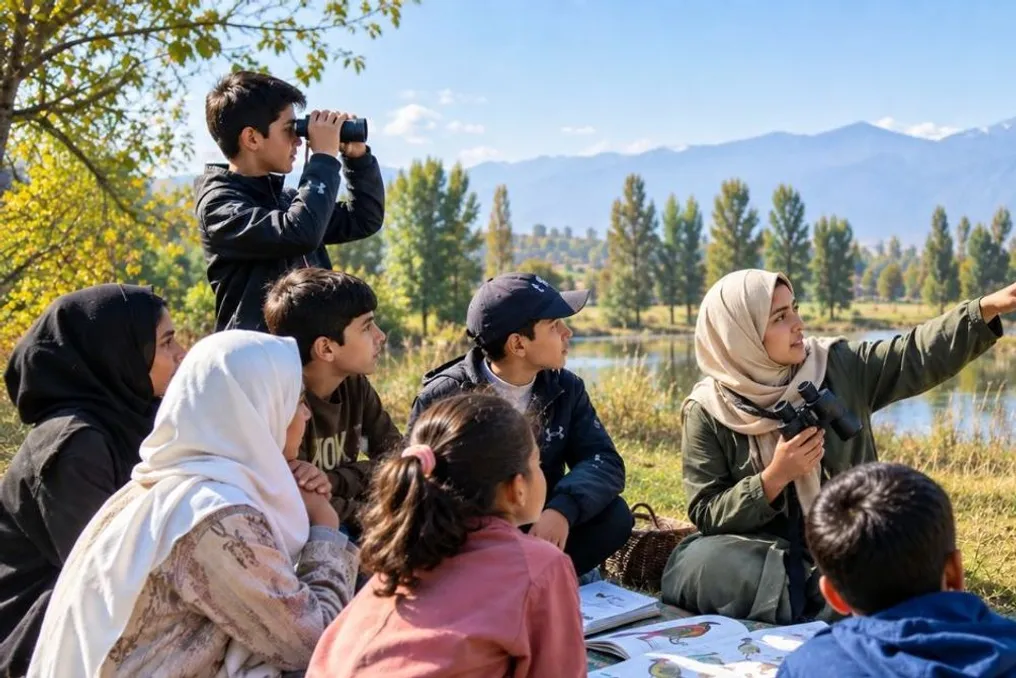
In Pampore, a saffron-growing region of Kashmir, Sundays are different for a group of children. Instead of spending time indoors, they gather in an open educational space where learning encompasses books, paints, discussions, fields, and nature.
During the weekdays, children attend regular school, but on Sundays, they learn at the 'Nature School'—an initiative founded by environmental lawyer Nadim Kadri. This school was created with a simple goal: for children to understand the environment they depend on, regardless of what they wish to do in the future.
The initiative started around 2019–20 and has evolved into a free Sunday learning platform, attracting children from various schools and age groups to study nature, develop communication skills, and explore interests that traditional classrooms cannot always provide.
The 'Nature School' team reports that since its inception, the initiative has been attended by hundreds of students. More than 30 students aged 8 to 30 regularly attend sessions on Sundays. Currently, about 10 volunteers, along with mentors and specialists, participate in the initiative's activities.
Seerat, an environmental science graduate who joined the 'Nature School' about four years ago and now works as a volunteer, says: 'We want to tell them that whatever your goals may be, you must also know how important the environment is to us.' For her, the message is very clear: 'When nature is in order, so will you.'
A School Without Walls, Fees, or a Curriculum
'Nature School' is not like a typical educational institution. There is no large concrete building or formal classroom structure. Instead, learning takes place in an open area, where children move between internal corners and the surrounding landscape.
A child interested in painting can access paints and materials. Those who love reading can use the library. Others participate in discussions or spend time outdoors, sitting on rugs and chairs in an open field.
The absence of a fixed curriculum is a deliberate choice. Organizers invite scientists, lecturers, and specialists to interact with children and conduct lessons based on their areas of expertise. A child showing interest in a particular topic can then seek advice from mentors and delve deeper into that subject.
The school is open every Sunday, and there are no age restrictions. Children from different schools and villages around Pampore can come without undergoing an enrollment procedure. The initiative also provides transportation for participating children. Volunteers use four-wheel-drive vehicles to pick up and drop off students, allowing children from different areas to participate.
The entire program is free. According to Seerat, the idea is that financial status should not determine access to these opportunities. She explains why the organizers decided not to charge families: 'A rich child should receive the same as a poor child.'
The initiative is largely supported by Kadri, and volunteers contribute their time and skills.
From Wetlands to Birds: Nature Becomes the Classroom
Environmental education at 'Nature School' goes beyond simply advising children on the need to protect nature. Students are encouraged to interact directly with it. They participate in tree planting and clean-up drives, engage with local communities, and learn how grassroots ecological campaigns can be conducted. They are also introduced to forests, wetlands, wildlife, and other aspects of the local ecosystem.
For Seerat, 'Nature School' changed her own perception of the landscape around her. She grew up near Pampore but says that when she went to college, she didn't fully understand what wetlands were or why they were important. She had seen wetlands before but didn't know about their ecological role. Thanks to 'Nature School', she began to study this topic more deeply, eventually becoming a bird watcher and bird guide. She learned to identify different species, understand migratory birds, and realize that the birds she saw in Kashmir sometimes traveled thousands of kilometers from other countries and continents. This knowledge, she says, she hadn't encountered even before college. This experience forms the basis of the school's approach: children are encouraged to ask questions, follow their interests, and learn from the environment.
The initiative also uses outdoor activities to develop skills beyond environmental awareness. Children from different schools meet, introduce themselves, participate in discussions, and gradually become more confident in communicating with others. For some, this can be a transformative experience.
Helping Shy Children Find Their Voice
When Seerat first joined 'Nature School', she described herself as a student from a small village who lacked confidence in interacting with people. The school provided her with opportunities to interact with children, participate in events, and gradually overcome this shyness. She recalls: 'Before I joined 'Nature School', I couldn't talk to anyone and didn't have the confidence to speak to anyone.'
Over time, these opportunities helped her feel more comfortable interacting with others. The school aims to create similar spaces for children who may be shy or introverted. A child can participate in a discussion, speak in front of others, join an outdoor activity, or simply meet students from another school. For the organizers, this experience is as important as the ecological lessons.
The initiative also focuses on providing girls with opportunities to participate in outdoor activities. She notes that convincing parents to allow rural girls to travel for programs can sometimes be difficult. She says that safety concerns can make families hesitate. As a young woman herself, she tries to reassure parents and accompany the girls during events and fieldwork. 'I want to tell them that your daughters are just as good. They can do it too,' she says.
The school provides transportation for participating children while volunteers maintain contact with parents. The goal is to give children an opportunity they might otherwise miss while ensuring their safety.
A Grassroots Initiative Run by Volunteers
Managing the initiative without charging children is not without its challenges. One of the biggest is convincing families that 'Nature School' is not just another extracurricular activity, but a space where children can learn something meaningful. Initially, organizers had to explain the concept to parents and students. Once children attended classes and returned home talking about their experiences, curiosity among other children often followed.
There is no formal staff structure. Instead, the program relies on a network of volunteers, mentors, and specialists who contribute their time. People involved in environmental and social initiatives support the program in various ways, while field volunteers help children navigate outdoor activities. Organizers also provide snacks, transportation, and educational materials free of charge.
According to Seerat, there is no regular NGO funding. Expenses, including transport and refreshments, are mainly covered personally by Kadri. Despite these limitations, the initiative continues to expand its educational resources. A library has been added, along with computers, a laptop, and free 5G Wi-Fi to assist children who may lack such access at home.
The idea is not to replace formal education but to supplement it by providing platforms that children might lack due to financial or social constraints. For parents, 'Nature School' offers children a different way of learning. Parent Shabir Ahmad said that the initiative helped his child become more confident and curious about the environment. He noted: 'My child now looks forward to Sundays and comes home talking about birds, plants, and the activities they did.'
Ahmad added that the free program allows children to learn outside the traditional classroom while developing communication skills and a deeper understanding of the natural surroundings.
Nurturing a Generation That Understands Its Environment
The ambitions of 'Nature School' extend beyond Sunday lessons. Organizers want to continue adding educational resources and opportunities for children, especially those who may not have access due to financial difficulties. For Seerat, the school has already demonstrated what such a platform can achieve. After graduating with a degree in 'environmental sciences', she plans to pursue a master's degree while continuing her work with 'Nature School'. She wants the children she teaches to have the same opportunities that helped transform her own confidence and understanding of the environment.
For Kadri, the broader goal of the initiative is to prepare the next generation to protect the world's nature. Children are introduced to forests, animals, wetlands, waste management, tree planting, and community involvement—not just as academic concepts, but as responsibilities they can undertake. In a region where wetlands are threatened, landscapes are rapidly changing, and environmental problems are becoming increasingly noticeable; the school offers a different view of education. Its classroom has no walls, its lessons have no fixed plan, and students do not pay fees. Instead, they learn by observing, asking questions, creating, and going beyond the familiar.
And on Sunday mornings, when children arrive carrying their curiosity, the reward for volunteers is often something much simpler than a certificate. It is the sight of a child holding a piece of paper, smiling, and proudly saying: 'Look what we did.'