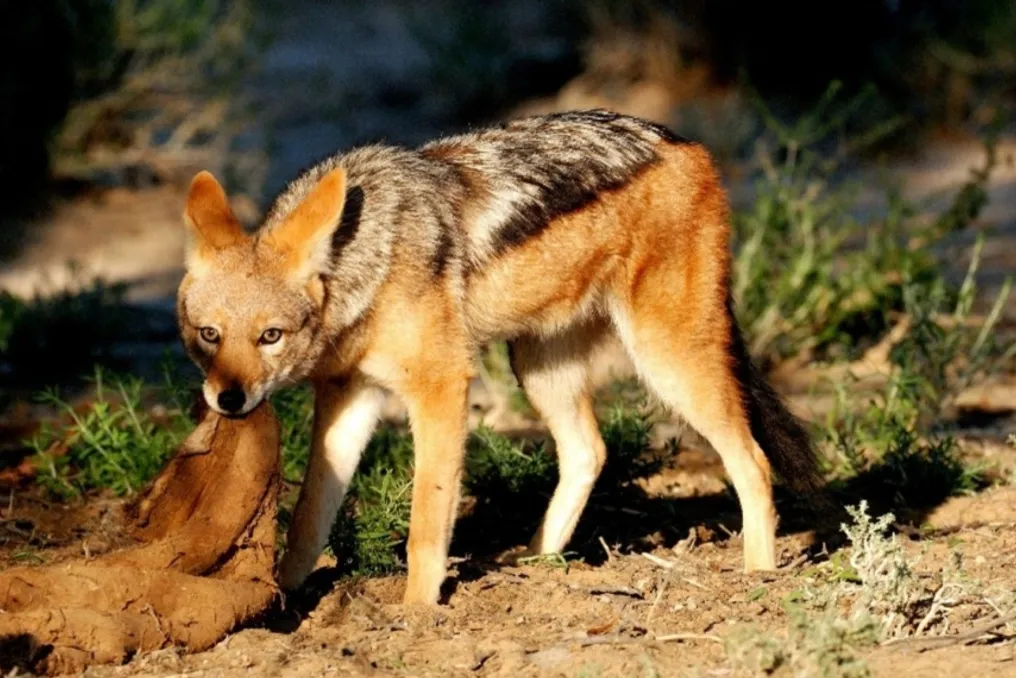
Black-colored jackals continue to pose serious problems for small farms and novice farmers as they hunt sheep, causing significant livestock losses, as well as financial and psychological stress.
Existing legal methods of controlling these medium predators in the food chain apparently do not yield the desired results.
Megan Le Roux, a postgraduate student in the Digital Signal Processing (DSP) laboratory of the Department of Electrical Engineering and Electronics at Stellenbosch University (SU), noted that predation by black-colored jackals presents a complex challenge for farmers, and clear solutions are scarce.
Le Roux emphasized that even the widely used 'lure and shoot at night' method, which uses recorded howls of jackals and prey to attract animals, has not solved the problem. Ecologists also believe that eliminating jackals disrupts their complex social system, often leading young females to breed and other jackals to move in and take over territory. Existing data suggests that lethal control methods can lead to increased predation.
Professor Rian Wolhuter and Thomas Nisler supervise the DSP laboratory.
Le Roux points out that the population of black-colored jackals has significantly increased in South African livestock areas, likely due to habitat loss and a corresponding decrease in natural enemies.
As part of her Master's program in Electrical Engineering at SU, Le Roux developed a biotelemetry system that remotely monitors wildlife in agricultural areas, collecting video footage and environmental data on animal behavior.
She explained that because black-colored jackals are opportunistic and highly adaptable hunters whose breeding habits, timing, and litter size depend on food availability, this system can help farmers, as well as biologists in environmental and wildlife conservation, better understand their behavioral patterns.
Initially, Le Roux used simulation software to test the system before deploying it on rural and equestrian farms. Wireless sensor nodes were placed at fixed points on the farms to collect video recordings of jackals and monitor environmental conditions.
These nodes contained integrated Wi-Fi equipment for further long-distance communication, as well as various sensors. She reported that field tests showed the system is capable of reliably and automatically capturing video material both day and night upon detecting movement.
Given that black-colored jackals are predominantly nocturnal, each node was equipped with wireless cameras capable of recording video in extremely low light conditions. The sensor nodes individually transmit collected data to Google Drive via internet access broadcast from an access node.
The system also collected environmental data, including temperature and humidity readings, at set intervals. During a five-day test period (from November 5th to the early morning of November 10, 2025), the system successfully transmitted 709 video clips, each lasting 30 seconds, to Google Drive—a total volume of 1.3 gigabytes (1.318 MB) of data.
Le Roux notes that the biotelemetry system achieved this without any human intervention. Unlike most traditional camera trap systems that require manual battery maintenance and physical removal of SD cards for data retrieval, the sensor nodes in her system are designed so that environmental data collection, motion detection, subsequent video recording, and data transmission are fully automated.
Motion detection is performed by a passive infrared sensor, which triggers the system to automatically record 30-second video segments. The system then processes the recording and transmits it to Google Drive.
Le Roux added that this system potentially can provide large volumes of video data on the hunting, feeding, and breeding habits of black-colored jackals and other medium predators in agricultural areas. She concluded that this additional research material could support the development of more ethically acceptable and environmentally sustainable methods for managing problematic animals in the long term.