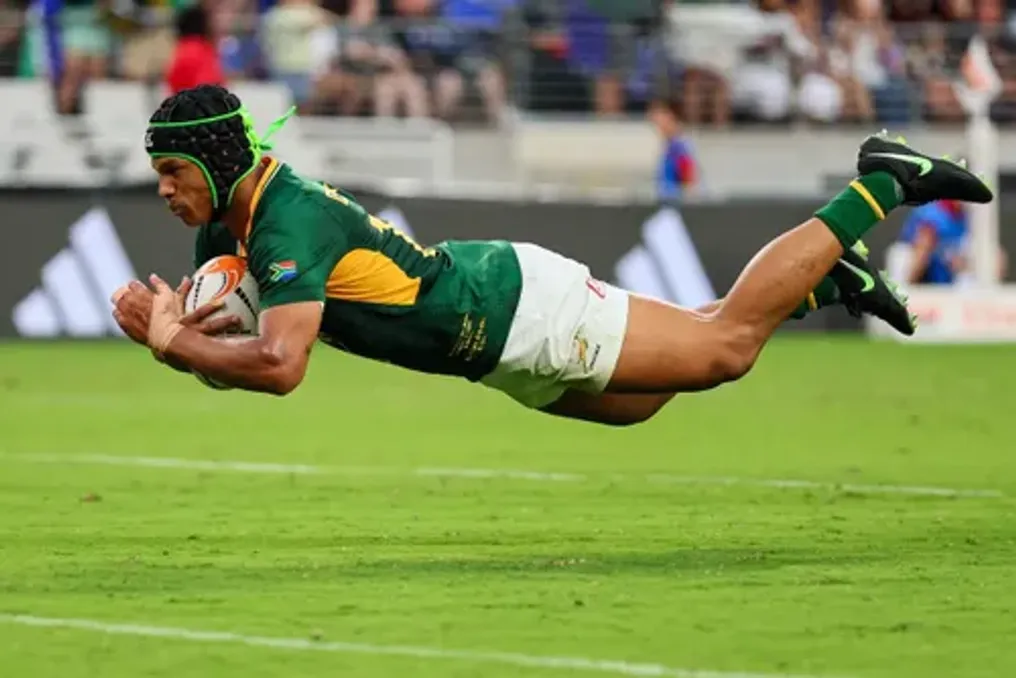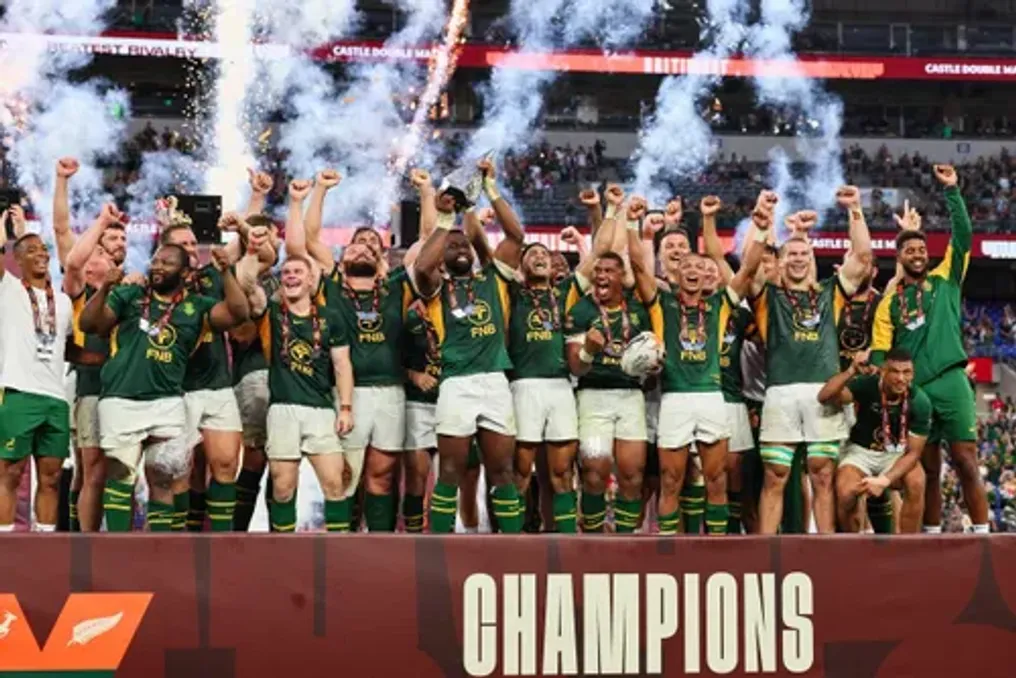
The Springboks team celebrated a victory over the All Blacks with a score of 43:28 in Baltimore, concluding the 'Rugby's Greatest Rivalry' series with a 3:1 result. This win allowed them to avenge their defeat in the 1996 series.
For South African rugby fans, the 1995 World Cup remains an almost mythical memory associated with the nation uniting around the Springboks, including figures like Nelson Mandela and François Pinaar at Ellis Park. However, this might be the only time many South Africans will see the Springboks playing for the Webb Ellis Cup on their home ground.
Therefore, the Rugby's Greatest Rivalry (RGR) series has become significant not only as four test matches between the Springboks and the All Blacks. SA Rugby and NZ Rugby have transformed this annual series into the closest financial substitute for hosting the World Cup—a major international event that generates significant revenue, mobilizes a huge fan base, and provides both countries with their own global rugby spectacle.
This is becoming increasingly important as the economic conditions for hosting the World Cup prove unfavorable for traditional rugby powers like South Africa and New Zealand, who are less economically viable compared to regions with stronger currencies or greater commercial potential.
International Rugby
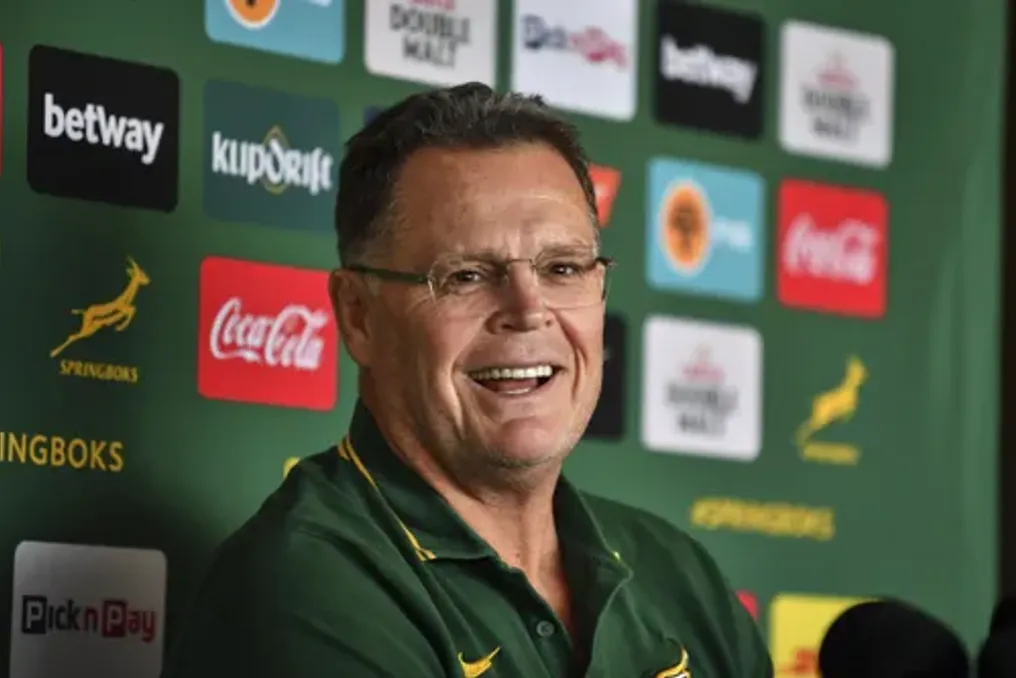
SA Rugby CEO, Rian Oberholzer, clearly stated that World Rugby must host its flagship tournament in markets where it can generate the most revenue. At the launch of Rugby's Greatest Rivalry in March, Oberholzer told IOL: 'The World Cup is the only source of income for World Rugby. It must fund the entire rugby ecosystem, and all members receive some funding from the World Cup. Therefore, World Rugby must host the World Cup where they can earn more money and go where they receive the greatest support from local authorities.'
Subsequently, Oberholzer became even more direct regarding the commercial disadvantage of South Africa and New Zealand. He noted: 'If we compare ourselves to Europe, for example, I don't see the money generated from South Africa ever being the same as what would be generated from Europe, or perhaps in the future somewhere in the Middle East.' He emphasized that this decision belongs to World Rugby, not SA Rugby, adding: 'World Rugby will host World Cups where they can make more money. We all have to understand this, and you cannot complain and demand the World Cup in your country while earning less, and then want a larger share of the annual grant you receive from World Rugby. It is about generating income to sustain the entire rugby system.'
In Oberholzer's view, the days when the World Cup could simply rotate between traditional rugby nations for sentimental reasons are over. He concluded: 'I think we have moved away from the philosophy that everyone should have an equal chance to host the World Cup. New Zealand and South Africa cannot guarantee the necessary revenue from the World Cup that World Rugby requires. I do not see this as negative for us; it is more a matter of what is best for the interests of World Rugby.'
The upcoming World Cup calendar confirms his point. The 2027 tournament will be hosted by Australia, the 2031 road show will move to the United States, and the 2035 event has received bids from Spain, Italy, Japan, and the Middle East, with Qatar, Saudi Arabia, and the United Arab Emirates among the contenders. A successful applicant is expected to be announced at the end of next year.
Thus, for South Africa and New Zealand, RGR represents an opportunity to create their own mega-event instead of waiting for the World Cup, which may never return to their shores.
The 2026 RGR season proved to be a great success in many aspects. SA Rugby earned approximately 200 million rand just from ticket sales for the eight-match series, and the final in Baltimore brought an additional 90 million rand to the union, which it might not have received if the fourth match had been held in Loftus Versfeld or Kings Park.
Financial figures are only part of the story. The 71,000 spectators at M&T Bank Stadium were believed to be over 80% expatriates from South Africa, creating an incredible sea of green and gold thousands of kilometers from home. These images told a story themselves—from the arrival of the Springboks at 2 am to the sounds of vuvuzelas, barbecues, and celebrations continuing long after the final whistle.
Baltimore demonstrated that the Springboks can bring their version of home advantage with them. This is important because South Africa's outstanding World Cup record—four titles in eight tournaments—does not give it greater right to host the tournament. The commercial equation carries more weight.
SA Rugby and NZ Rugby cannot control where World Rugby will hold the World Cup. But they can benefit from their great rivalry, build an event around it, and stage it in markets where it can generate new revenue while strengthening their global brands.
The Baltimore match also showcased commercial potential. Two of the Springboks' main sponsors, Coca-Cola and Nike, are based in the United States, and the match allowed SA Rugby to deepen its relationship with the market that will host the 2031 World Cup.
Some of the most valuable outcomes cannot be quantified on a balance sheet. During the week, social media was filled with images of South Africans enjoying the extraordinary sight of the Springboks match in America. The expat community turned Baltimore into a green and gold carnival, sending an unequivocal message to SA Rugby: there is a huge overseas Springboks community ready for mobilization.
The task now is to continue building on this. If SA Rugby can turn the 'Braai Army' in America into a genuine traveling fan base, then by the time the 2031 World Cup arrives in the United States, the Springboks might gain something close to a home advantage. It won't be Ellis Park 1995, but it could be something better.
Perhaps this is the true legacy of Rugby's Greatest Rivalry: South Africa and New Zealand may have lost the realistic prospect of hosting the World Cup, but they found a way to create something that can come close to it.