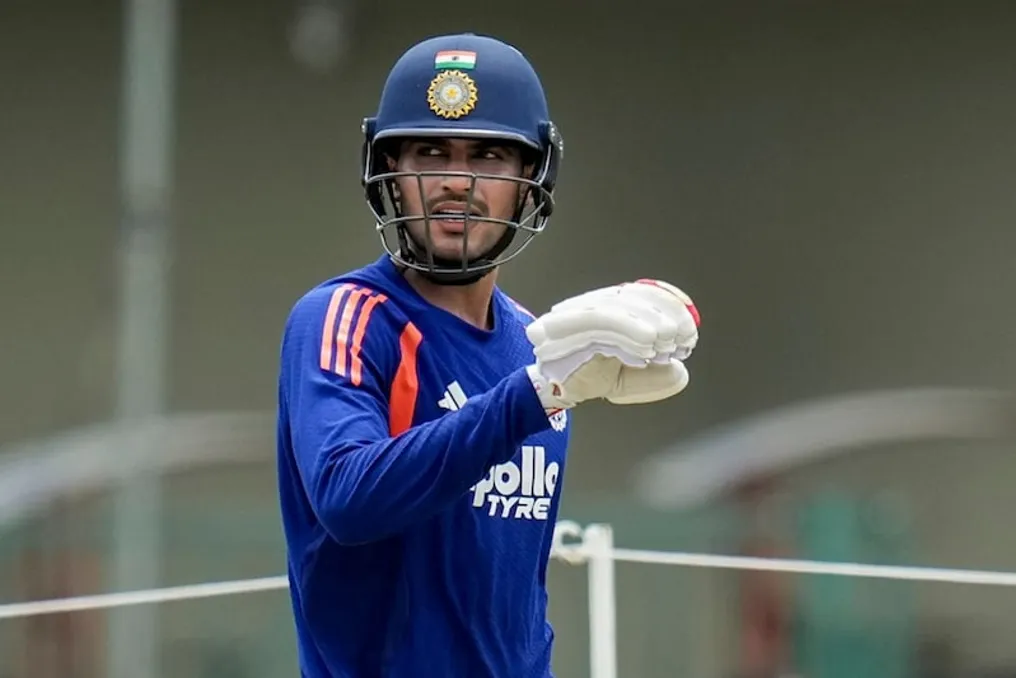
During training, captain Shubman Gill sustained an elbow injury from Mohammed Siraj's ball; fitness issues with Hardik Pandya also worry the team
Read more
Aaj Tak
www.aajtak.in

During training, captain Shubman Gill sustained an elbow injury from Mohammed Siraj's ball; fitness issues with Hardik Pandya also worry the team

Tension in the Indian squad has increased ahead of the three-match home ODI series against West Indies. During a training session, captain Shubman Gill sustained an injury to his right elbow bone.

The first match of the series between India and West Indies is scheduled for Sunday, September 27, in Tiruvannanthapuram. Gill's injury occurred during team practice on Friday, two days before the match.

Shubman Gill was practicing shots against the right fast bowler Mohammed Siraj. During this drill, a sharply bouncing ball hit him directly in the right elbow. After the impact, Gill appeared to be in pain and left the net. The team's physiotherapists examined him, and Siraj immediately learned of his condition. Virat Kohli, who was training in the adjacent net, also approached Gill.

After sustaining the injury, Shubman Gill sat in another part of the net, holding his elbow and clearly suffering from pain. The coaching staff bandaged his arm. He did not participate further in the training and spent the rest of the session recovering. However, by the end of the training, his condition seemed slightly improved. Shubman chatted and joked with Gurunoor Baar, and he did not look overly upset when leaving the field. Nevertheless, his physical readiness remains a critical issue before the first ODI.

Gill's Injury Concerns

This is the second consecutive instance where an injury has caused concern before a series for Shubman Gill. Last month, during training in Sri Lanka, a ball hit his ring finger. Despite this injury, he recovered in time and participated in two matches of the Test series. Before Friday's training, Shubman looked in good form. He was one of the first batsmen to come out for practice along with Virat Kohli, Rohit Sharma, and Ritardh Gaikwad.

Nitish Kumar Reddy also caused Shubman concern with his high bounce. After this, Shubman initially played cautiously against Gurunoor Baar but then demonstrated several excellent shots. The injury forced him to end the training session earlier than planned.

Shubman Gill's injury occurred at a time when the Indian team was already facing fitness difficulties with several players. During the tour of England, the availability of Nitish Kumar Reddy, Jasprit Bumrah, Hardik Pandya, Harshit Rana, and Washington Sundar was affected by injuries. The team's bowling coach, Morne Morkel, acknowledged that India aims to take the field with the strongest available squad. He also noted that injuries are part of the game, and such situations give other players a chance to establish themselves for India.

How Soon Will Hardik Pandya Be Fit?

Meanwhile, the health status of all-rounder Hardik Pandya has further heightened the concerns of the team management. Hardik was supposed to participate in the three-match series against Australia-A as part of the India-A tournament, but he was excluded from these matches due to pain in his right shin. Constant efforts have been made to recover Hardik in recent months. He worked on his physical conditioning at the Centre of Excellence (CoE) and was approaching a return to competitive cricket. However, the recurrence of the injury has once again postponed his return plans.

The BCCI medical team advised him to rest following a recent scan. It is likely that Hardik Pandya will also be unable to participate in the five-match T20 series against New Zealand. Although India is set to play ODI matches on the tour of New Zealand, selectors may wait for his full recovery instead of rushing his return. Hardik's return is crucial for the Indian team, as he is indispensable in both batting and bowling.

Similar stories

Why the cycle of injuries in the Indian team does not stop: an analysis of the injury management system
Read more
www.aajtak.in

Why the cycle of injuries in the Indian team does not stop: an analysis of the injury management system

In Indian cricket, the discussion is no longer just about when a player will recover, but also how long they will remain healthy after returning. A return after four months sounds encouraging, but if they play a few matches and then get injured again with the same or another injury, the point of this rush becomes unclear. This very question has sparked a debate around the Injury Management System of the Indian team.

During these debates, reports emerged about the dismissal of Indian team physiotherapist Kamlesh Jain. He is currently on notice leave, and new medical staff is expected to be brought in soon to replace him. These changes occurred while questions about the physical condition and injuries within the Indian squad are constantly being raised. Nevertheless, Jain's decision cannot be directly linked to the injury of any specific player.

Injuries to fast bowlers are part of cricket. However, the problem arises when a player returns after an injury, undergoes rehabilitation, and then ends up back in the medical room. This raises three questions: was the injury diagnosed correctly? Was there an error in the rehabilitation process? And was the decision to return made too early?

Therefore, the idea of a 'quick return' must now be questioned. It is better to spend six months than to return a player so that they can play continuously without fear of the next injury, even if it takes longer than four months.

Judging a player's availability solely by the calendar can be dangerous. True success is not in them taking the field after four months, but in them remaining on the field after four, six, or even a year.

Jasprit Bumrah is one of the brightest examples of how complex decisions about fitness can be in Indian cricket. After sustaining a left knee injury during an ODI match against England in July 2026, he was excluded from the Test series in Sri Lanka. Despite rehabilitation at the BCCI Centre of Excellence (COE), he could not fully recover in time.

Currently, in September, his fitness is once again being discussed. He has been included in the squad for the T20 series against Afghanistan and the Asian Games, but assessing his readiness remains critical. According to the latest reports, Bumrah has passed a fitness test and is ready for selection.

This shows that the question is not just 'is he ready,' but 'is he ready for what load?'

The case of Rishabh Pant is also important in this discussion. In 2023, he traveled to New Zealand for surgery, after which a BCCI medical update indicated that he was undergoing rehabilitation at the NCA along with Jasprit Bumrah. Pant himself stated that it took him about 24–26 weeks to return to bowling after the operation.

Thus, this presents an example of a long process, not a 'quick return.' The case of Mohammed Shami is also worth remembering: he was absent from cricket for a long time due to a heel operation and did not participate in IPL 2024.

And Rishabh Pant: after a terrible accident in December 2022, he returned after multiple surgeries and approximately 14 months of rehabilitation. His preparation was based on a long process, not on rushing.

These cases clearly show that long rehabilitation is not always a negative factor; sometimes a player needs more time to fully recover.

Harshit Rana's situation in 2026 further intensified this discussion. Initially, he missed the T20 World Cup and IPL due to a hamstring injury. Upon his return, he sustained another hamstring injury during a fitness test and was excluded from the Asian Games, except for the series against Afghanistan.

This is where the term 'injury cycle' gains the most significance. If a player returns after rehabilitation and then gets injured again during a fitness test, it cannot be attributed solely to fate. A complete review of the entire process is necessary: training, load, recovery, injury diagnosis, and rehabilitation.

The decision must now be based not on 'speed,' but on the 'correctness' of the return.

Indian cricket possesses one of the strongest cricket systems in the world and modern medical capabilities. Therefore, the goal should not just be to get the player back on the field as soon as possible, but to return him completely healthy.

Popular