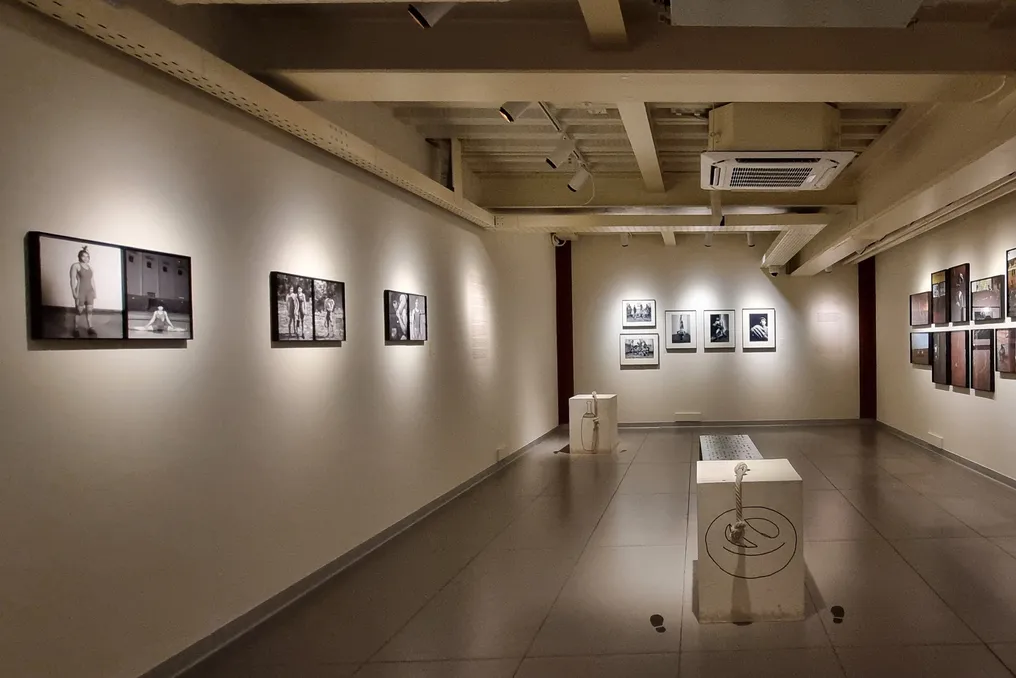
The Museum of Art and Photography (MAP) has presented two significant exhibitions: 'Grip, Hold, Pin' and 'A Moving Line'. Both exhibitions will be available until November of this year.
The first exhibition, 'Grip, Hold, Pin', is curated by Ayati Sengupta. It combines historical artifacts and contemporary photography dedicated to the Indian wrestling as a living cultural tradition. Sengupta notes that even before the advent of cameras, artists documented the rituals, discipline, and symbolism surrounding wrestling.
Examples of early paintings by Ragamala and textile labels demonstrate that wrestling was not merely a display of strength, but an expression of community, identity, and labor. The exhibition illuminates the social, cultural, and artistic aspects that have shaped this practice.
Aspects such as resilience and vulnerability are presented through the works of Jyoti Bhatta, Raghu Rai, TS Satyan, Indrajit Khambe, and Prartna Singh. The exhibition also features contemporary practices and some recent political debates. Khambe emphasizes that for him, wrestling was never just a competition, but a way of life shaped by discipline, community, and generational traditions.
The physical aspect of the sport serves as a form of expressing values such as respect, endurance, and courage. Meanwhile, wrestling evolved parallel to changing social conditions, moving between traditional akhadas, organized competitions, and modern sports institutions. Thus, wrestling is a living practice, not a static tradition; the earth of the wrestling ring, the equipment, and the ritual objects speak to the connection of wrestling with place, memory, community, and inherited knowledge.
Singh focuses on the lives, aspirations, and resilience of female wrestlers, expressing hope that the photographs will prompt viewers to see strength not only in contests but also in everyday acts of bravery.
The second exhibition, titled 'A Moving Line: 1500 Years of Indian Visual Storytelling', is curated by graphic novelist Amruta Patil. It includes over 250 pieces tracing how India told stories throughout the centuries.
The exhibition incorporates living Indian narrative traditions, such as Kavadi and Pattachitra, as well as later comics and publications, including Amar Chitra Katha, Tinkle, and The Phantom. Modern graphic novels and webcomics continue these discussions in new formats.
Kavadi is a portable wooden altar originating from Rajasthan; painted panels unfold, revealing sequential scenes and characters. The very act of unfolding the panels creates a shared experience where narration becomes a mutual interaction between the storyteller, the object, and the audience.
Pattachitra merges narration and visual art, presenting itself as textile painting featuring mythological figures and stories. Decorative frames and sequential scenes allow complex plots to be conveyed through a visual language.
Other similar traditions include Cheriyal scroll paintings from Telangana and Phad painting from Rajasthan. There are also puppetry traditions, such as Kathputli from Rajasthan, Yakshagana in Karnataka, Kathakali in Kerala, and Therukuttu in Tamil Nadu.
These diverse practices are unified by their ability to transform storytelling into a collective cultural experience. Stories are remembered and interpreted from generation to generation not only in texts but also through gestures, images, sounds, objects, places, and performances.
The exhibition also showcases political graphic novels, feminist and queer narratives, as well as digital formats. MAP has prepared a special scholarly publication on this exhibition, along with interactive elements such as audio guides, tactile displays, and a book library for viewing.
The diverse artworks demonstrate how creators conveyed movement, emotion, and sound in a dense, two-dimensional format. Although the mediums have changed over the years, the exhibition invites visitors to explore how storytelling has shaped us throughout life and what the future of visual storytelling might hold in the age of artificial intelligence.
Overall, visiting such varied exhibitions at the museum can create a captivating experience, as each offers a unique way of understanding culture, history, and the human experience. Moving from one gallery to another allows guests to encounter different practices and viewpoints while noticing the connections between them.
Themes such as professional community and embedded knowledge prompt visitors to consider how various cultural practices may have deeper connections. The museum experience creates a space for reflection, allowing visitors to interact with objects at their own pace. Consequently, the museum becomes not just a place for displaying objects, but a platform for observation, discovery, and contemplation. Each exhibition contributes to a broader experience, resulting in visitors leaving with perspectives that may continue to evolve after their visit to the museum.