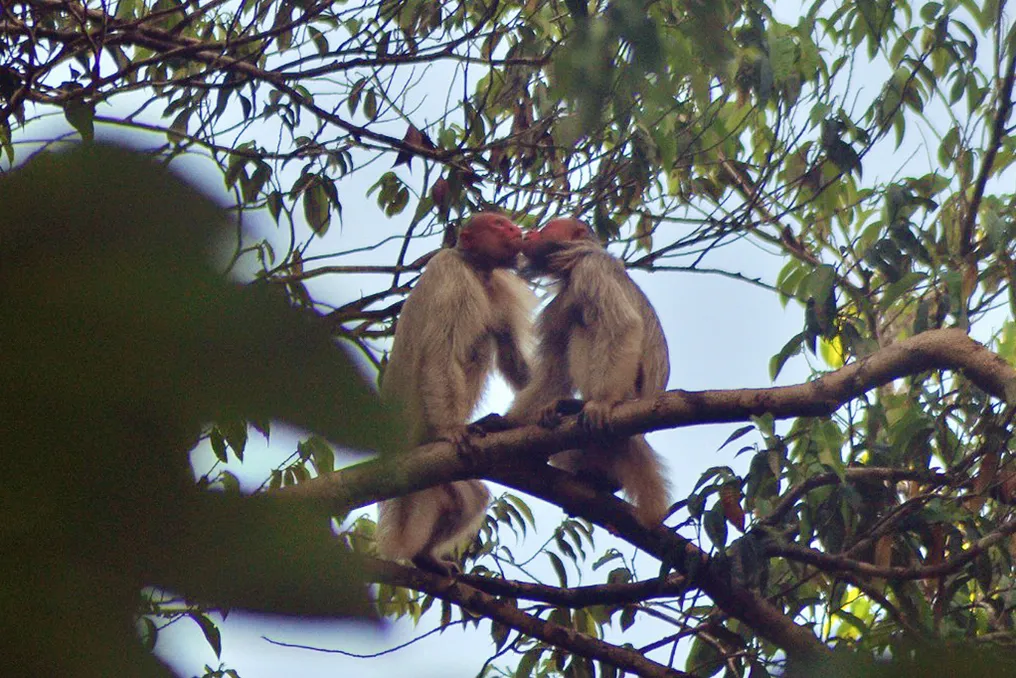
Kissing is not exclusively human behavior. Researchers have previously documented such affectionate gestures in chimpanzees, bonobos, and orangutans. It is hypothesized that the habit of touching with lips was inherited from a common primate ancestor about 21 million years ago.
However, among New World primates, known as monkeys, such observations are extremely rare. This is why the recording of such contact in wild white-faced uakaris attracts particular attention.
On April 18, 2023, at 16:28, an adult male of this species approached an adult female resting on a branch in the upper levels of the Amazon forest. Using his hind limbs, the male climbed up and dared to approach his potential partner until their faces touched.
For approximately ten seconds, while researchers observed, the pair remained with their faces touching. The female appeared content with this contact, assuming a seated position facing the male, which the study authors described as a 'relaxed posture consistent with receptivity.' This was highly significant for the first case documented in a scientific study.
In the article, the scientists note that 'it seemed that both individuals had their lips touching, their faces aligned in a straight direction, face to face.' Furthermore, neither animal showed muscle tension or any signs of aggression or stress, confirming that it was indeed a 'little kiss.'
The contact also appeared soft and continuous, which is a characteristic feature of social interactions aimed at strengthening emotional bonds between animals. After this event, things became even more interesting: the male moved deeper into the tree canopy, followed by the female. The researchers do not know what they were doing there—this remains for the reader's imagination.
Overall, the interaction, from the male's approach to both disappearing into the treetops, lasted about a minute. According to the article published earlier this month in the journal Biotropica, this is the first recorded instance of direct facial contact in wild white-faced uakaris of the family Pitheciidae.
In an interview with Super, a researcher from the Federal University of Amazonas (UFAM) and the study's first author, Renan Dias da Silva, admitted that he initially did not fully understand what was happening when he saw this kiss. At that moment, he was only filled with delight at the scene, leading him to move on to other observations. Only after returning from the expedition did he decide to delve into the literature to understand this behavior.
Among primates, such contacts serve many social functions, including maintaining pair bonds, resolving conflicts, assessing reproductive fitness, and sexual solicitation. For Renan, the white uakari—a species endemic to the floodplain areas of the Amazon forest and possessing unique characteristics—is a particularly interesting example of these functions.
Reddened, highly vascularized faces that emit scents signal the animal's health status and help the female choose a mate during mating through facial contact. The author explains: 'She wants a healthy male and sees it on their faces because the redder the face, the healthier the animal.'
There is also the issue of recognition. During a second moment observed by researchers in the field, an adult male approached a young individual sitting on a branch and leaned toward the person's face for three to four seconds. Since no violence was observed, the hypothesis arose that they might recognize each other.
'During the day, to avoid competition within its own group, uakaris divide into smaller groups. But at other times, they gather together again,' says Renan. 'This close facial contact helps with identification, calming, and group cohesion. Bringing one's face close to another primate's face in this context means you are exploring the environment.'
Renan, who is a primatologist at UFAM, observed wild white-faced uakaris from September 2022 to August 2023. He recalls: 'I had to wake up every morning before the monkeys. And I only left the jungle after the monkeys fell asleep.'
He was located in the Lago Surara Biological Reserve, situated in the Juruá River area in the Amazon, and observations were conducted during the flood season. Since there were only two recorded demonstrations, it cannot be definitively stated whether seasonality influenced their behavior. However, it is known that during this period, when the soil floods, uakaris restrict themselves to the tops of trees—which forces greater proximity between individuals, possibly to soothe their moods with 'kisses.'