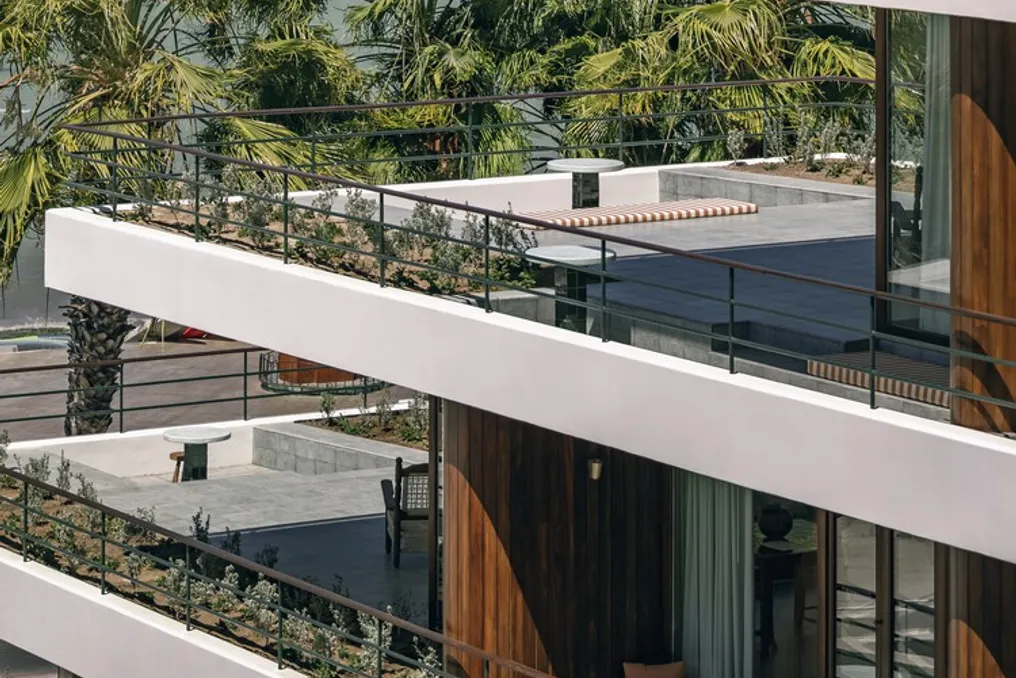
Which wood species should be used in coastal areas?
Read more
ArchDaily Brasil
archdaily.com.br

Which wood species should be used in coastal areas?

Wood and coastal architecture are always closely linked, as wood is one of the materials that defines coastal structures. However, implementing this aesthetic in conditions of constant adverse effects requires the chosen material to have special qualities.

Rain is not a unique feature of coastal areas. The key difference of the littoral zone lies in the combination and frequency of exposure to factors: humidity, sea winds, sea salt, direct sunlight, and frequent storms. These conditions subject the wood to constant cycles of wetting and drying. In many coastal regions, these phenomena are not random weather events but part of daily life.

Therefore, when choosing wood for construction in a coastal area, two properties are critically important: durability and dimensional stability.

Coastal zones impose higher demands on wood

Wood naturally absorbs and releases moisture depending on changes in environmental conditions. It expands when humidity increases and contracts when it dries. Over time, the repetition of this movement can lead to the formation of cracks, splits, warping, and gaps between boards. Furthermore, this can place excessive stress on joints, fasteners, and finishes. Moreover, prolonged exposure to moisture creates favorable conditions for rot and material degradation.

Consequently, selecting suitable wood for a coastal area goes far beyond aesthetics or expected service life. The material must possess sufficient resistance to withstand the harsh climate and be stable enough to exhibit predictable performance under such conditions.

Construction for coastal areas

Construction specialists have faced these conditions for generations. Successful projects in coastal areas utilize thoughtful design solutions and detailing to manage water and ensure the drying of the wood. Designing cladding profiles and appropriate spacing can compensate for material movement, while ventilation and drainage prevent moisture accumulation. Corrosion-resistant fasteners withstand the action of sea salt, and protective coatings add another layer of defense.

These methods remain extremely important regardless of the type of wood used. Nevertheless, careful material selection can provide an additional level of resilience. Choosing wood that resists rot and is less susceptible to dimensional changes with humidity fluctuations means that the building will not rely entirely on finishes or structural details for its protection. The material itself becomes part of the design strategy—a decisive factor in an environment where weather impact is inevitable.

Change in wood's reaction to the environment

Traditionally, builders chose wood species with natural durability and relied on detailed design to mitigate natural wear and material movement. Today, advancements in wood technology offer an alternative approach: changing how the wood itself reacts to the environment.

Acetylation achieves this by irreversibly altering the wood at the cellular level, changing its interaction with water. The wood begins to absorb significantly less moisture, which reduces swelling and shrinkage, and also provides excellent resistance to rot and decay. Since the modification occurs throughout the material's structure, its durability does not depend on surface coatings or treatments. The wood can be finished to achieve a certain aesthetic or left to age naturally while retaining its original characteristics. For work in coastal areas, this opens a new level of security. Although good design and execution practices remain necessary, the wood itself becomes much better prepared to withstand local adverse conditions.

The role of Accoya

Accoya is a wood specifically developed for coastal environments, offering long-term durability combined with exceptional dimensional stability. Its resistance to rot and decay is guaranteed by a 50-year warranty for above-ground use and a 25-year warranty for use in direct contact with soil or fresh water. This stability is also supported by a contractual guarantee ensuring strict limits on expansion and contraction movements.

These characteristics allow Accoya wood to be used in various coastal projects, including facade cladding, decking, window and door frames, and other structures exposed to the elements. If a specific appearance is desired, it can be coated or allowed to age naturally without compromising its durability. For architects, builders, and owners, this technology opens up new possibilities for using natural wood in places where extreme exposure previously limited design solutions. Coastal construction will always require careful planning and good execution practices; however, the key difference lies in using material specifically designed to resist this scenario. Complete confidence in the wood's behavior allows for much greater freedom in its application.

Similar stories

Nautical architecture: lessons in space and materials from floating homes
Read more
archdaily.com.br

Nautical architecture: lessons in space and materials from floating homes

Unlike traditional buildings, which have fixed foundations and react to the climate of a static point, yachts are designed for movement and constant change. Their interiors oscillate with the vessel, the light varies every minute, humidity is a permanent design factor, and every gram impacts performance. Thus, designing for the marine environment requires specialists in architecture, naval architecture, engineering, and interior design to solve problems rarely found on dry land: how to maintain a serene space when everything around is in motion?

This modality of floating architecture has centuries of history. The word 'yacht' derives from the Dutch 'jacht,' which originally designated a fast boat used for hunting, later evolving into leisure ships and long-distance cruisers. As yachts began to function as residences, and not just as means of transport, naval architecture transcended engineering to plan complete living environments, harmonizing hydrodynamics, structure, circulation, natural lighting, and internal organization on a perpetually moving vessel.

Just like in terrestrial architecture, naval architecture organizes circulation, structure, natural lighting, and material interaction, while also considering buoyancy capacity, balance, and water resistance. The hull shape determines speed, efficiency, stability, and the perception of internal movement. Weight distribution is crucial for stability, causing furniture, stone surfaces, bathrooms, and technical equipment to integrate into the vessel's balance strategy.

These technical limitations extend to the smallest architectural details. Materials must withstand salt, humidity, UV exposure, and continuous vibrations while simultaneously preserving a pleasant indoor environment. Therefore, woods, stones, metals, fabrics, and sanitary fittings must meet the specific needs of a maritime setting. Collections such as those from Dornbracht offer options for naval applications, with finishes and details appropriate for highly customized yacht interiors, meeting the demands of life at sea.

How to make a small space look generous

Unlike a common building, a yacht has a strictly defined area. Every room, piece of furniture, and storage component must justify its presence, making spatial optimization a fundamental pillar of the design. This is particularly visible in how yacht interiors use integrated elements to create spacious living areas within a restricted projection area.

The REN 62, a 19-meter motor yacht designed by BAZ Yacht Design, illustrates how compact spaces can appear remarkably larger through proportion, continuity, and integrated architecture. Custom carpentry, built-in storage, and specialized boat furniture utilize every square meter efficiently, maintaining free and fluid circulation. A discreet palette composed of dark wood, brushed metal, stone, and soft fabrics runs through the living room, kitchen, and cabins, establishing a cohesive material identity. Elongated horizontal windows frame the ocean and introduce variable natural light into social spaces, turning the horizon into part of the internal experience. This material uniformity extends to the kitchen and bathrooms, where the Dornbracht LYV line in Soft Black harmonizes with the yacht's almost monochromatic galley, while the META line in Brushed Platinum complements the marble surfaces and cooler metallic finishes.

High-performance materials in the marine environment

Material selection on a yacht involves both its composition and its performance. A vessel must maintain an adequate weight to operate efficiently, placing weight as an architectural consideration as important as craftsmanship and longevity. Such restrictions influence not only the performance of the materials but also the way they are combined to generate comfortable, durable, and visually balanced interiors in yacht design.

On the Santosha, a 57-meter yacht by Heesen Yachts, the materials define the atmosphere and character of the interior. Harrison Eidsgaard combines dark wood, leather, brushed metals, cream-toned fabrics, and large glass panels to create environments that maintain a constant visual connection with the surrounding landscape. The bathrooms follow this palette with sculpted marble surfaces, including a relief panel created by DKT Studio in the master suite. The metals from the Dornbracht CYO line in chrome finish integrate into this composition as another material layer, subtly contrasting with the stone while reinforcing the project's sober palette.

Blurring boundaries

Aquatic architecture continuously navigates the intersection between refuge and landscape. Unlike a fixed construction on a specific plot of land, a yacht constantly moves through various settings. Its windows, decks, terraces, and openings thus become vital architectural features connecting the interior to the water.

The Ocean Z explores the relationship between interior and water through openness and light. The Reymond Langton Design office combines light wood, white marble, curved forms, and a simplicity inspired by Scandinavian style, adding touches of navy green and deep blue. Floor-to-ceiling frames, outdoor terraces, and a retractable swim platform soften the transition between internal living areas and the adjacent sea, allowing views and natural light to shape the onboard atmosphere. In the bathrooms, the wooden panels and marble maintain the coherence of the material language, while the Dornbracht CL.1 metals in chrome finish complete the minimalist and clean composition.

Yacht design encompasses many of the issues that architecture professionals face on land, but within a much more limited context. Space must fulfill multiple functions without appearing congested, materials must balance durability and touch, and interiors maintain a constant dialogue with the surroundings through light, views, and carefully framed openings. The REN 62, the Santosha, and the Ocean Z address these challenges in different ways, but all demonstrate how architecture on the water depends on meticulous coordination between structure, materials, lighting, and interior planning. The result is a design methodology where performance and the experience of inhabiting the space develop in an integrated manner.

Popular