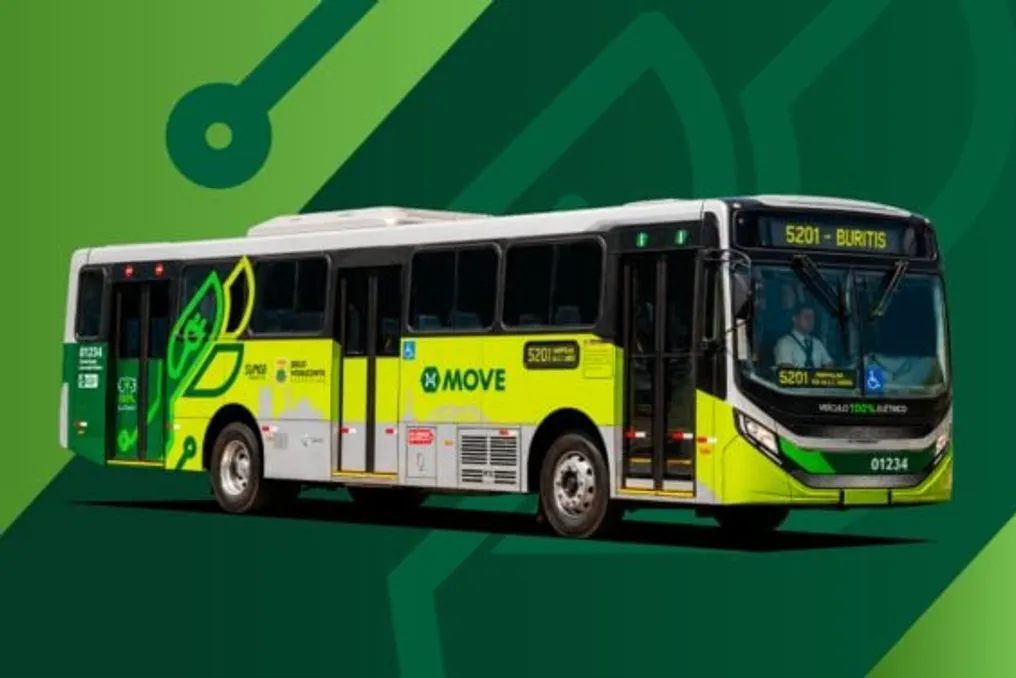
The Belo Horizonte City Hall formalized the acquisition of 96 fully electric buses intended for the public transport of the capital of Minas Gerais. The contracts were signed on September 16th, and their excerpts were published in the Municipal Official Gazette on Tuesday, the 22nd. The total value exceeds R$ 313 million, funded by resources from the federal PAC Seleções program.
The majority of the investment was directed to the body manufacturer Caio Induscar, through an agreement worth R$ 307.6 million with a validity of 20 months, counted from the supply order. Additionally, a second contract, valued at R$ 5.5 million and lasting 18 months, was established with Nansen Instrumentos de Precisão to supply and install 27 chargers, including driver training.
Marco Antônio Silveira, Municipal Secretary of Urban Mobility, highlighted that electric buses offer benefits such as being quieter, not emitting pollutants during operation, and representing an advance in the modernization and sustainability of the system.
Initially, the city hall's plan contemplated 100 units. The bidding process for this total number had been approved in June for R$ 320.5 million, a value higher than the estimate of R$ 317 million presented in April when the competition was opened. However, the purchase was adjusted to available resources after updating the values in the contracting process.
Each vehicle will cost approximately R$ 3.2 million, maintaining the unit value from the approval, according to information from the specialized website Diário do Transporte. The buses will be provided to operating companies under a comodato regime, which is a free loan of goods, and their entry into service will occur gradually, following the production and delivery schedule. The city hall has not yet specified the start date for the circulation of the first vehicles.
These buses are of the BRT Misto model, equipped with five doors (three on the right side and two on the left), allowing boarding at both common stops and exclusive corridor stations. They have air conditioning, accessibility features, and a capacity to transport up to 71 passengers. Their range is over 250 km on a single charge, and the 160 kW chargers allow simultaneous recharging of multiple vehicles.
According to Diário do Transporte, the vehicles will incorporate Electra technology, Caio bodywork, and Mercedes-Benz chassis, using motors, inverters, and batteries from WEG. The tender establishes rigorous requirements, demanding an electric motor with at least 197 hp and 91.8 kgfm, batteries of at least 337 kWh, and a length between 12.4 and 14 meters. The batteries have an eight-year or 600,000-kilometer warranty.
Between 2023 and 2024, the Municipality's Mobility Superintendence (Sumob) conducted tests with models from various manufacturers, and these studies indicated a decrease in operational costs, in addition to providing greater comfort to both passengers and drivers. The municipal administration estimates that replacing diesel-powered buses with electric models could prevent the emission of about 11.8 thousand tons of carbon dioxide annually, in addition to reducing noise levels in the city's streets.