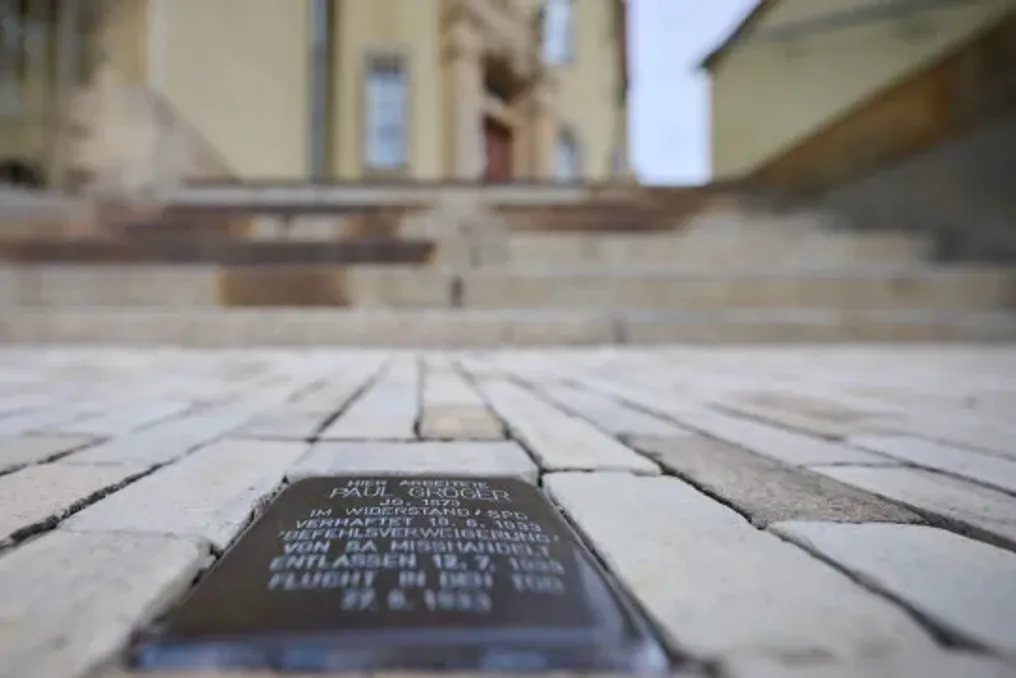
A local political initiative led to the rejection of the project by its supporters. Katja Demnig, head of the foundation managing the 'Stolpersteine' or 'stumbling stones' project, expressed bewilderment about what happened, stating: 'It is difficult for us to understand how this could happen.'
The name of this initiative refers to small concrete blocks on which a metal plaque is cast and installed in front of buildings where victims of the Hitler regime's persecution in Germany lived—a period that led to the death of six million Jews. The names of Holocaust victims are engraved on the characteristic golden plate.
Demnig added that she understands not everyone approves of these plaques, but the motion claims that they are critically viewed in most municipal councils in Germany, which she believes is untrue. She referred to a decision made by the councilors of Heidenau.
On Thursday, according to the publication Bild, an initiative by councilors from the AfD and CDU parties was approved, which also received support from representatives of the Civil Initiative Upper Elbe for More Democracy (BOD). This initiative calls for a ban on installing new memorial plaques. The motion states: 'In the future, the installation of so-called 'stumbling stones' on public roads and sidewalks will be rejected.'
According to Demnig, this voting result represents a 'breach of trust' by the CDU towards its voters. This is because the party, led by current Chancellor Friedrich Merz, officially rejects any cooperation with the AfD, as well as other parties represented in the German parliament.
'Since Friedrich Merz often states that he supports a sanitary cordon around the AfD—and that it will not be violated—this naturally represents a breach of trust for all CDU voters,' she stated, commenting on the cooperation between Christian Democrats and the far-right regarding 'stumbling stones.'
The adopted initiative also prioritizes that acts of remembrance for Holocaust victims take place at the Heidenau cemetery, which Demnig also condemned. Criticizing this decision, she called it 'absolute madness,' saying that the names of victims whose oblivion this project aims to prevent will now be 'expelled from the city center, moved to the cemetery, and left there to create historical memory.'
In Saxony, the federal state in eastern Germany where Heidenau is located, the CDU showed a division regarding the measures taken by the councilors of this town of about 17,000 residents. Although the regional president, Christian Democrat Michael Krechmer, stated that municipalities have the freedom to honor the victims of National Socialism as they see fit, the party's regional secretary, Tom Unger, supported Demnig's foundation initiative, according to the local newspaper Sächsische Zeitung.
In Berlin, the Federal Government, composed of the CDU and Social Democrats, declined to comment on the Heidenau decision. A government representative, Steffen Meyer, acknowledged at a regular press conference in the German capital that he learned of this fact through the media, emphasizing: 'Memory, especially the memory of Holocaust victims, is a very important topic for us.'