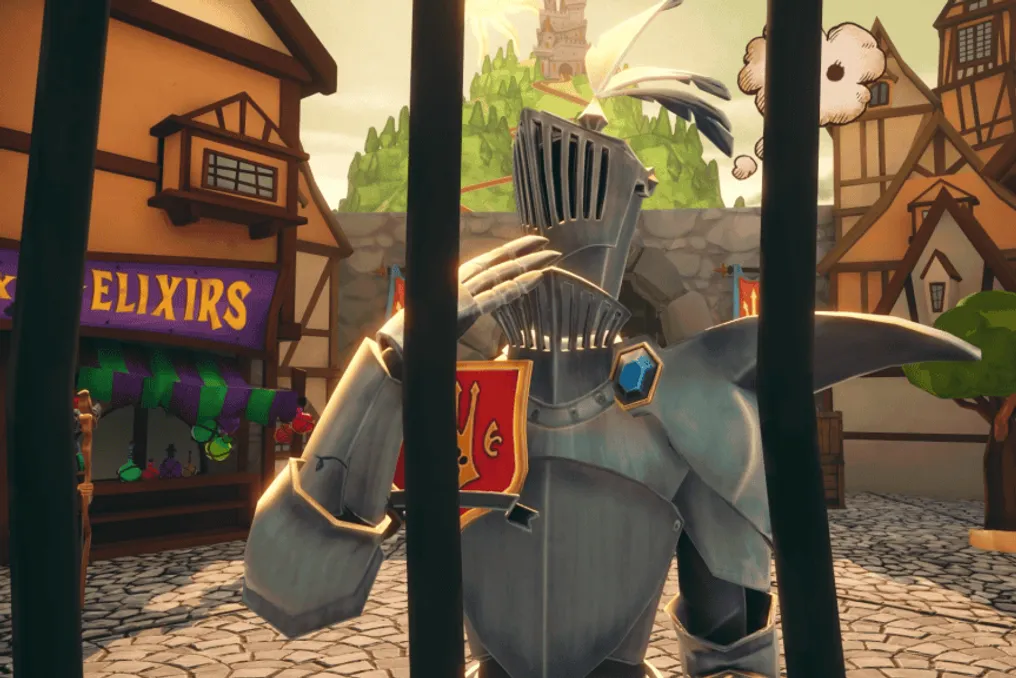
The narrative experience in virtual reality called Fábula Rasa, created by the Brazilian studio Árvore, proposes to players convincing the residents of a village that they do not deserve to die. This title was recognized with the best XR award at SXSW 2026.
The game's premise places the player in a cell, accused of a crime and awaiting their verdict. For about thirty minutes, the objective is to dialogue with the inhabitants and persuade them to spare the protagonist's life before the king's decision.
The differentiator lies in the interactions. Instead of following pre-written dialogue scripts, the characters are managed with the help of generative artificial intelligence, responding to the player based on what occurred during that session. Consequently, two playthroughs do not have to follow exactly the same path.
Ricardo Justus, co-founder of Árvore, emphasizes that the technology serves as a tool to expand developers' capabilities, not to replace them. According to him, AI enhances creators, allowing those with creativity to achieve even more remarkable feats.
Behind the dialogues, there is an architecture that unites Unity with language models. The engine is responsible for managing the environment's state, while the game information is converted into text and sent to the model. This includes what the player uttered, the items they possess, and the entire interaction history.
This way, the characters can take past events into account when determining how to react or act. There is also a director AI working behind the scenes to monitor the narrative arc. One example of this is when a character creates a potion; if it produces a specific effect, this information enters the context provided to the model and can influence subsequent interactions.
Despite the use of generative AI in dialogues, Árvore kept the entire artistic process under human control. The adoption of the technology was not just aimed at reducing costs, since each session consumes tokens to process interactions, which generates a distinct challenge for the business model.
A crucial point in development arose after most of the technology was operational. The challenge was that the experience still didn't function like a game. The solution came from outside conventional development tools: the team participated in an improvisation theater workshop and began applying concepts such as 'yes, and,' which consists of accepting the presented situation and adding something to it.
The experience also intentionally incorporated a comedic tone. This choice not only encourages the player to explore possibilities and play with the dialogues but also helps integrate any unexpected behaviors of the AI itself into the game's proposal. The final result is a structure where conversing transcends mere response selection, becoming an essential component of gameplay.
Founded in 2017 by Ricardo Justus and two other partners, Árvore began its journey primarily focused on virtual reality experiences, but expanded its activities to various forms of gaming and immersive narration. During this period, the Brazilian studio gained international recognition; Linha received a Primetime Emmy in 2020, and other projects were awarded at global festivals. In 2026, besides the highlight of Fábula Rasa at SXSW, the studio launched an RV experience based on The Boys.
Currently, AI opens a new area of experimentation. Justus particularly highlights the impact of the technology on prototyping, as processes that once took weeks can be tested in a few hours, facilitating idea experimentation and quick discarding of ineffective ones.
For companies interested in this potential, the executive advocates for a methodology more focused on experimentation than bureaucracy, summarizing: 'I don't know how to do it is just the first line of the prompt.' In Justus's view, giving teams access to the tools allows them to discover applications that would hardly arise from committee decisions alone.
This access can also impact the Brazilian gaming market. Justus sees an opportunity for Latin America given the more saturated markets in the so-called Global North. However, Brazil still faces difficulties such as lack of capital, restricted access to certain devices, and games that are not always adapted or priced for the national consumer reality.
Although the Games Legal Framework was recently approved, the executive assesses that there is still room to increase both public support and private capital participation. AI can contribute to this equation by mitigating certain technical barriers and streamlining prototype development. This does not negate the need for professionals, investment, or knowledge, but it allows smaller teams to test concepts that previously required more time and resources.
For Justus, Brazilian talent already exists; the challenge lies in converting this potential into products suitable for the domestic market and capable of competing globally. After its presentation at festivals, Árvore plans to make Fábula Rasa available to the public, with a Meta Quest version expected in 2026, without a set release date. The studio is also investigating versions that do not depend on virtual reality, as the core of Fábula Rasa is not in the headset, but in the conversation. The technology allows characters to remember, react, and improvise in response to the player's choices, thus building a game where not even its creators can precisely predict what the character will say next.