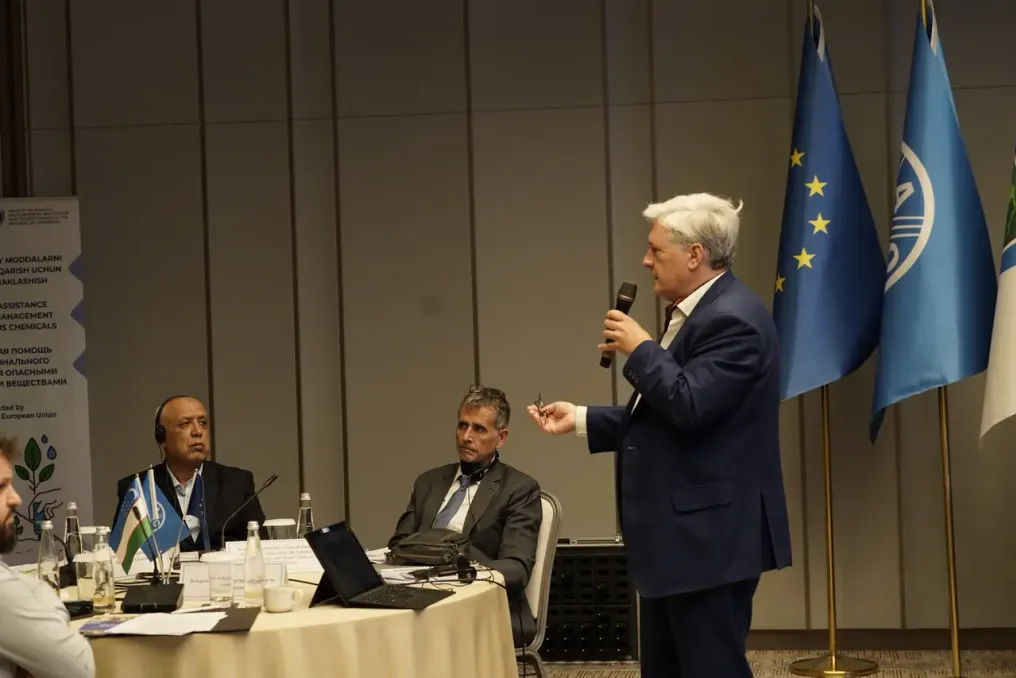
Representatives from FAO, the Waste Management and Circular Economy Development Agency, and representatives of Uzbekistan's cement industry held a meeting in Tashkent on September 23 to discuss the prospects of using cement kilns to treat certain categories of hazardous waste.
The main focus of the round table was on the co-processing technology, where some types of waste are used in cement production to replace part of the traditional fuel or raw materials. This approach is already being applied in several countries for managing specific types of waste.
According to the organizers, Uzbekistan's existing capacities for neutralizing and permanently disposing of hazardous waste remain limited, which poses potential risks to public health and the environment.
As an example, participants were presented with Azerbaijan's practice. With FAO's support, controlled tests were conducted there on using cement kilns to process pesticide waste containing persistent organic pollutants.
A potential pilot project in Uzbekistan will require preliminary work on several issues, including regulatory requirements, permitting procedures, availability of necessary infrastructure, and funding sources. Furthermore, individual cement plants may undergo technical assessments to determine their suitability for participation.
Artur Shamilov, an FAO agricultural specialist and lead technical staff member of the project, noted: 'This round table is the first step towards assessing capabilities, identifying interested cement plants, and establishing the technical, regulatory, and environmental requirements that must be met before considering any pilot operation.'
Currently, a specific list of plants for a potential pilot has not been determined, nor are the types and volumes of waste that could be treated known. Environmental monitoring of such operations remains a separate issue.
The discussion was part of the FAO project 'Technical Assistance in the Field of Proper Management of Hazardous Chemicals,' which is funded by the European Union. The project has a budget of 3.9 million euros and began implementation in 2024.
The project's goals include assessing the volumes of obsolete pesticides and contaminated lands, improving the chemical management system, and reducing the use of highly hazardous pesticides. As part of this work, eight sites in Uzbekistan containing buried obsolete or banned pesticides and chemical containers have been secured; environmental protection work has also begun at two other sites.
In parallel, the country is developing individual projects related to the management of hazardous industrial waste. In June 2025, Uzbekistan signed agreements with Vision International Investment from Saudi Arabia and Suez from France on a $78 million project. This project involves building specialized landfills, producing fuel from waste, and creating a facility for thermal waste treatment.
Co-processing in cement kilns involves feeding waste together with traditional fuel and raw materials into the kiln. Combustible components can partially replace coal or other fuels, while mineral components can be incorporated into cement clinker.
This technology is being considered, among other things, in the context of the Basel Convention on the Control of Transboundary Movements of Hazardous Wastes and Their Disposal. In a cement kiln, flame temperatures can reach about 2000 degrees Celsius, and the material processing temperature is approximately 1450 degrees.
Long exposure to high temperatures promotes the destruction of organic pollutants. However, the technology requires strict waste selection. It is not suitable for all hazardous materials and requires prior determination of their composition, controlled feeding into the kiln, and continuous emission monitoring. Specifically, levels of heavy metals, dioxins, and other toxic compounds must be monitored.
Consequently, the possible introduction of this technology in Uzbekistan will require preliminary technical and environmental assessment, development of requirements for participating plants, and creation of continuous control mechanisms.