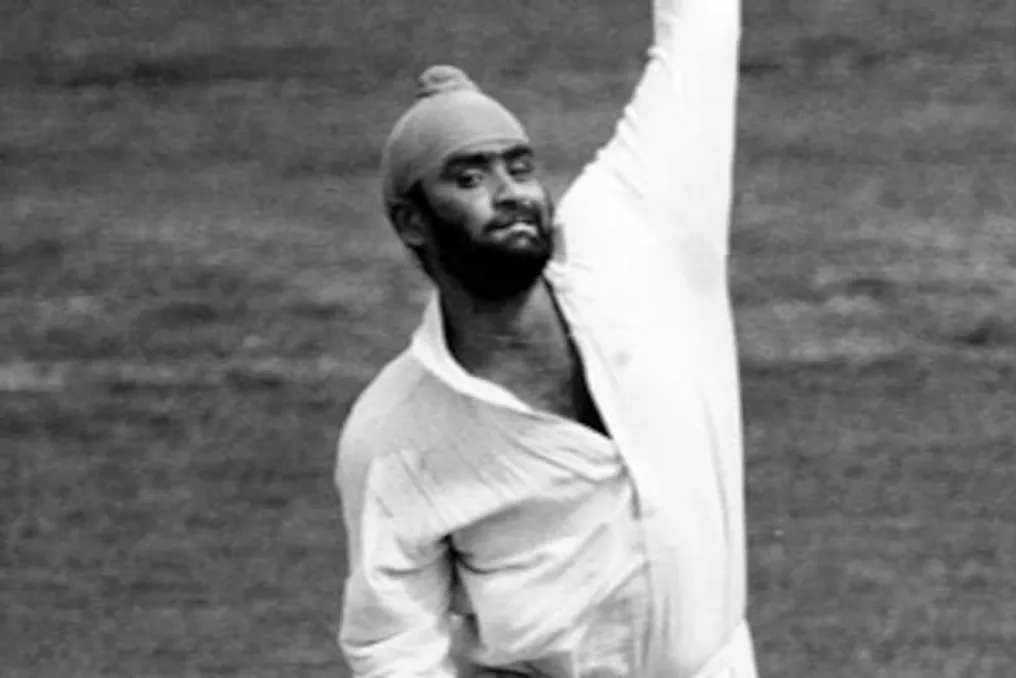
Bishan Singh Bedi's History: Achievements and Contribution to Indian Cricket
Read more
Aaj Tak
www.aajtak.in

Bishan Singh Bedi's History: Achievements and Contribution to Indian Cricket

Bishan Singh Bedi, one of the most artistic and beautiful spin bowlers in the history of Indian cricket, was born on September 25, 1946. He gained fame for his vibrant demeanor on the field, and his bowling possessed a unique charm.

As a left-arm spinner, Bedi carved out a unique niche for himself. His deliveries were a magnificent combination of control, spin, pace, and flight. He could confuse batsmen by hanging in the air with the ball before directing it in various directions using rotation.

In the 1975 World Cup match, Bishan Singh Bedi played a crucial role in India's victory in the first ODI. In his 12-over spell against East Africa, he bowled 8 clean overs and took only 1 wicket, conceding just 6 runs.

Besides playing, Bedi also took on the responsibilities of captaining the Indian team, leading the side in 22 series matches. During a match in Jamaica in 1976, when the team faced aggressive bowling from the West Indies, Bedi made an unusual decision—prematurely declaring both Indian innings closed, which was a very unexpected move for that time.

Throughout his career in 67 Tests for India, Bedi accumulated 266 wickets, including 14 instances where he took five or more wickets. In 1979, he played his last match at 'The Oval' and officially retired from international cricket. Bedi is the only player in the history of Indian cricket to have taken 1560 wickets in his first-class career. Furthermore, he became the first bowler to take 200 wickets in Test matches for the Indian team.

Bedi is also known for being one of the first captains in the world who intentionally allowed his team to lose, even when close to victory. This happened in November 1978 during the India versus Pakistan match in Sahival. At that time, India needed to score 23 runs in 14 balls, having 8 wickets remaining. When Pakistani fast bowler Sarfaraz Nawaz bowled four consecutive bouncers, and the umpire refused to call one of them a wide, Bedi withdrew his batsmen.

Overall, his international statistics were as follows: in Tests, he played 67 matches, in 118 innings, taking 266 wickets at an average of 2.14, with his best figures being 7/98. In ODIs, he participated in 10 games, 10 innings, taking 7 wickets at an average of 3.45, with his best performance being 2/44.

Bishan Singh Bedi was valued not only for his statistics but also because his bowling itself was an art form. He turned 77 years old on October 23, 2023, and passed away.


Similar stories

Akash Deep spoke about his journey from giving up ball games to becoming a fast bowler
Read more
www.aajtak.in

Akash Deep spoke about his journey from giving up ball games to becoming a fast bowler

The fast bowler for the Indian national team, Akash Deep, shared his little-known story during the 'Play, Jump, Become a Gentleman' session at the Panchayat AajTak venue in Patna. He recounted that in his village in Bihar during childhood, there was no money to buy equipment for ball games, so he gave up playing ball games and started practicing bowling.

Deep also told about the tragic loss of his father and elder brother over several months, which forced him to leave home. He noted that in his native village, playing cricket was considered something akin to a crime because at that time, none of the players from Bihar could secure a future through sports. His father was a teacher, and since the family belonged to the middle class, all parents wished for their children's futures to be secured through education. Furthermore, there was no cricket field in the village.

At the age of 20-21, his father and elder brother passed away. This period hardened his character and gave him the determination to go to Delhi, where his sister and uncle, who served in the army, lived. There, he first saw the game of cricket with a leather ball, as they only played with a soft ball in the village. Due to the high cost of ball game equipment, he chose bowling because a bowler did not need to buy his own equipment.

After this, he went to Calcutta, trained diligently, and was able to transition from club cricket to professional cricket the following year. In 2023, he was selected for the team. The news of his inclusion in the Test squad reached him via a message from Rahul Dravid, which he initially missed because the number was not saved. His debut took place in Ranchi, where his mother and family were present. He named Sachin Tendulkar his idol and highly praised the policy of the Bihar government regarding sports, noting that the sports budget increased from thirty to six hundred and fifty million. He himself also manages a sports academy.

After advice from Yuvraj Singh, Abhishek Sharma made a historic feat in T20I against Afghanistan
Read more
www.aajtak.in

After advice from Yuvraj Singh, Abhishek Sharma made a historic feat in T20I against Afghanistan

Abhishek Sharma created a real storm with the bat in the third and final T20 match against Afghanistan, changing sports history. For this historic innings, he received special advice from his mentor, Yuvraj Singh, just one day before the match.

Yuvraj advised Abhishek not to try to force every delivery. He recommended taking singles or doubles for player rotation if the ball did not come into his hitting zone.

Abhishek shared that he received a message that he should not force himself to play every ball, especially if the ball was outside his comfort zone, and instead take one or two singles.

Following this, Abhishek demonstrated a performance in Delhi that will be remembered for a long time. He scored a hundred runs in just 30 balls. This became the fastest century in T20I among a full squad player, and also broke Rohit Sharma's record for the fastest century in T20I for India.

Abhishek played a powerful innings of 108 runs, which helped India score 221/7 in 20 overs. In response, the Afghanistan team was dismissed for only 94 runs. India won the match by a margin of 127 runs. Nitish Kumar Reddy and Ravi Bishnoi took three wickets each.

The series turned out to be magnificent for Abhishek. In three matches, he scored 82, 39, and 108 runs respectively, totaling 229 runs. In all three games, he provided India with a quick start.

Before the series against Afghanistan, Abhishek had faced difficulties scoring runs during his visit to Zimbabwe. The team also had questions regarding the batting order. However, he managed to return to the game brilliantly. This was his third century in T20I for India and his second century scored in less than 40 balls.

Triple Series in ODI: The Rise and Fall of a Golden Era
Read more
www.aajtak.in

Triple Series in ODI: The Rise and Fall of a Golden Era

At one time, the ODI (One Day International) itself was synonymous with a major event. Although the World Cup is held every four years, between these tournaments, there were other significant competitions for fans, among which triple series held a special place. These tournaments involved a competition between three teams with a league stage, a leaderboard, a fight for the final, and constantly changing dynamics in every match.

The popularity of these series was so great that the excitement was not limited to the action on the field. Spectators watched which teams would reach the final, how many wins each team would need, and under what conditions the pace of the game would be decisive.

In modern realities, where Test cricket has gained the goal of a Test World Cup, and T20 cricket has captured a huge market thanks to franchise leagues, ODI is trying to find its place between them. At such a time, memories of old triple series are particularly interesting, as 50-over cricket did not need external stimuli then.

Kerry Packer is often mentioned in the history of triple series. A dispute arose between media magnate Packer and Cricket Australia regarding television rights. Following this, Packer launched World Series Cricket. To make this league successful, Packer needed the best cricketers in the world. At that time, the West Indies were the strongest team, and Packer's team attracted many of their star players.

After this, triple series were held between Australia, the West Indies, and World XI. Matches concluded in a single day. Bright uniforms and white balls were used, and the television coverage was much more modern than before. The quality of the cricket was also outstanding. The West Indies participated in four of the first six Australian seasons and were champions every time. Even after Packer and the Australian board reached an agreement, this format continued to be held within Australia's domestic cricket calendar.

When this model, popular in Australia, reached South Asia, its influence grew. In 1983, the then Chairman of the Indian Cricket Control Board (BCCI), N.K.P. Salve, began working on organizing the World Cup in India. He was joined by Nur Khan from Pakistan and Gamini Dissanayake from Sri Lanka. During this process, the Asian Cricket Council (ACC) was founded on September 19, 1983. Then, in 1984, India, Pakistan, and Sri Lanka held the first Asian Cup in Sharjah. This event marked the beginning of multinational cricket in Asia. Gradually, Sharjah transformed into not only a venue for the Asian Cup but also a major center for ODI cricket.

In the 1990s, the influence of English cricket began to spread to the Indian subcontinent, and Sharjah became the focal point of these changes. Major players from India, Pakistan, and other countries regularly played here. Celebrities attended the matches, and the popularity of the games on television steadily increased. Long before the era of franchise cricket, Sharjah turned cricket into a large-scale spectacle. By the end of 1992, 29 ODI tournaments involving three or four countries had been held. Of these, 15 took place in Australia, and nine in Sharjah. Thus, the history of triple series in ODI is mainly linked to two locations: Australia and Sharjah.

In the 1990s, international cricket from South Africa returned, and Sri Lanka also quickly became one of the strong global teams. In 1996, Sri Lanka became the World Champion. The number of strong ODI teams in international cricket increased. This directly benefited the triple series. From 1996 to 2008, full member teams held three-nation ODI tournaments in Singapore, Morocco, Netherlands, Malaysia, Ireland, Scotland, and Canada. The four-year interval between World Cups and the limited popularity of the World Cup also made these tournaments important. It was the main way to watch ODI cricket between strong teams throughout the year.

These tournaments saw not only trophies won but also events that influenced rules, tactics, and thinking in cricket. In 1979, in Sydney, the England team had to save three runs on the last ball. Captain Mike Brearley positioned almost all his fielders near the boundary. A year later, New Zealand needed to score seven runs off one ball. Greg Chappell from Australia asked his brother Trevor to throw the ball underhand. This incident caused a big controversy in cricket. In 1982-83, Lance Cairns hit six sixes at the MCG (Melbourne Cricket Ground) using a specially prepared bat. In the 1980s, Javed Miandad took advantage of the conditions at the WACA Ground in Perth and scored an unbeaten 59 against the West Indies, including 45 singles and no fours or sixes. In 1986, Gus Logie from the West Indies was named 'Player of the Match' for his fielding performance in Sharjah. This in itself was an exceptional event.

Popular