Since Galileo Galilei pointed his telescope to the sky, astronomy has undergone significant changes, opening a window to the Universe for humanity. Since then, telescopes have become increasingly sophisticated and precise, allowing the discovery of ever more distant worlds. Now, humanity is facing the emergence of a new generation of giants.
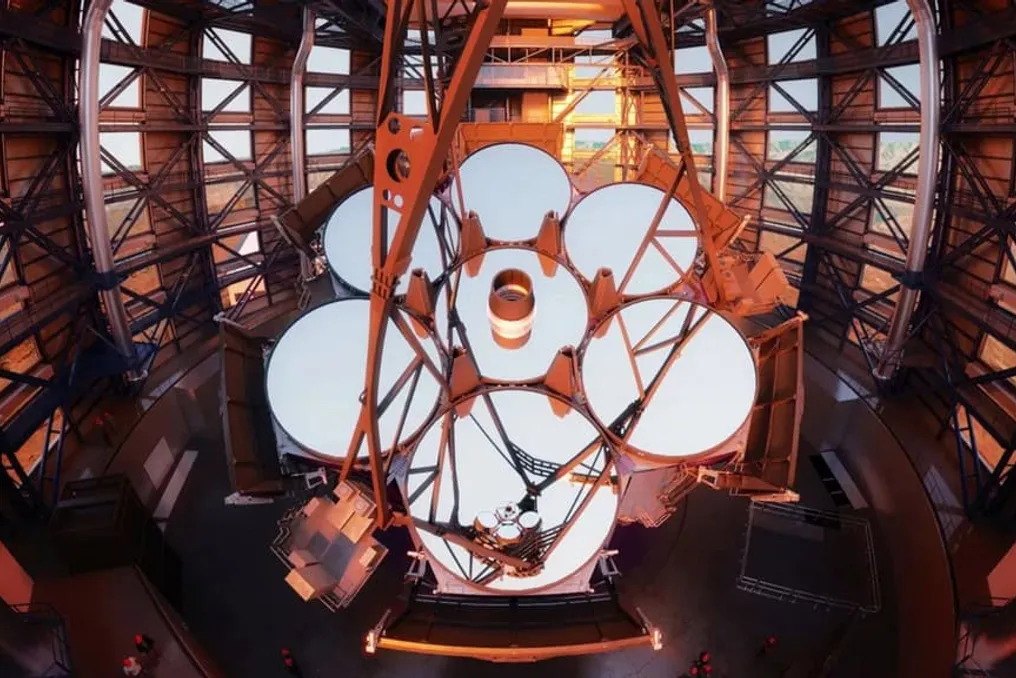
As part of the Olhar Espacial program, which airs on Friday (the 25th), the Giant Magellan Telescope (GMT) is presented, which is under construction in the Atacama Desert, Chile. This telescope will consist of seven primary mirrors, each with a diameter of 8.4 meters, providing a collecting area equivalent to a single mirror with a diameter of 25.4 meters.
Thanks to these large sizes, the GMT will significantly expand the capabilities for observing space and allow the investigation of fundamental questions in astronomy. It is expected to be 200 times more powerful than the best existing telescopes, providing an unprecedented level of detail when studying the Universe.
The international consortium for the project includes Brazilian participation, led by the São Paulo State Research Foundation (FAPESP). Through the GMT Brasil initiative, Brazilian researchers and institutions are working on developing systems and instruments for the telescope, covering areas such as engineering, optics, mechanics, electronics, and software, while also creating opportunities for national industry in high-complexity projects.
To discuss the GMT, its goals, the difficulties of building such a massive telescope, and its significance for science, Eduardo Cipriano, coordinator for scientific popularization of GMT Brasil, is invited to the program.
Eduardo Cipriano is a researcher and associate professor in the Department of Astronomy at the Institute of Astronomy, Geophysics, and Atmospheric Sciences of the University of São Paulo (IAG-USP). He holds a bachelor's degree in physics from the USP Institute of Physics (IF-USP), as well as master's and doctoral degrees in astronomy from IAG-USP. He completed a postdoctoral fellowship at University College London (UCL) and worked as a resident astronomer at the Southern Astrophysical Research Telescope (SOAR). His extensive experience in galactic astrophysics focuses on galaxy clusters, gravitational lensing, and observational cosmology.
The program, presented by Marcelo Zurita, president of the Paraíba Astronomy Association – APA, a member of the Brazilian Astronomical Society (SAB), technical director of the Brazilian Meteor Observation Network (Bramon), and national coordinator of Asteroid Day Brasil, airs live every Friday at 9:00 PM (Brasília time) on the official channels of the publication on YouTube, Facebook, Instagram, X (formerly Twitter), LinkedIn, and TikTok.