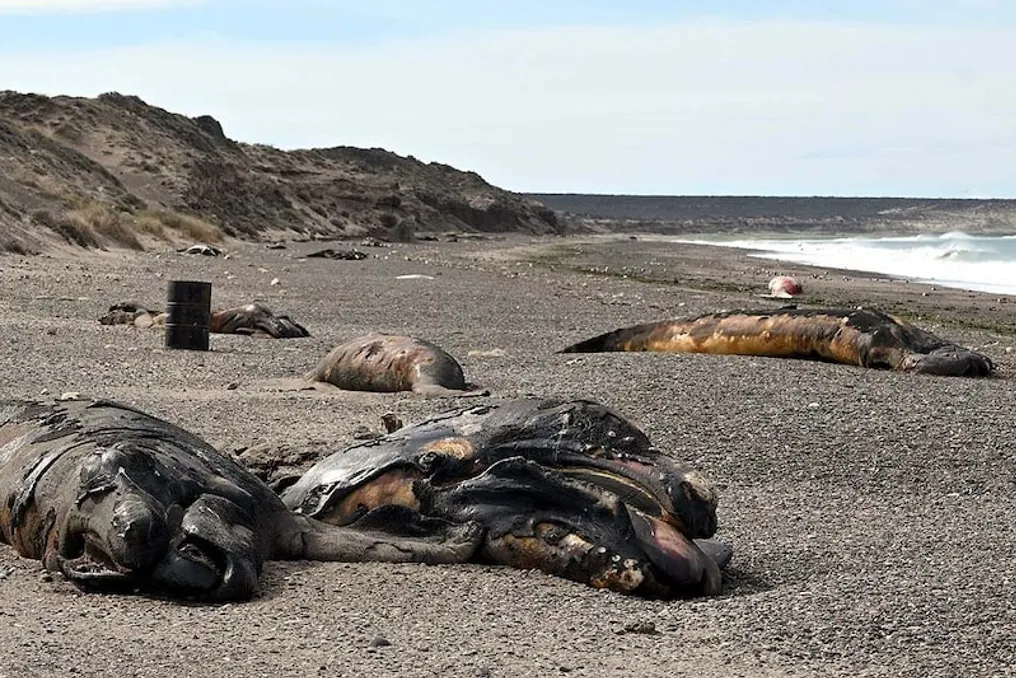
In the southern part of Argentina, Patagonia, a significant number of deaths among young Southern Right Whales have been observed. Since June, the corpses of these whales have been regularly found on the coast of the Chubut province. Scientists hypothesize that a bacterial infection may be the cause of these deaths, although final confirmation has not been obtained, and the investigation is ongoing.
This year, approximately 1375 Southern Right Whales were registered in the region, about 400 of which were calves. According to scientists, the mortality rate among young whales is elevated this season. The Chubut government is cooperating with scientific and research groups to determine the causes of these deaths. Preliminary studies point to common marine bacteria as a possible cause.
The appearance of dead young whales on the coast of Chubut has continued since June. Dead Southern Right Whale calves were also found this week. Local scientists are keeping track of all these cases and, where possible, taking samples from the deceased whales for analysis.
According to researcher Mariano Coscarella from the Marine Mammal Laboratory, the mortality rate among young whales is particularly high this season. Scientists suspect a disease called Erispiles, which is a serious bacterial ailment caused by bacteria that can be found in the bodies of marine animals and in the environment.
According to information from the Chubut government, initial data links the possible cause to a common marine bacterium. However, it has not yet been proven that this specific bacterium caused the death of all the whales. Scientists are also trying to establish how the infection could have entered the young whales' bodies and what its connection to their death is. To do this, samples from the dead whales, as well as environmental and seawater conditions, are being studied.
Currently, scientists tend to consider this situation natural, but the role of human activity has not been completely ruled out. Nevertheless, the Chubut administration reports that there is currently no information directly linking these deaths to human activity.
Scientists emphasize that understanding this phenomenon requires more than just counting the number of dead whales; it is also necessary to consider the number of births, the number of fatalities, and mortality statistics from different years.
Puerto Madryn and the adjacent Valdés Peninsula are part of a vast breeding area for Southern Right Whales. These whales can reach lengths of up to 17 meters, and their average weight is about 40 tons. In 2025, a record number of 2110 Southern Right Whales was registered in the area, about 800 of which were calves. This year, 1375 whales were counted, including about 400 calves.
An increase in the death rate of young whales has also been recorded in the Valdés Peninsula previously. In 2012, 113 dead calves were registered there, which was one of the highest mortality rates for this species. The current calf mortality rate continues to worry scientists, although further research is required for a full understanding of the situation.
In the opinion of scientists, the current cases are alarming but are not yet considered a major long-term threat to the entire Southern Right Whale population. Local authorities note that the average age of these whales is about 60 years.
Scientists are currently analyzing samples from the dead whales and the marine environment. It will only become clear after these studies are completed how responsible the bacterial infection is for the death of young whales and whether there is any other cause.