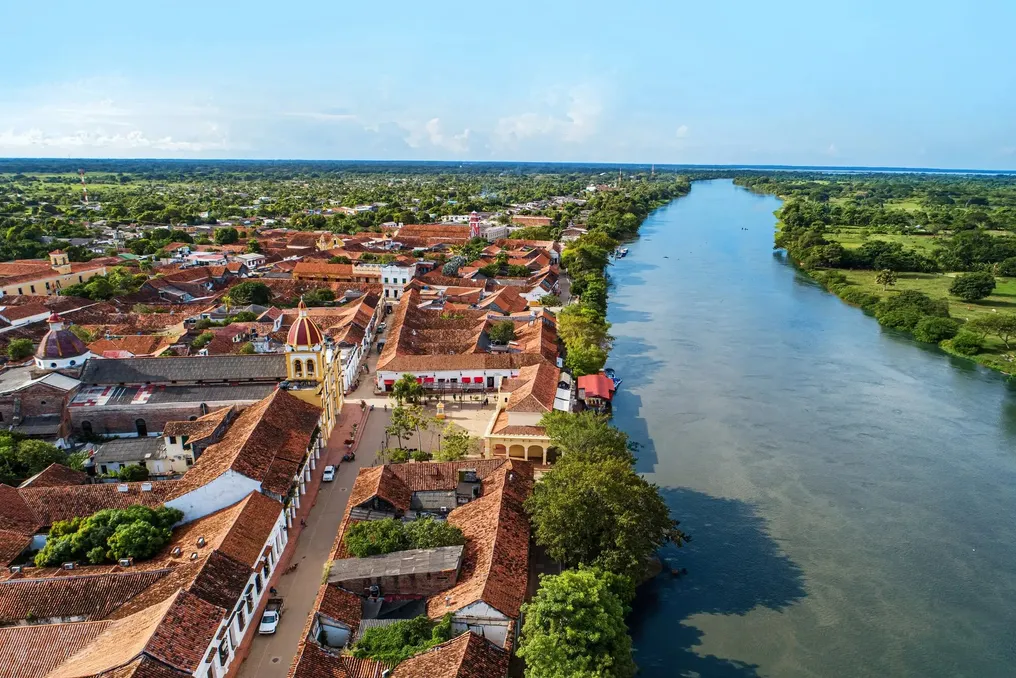
The Magdalena River runs through all of Colombia, echoing the literary trajectory of Gabriel García Márquez. In Gabo's universe, the Colombian Caribbean is a setting where the everyday merges with the extraordinary, mythology coexists with history, and the presence of the dead is constant. Through novels spanning decades and disappearing cities, Gabo captured the landscapes and memories of the river he experienced on old steamships during his student years.
Born in the Colombian Massif, in the Andes, the Magdalena extends for over 1,500 kilometers until it discharges into the Caribbean. For centuries, it functioned as one of the main circulation arteries of Colombia, connecting the interior to the coast. Products such as coffee, tobacco, metals, mail, soldiers, and passengers traveled on its waters before roads developed in the 20th century restructured national traffic flow. With the growth of land transport, ports lost relevance, and several localities became isolated.
In 2025, the Magdalena resumed receiving passengers on river cruises. The report describes boarding the AmaMelodia, operated by AmaWaterways, for a seven-night trip between Barranquilla and Cartagena, providing an immersion into a stretch of Colombia reminiscent of Gabo's works.
Unlike large maritime ships, which offer extensive programming and multiple restaurants, the proposal on the Magdalena is to promote deceleration, observing local life while the AmaMelodia sails in harmony with the colors of the landscape. Although comfort is maintained on board, the river remains present, entering through the cabin windows, accompanying meals, and being visible on deck, creating an intimate experience.
The calm waters serve as a portal to colonial settings that seem frozen in time. Although Macondo was fiction, the author could witness elements of magical realism at various moments. The trip began in Barranquilla, the region's largest city, where Gabo studied and married, and also where Shakira was born. The encounter with the AmaMelodia took place at the river mouth, called 'Bocas de Ceniza,' where the dark water of sediments mixes with the blue tone of the sea.
The ship has three levels, 32 cabins, and accommodates up to 64 passengers per trip. Internally, the AmaMelodia reflects a Colombian style, despite its hull originating from Vietnam, displaying vibrant fabrics and decorations by local artists. The internal layout is functional, with easy access to areas such as the lounge, bar, restaurant, gym, and massage rooms. A highlight was the upper deck, equipped with sun loungers, parasols, and a small pool, ideal for cooling down from the intense heat.
The traveler's cabin, approximately 22 square meters, exceeded expectations for space on a riverboat. However, the greatest pleasure lay outside; large glass doors provided access to a balcony, allowing the Magdalena to seem like it was invading private space. From the bed, one could watch the river, and every morning was dedicated to observing the unique, ever-changing landscape.
The AmaMelodia was specifically designed for navigation on the Magdalena. On the first night, the traveler discovered that the greatest luxury on board was simply the ability to observe. On top of a hill stood the Church of Santo Domingo de Guzmán, in shades of blue and white, with the city spreading out below in varied colors. Graffiti art adorned facades, murals, staircases, and roofs. This is how Usiacurí welcomed the AmaMelodia at its first stop.
During the tour of Usiacurí's streets, there was an encounter with children from a school dancing next to the ship. While some followed the choreography with great focus, others showed distraction, running to rejoin the group upon realizing they had lost their steps. Usiacurí's cultural and economic identity is based on the artisanal weaving of iraca palm. Before becoming an accessory, bag, hat, lamp, plate rest, fruit bowl, or basket, the vegetable fiber undergoes treatment, dyeing, washing, and drying processes. The time spent with the artisans revealed their skill in weaving, and the manually applied dyes enchanted with the vigor of the colors obtained. The traveler participated in the process, braiding a small ring to keep as a souvenir.
The city houses the residence of the poet Julio Flórez, who died in 1923. Considered one of the greatest exponents of Romanticism in Colombia, his poems possessed a melody such that many were adapted into popular songs. This house has been transformed into a museum, preserving books, furniture, and personal belongings.
Upon returning to the AmaMelodia, the understanding of the climate became evident, as the heat significantly influenced the pace of the trip. Some excursions started before seven in the morning, and itineraries avoided long walks. At different times, the boat was replaced by colorful tuk-tuks, known as 'paolas,' or smaller vessels.
On free mornings, the morning ritual consisted of a stretching session on deck while the temperature was still mild. This moment of bodily awakening was complemented by the view of water, vegetation, various birds, and small canoes. This activity became a small personal habit.
It was during the navigation that it was understood that the Magdalena transcended the function of a mere route between tourist spots; it was the journey itself. The philosophical saying 'what matters is not the destination, but the journey' gained full meaning. One afternoon on deck, a cloud of brown dust appeared, followed by a herd of cattle following in a line along the bank. There were dozens of animals, accompanied by cowboys with wide hats, cracking whips in the air.
Further on, a group of four or five trees displayed large white flowers. As the boat approached, what seemed to be flora began to move and take flight: they were egrets, but in the traveler's memory, this evoked magical realism. The birds gathered in the branches, almost hiding the trees.
In the narrower sections of the canals, the proximity to the land was so great that one could feel the vibration of the settlements. Music could be heard coming from residences, children could be seen flying kites and dogs running towards the water, barking at the boat. Under the trees, families sought shelter from the sun, and the traveler witnessed a woman preparing lunch at home.
On certain occasions, the AmaMelodia was left to follow in smaller boats. Upon entering the canals, the noise of the speedboat diminished, intensifying the feeling of closeness. It was on one of these outings that fishermen were found, protected by large straw hats, operating four canoes of distinct colors. Some smoked, and robust hands skillfully managed the net, adjusting the weights and casting luck onto the river. The net opened into an almost perfect circle before falling into the water, returning minutes later with fish. The fishermen noticed the curiosity of the passengers, and some smiled shyly as the cycle of the nets resumed.
Further ahead, on the horizon, black and shiny dots appeared on the water: a herd of buffalo crossed the river in a line, displaying enormous horns and part of their bodies submerged. The sun reflected on the wet fur, creating silvery glints. The giants passed close to the boat and proceeded noisily to the opposite bank.
The guides identified birds that the traveler struggled to locate, including the blue-winged duck, egrets, thirty-crowns, and other aquatic and raptor species, such as the golden eagle. Among the branches, families of red howler monkeys were seen moving with remarkable agility. Despite the lush landscape, the Magdalena faces challenges such as sedimentation, deforestation, irregular occupation of the banks, and water pollution, issues inherent to the reality of the river and its riverside inhabitants.
At the end of this journey, new colors emerged: on the facades of the houses, in the churches, and later, in the skirts of women dancing in Mompox, the next stop. During the colonial period in Colombia, Mompox was a vital center for connecting the coast to the Andes. Founded in the 16th century on a river island, the city prospered due to its strategic location between Cartagena and the interior of the then New Granada. Its banks were bustling with large vessels, and the streets buzzed with the trade of tobacco, precious metals, and the smuggling of enslaved people. With the change in river routes, the city lost part of its original commercial function but retained churches, mansions, and goldsmith workshops, its relative isolation being a factor in urban preservation. In 1995, Mompox was declared a World Heritage Site by UNESCO.
The AmaMelodia remained anchored in Mompox for two days, allowing exploration of the city at different times of the day. At 12 PM, the thermal sensation exceeded 45°C, leading to the emptying of the streets and the need to plan any movement based on proximity to shaded areas, as fans seemed to operate beyond their capacity. In the late afternoon, the city came alive again, with doors opening, chairs being placed in front of houses, and colorful fans swaying intensely.
Albarrada, the waterfront promenade with a stone wall, passes by important Catholic churches in Mompox, such as Santa Bárbara, San Francisco, and Immaculate Conception. Participants took part in a filigree workshop, an artisanal goldsmithing technique where metal is stretched to form very fine wires, followed by twisting, flattening, curving, and soldering. Observing a finished piece reveals the amount of work hours dedicated. The local tradition of goldsmithing has deep roots; before the arrival of the Spanish, indigenous peoples of the region, such as the Zenú, already mastered advanced methods of working with metals, such as lost-wax casting, an ancestral metallurgical process that creates detailed pieces from a wax mold.
The heat persisted even at night. During Mompox Midnight, the streets were filled with families, with children running among adults and food stalls, enjoying ice cream and participating in games like target shooting. Suddenly, drums began to play. Women appeared dressed in voluminous skirts and holding candles, while men approached, bowing, bending, and retreating. They spun, exposing their skirts to the air, while sweat dripped. The traveler ended up participating in the dance.
Colombian flavors were presented in various ways during the AmaMelodia's meals, including dishes with shrimp, coconut, plantain, ceviche, fish, and tropical fruits, in addition to international options. Unexpected details marked the experience, such as the ice creams served on board, which the traveler constantly repeated. A waiter taught an unusual combination: chocolate ice cream with salt and freshly ground black pepper, a flavor that was kept after the trip.
At dusk, the bar became the meeting point for Sip & Sail, the ship's happy hour. Passengers gathered to socialize, drink, play cards, or board games. At this time, the staff also announced the next day's schedule, detailing times, tours, and practical information about the excursions.