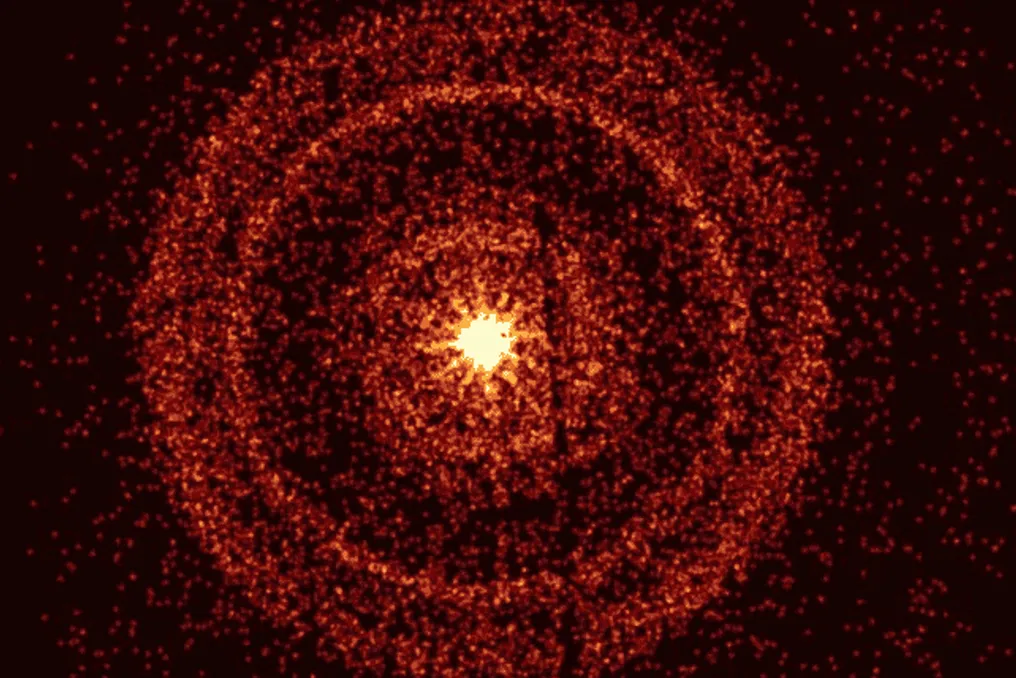
Researchers have recorded a photon with such high energy that, according to known laws of physics, it should not have reached Earth. This particle traveled about two billion light-years in space, challenging predictions regarding the propagation of high-energy photons.
This discovery is linked to GRB 221009A, the brightest gamma-ray burst ever observed. This phenomenon was registered in October 2022 and is the result of an extremely powerful explosion associated with the collapse or collision of stars.
The photon was identified using the Carpet cosmic ray detector installed at the Baksan Observatory in Russia. The particle possessed an energy of 300 teraelectronvolts (TeV), which is approximately one hundred trillion times greater than the energy of visible light.
The problem is that space is not absolutely empty; it is saturated with the relic microwave background radiation known as the CMB, which represents the residual glow of the Big Bang. When extremely energetic photons interact with this radiation, they can transform into other particles, meaning the photon with the observed energy should have had small chances of surviving such a long journey.
Some quantum gravity models suggest that the rules concerning Lorentz invariance may change at extreme energy levels. Under such conditions, the Universe could become more transparent to ultra-high-energy photons, which can be compared to the existence of a kind of 'fast lane' for these particles.
Additional Explanation of GRB 221009A Characteristics
This hypothesis could also potentially explain another feature noted in GRB 221009A. The 300 TeV photon reached Earth approximately an hour after lower-energy photons. According to the article, another study already indicated that such a delay might be related to a possible violation of Lorentz invariance.
For researchers, the most significant aspect is the combination of these two concepts, which were previously developed independently. Astrophysicist Marco Roncadelli from INFN stated: 'The most interesting aspect of our work is that we are combining two ideas that have been developed separately until now.'
If future observations confirm this scenario, the Universe could function as a natural laboratory for studying quantum gravity at energies far exceeding the capabilities of any terrestrial accelerator. However, for now, the explanation remains only a theoretical model based on the observation of a single photon, and new similar events will be required to confirm this theory.