Tulsi is used for more than worship: 6 ways to use it at home, including skincare
Read more
Aaj Tak
www.aajtak.in

Tulsi is used for more than worship: 6 ways to use it at home, including skincare

In Indian homes, the Tulsi plant is often grown because people use it for morning worship rituals. However, Tulsi is not just a plant, and its significance extends beyond purely religious and medicinal uses. It also possesses many beneficial properties for everyday household tasks.

Although Tulsi holds a special place in Ayurveda, there are various ways to use this plant at home. Proper application of Tulsi can assist in cooking, house cleaning, skincare, and insect repellent.

Uses of Tulsi at Home

To eliminate unpleasant odors in the house, instead of expensive chemical air fresheners, Tulsi can be used. To do this, take a bowl of water, add a few Tulsi leaves and lemon juice, then bring it to a boil. After cooling, this water can be poured into a spray bottle and sprayed around the corners of the house to ensure lasting freshness.

You can also make Tulsi tea. Instead of traditional additions like ginger and cardamom, you can brew pure green Tulsi leaves in tea; this significantly improves the taste of the drink.

Insect and Mosquito Repellent

The aroma of Tulsi is disliked by mosquitoes and small insects, so it can be used to protect the home. Placing the plant near windows and doors helps repel pests. Furthermore, wiping the floor with a solution made from crushed Tulsi leaves in water effectively eliminates insects and ants.

In skincare, Tulsi is valued for its antibacterial properties, which help reduce skin problems. To create a face mask, crush Tulsi leaves, mix them with a small amount of rose water and gram flour (besan). This mixture helps reduce pimples and spots on the face. Tulsi can also be used to prepare homemade facial oil.

If dishes have a persistent odor or grease, Tulsi can help clean them. By boiling Tulsi leaves, you can wash dishes with the resulting infusion, which will eliminate unpleasant smells and make the dishes bacteria-free.

To protect clothes in the wardrobe, especially during the rainy season when dampness smells occur or there is a risk of insects, dry Tulsi leaves can be used. They should be wrapped in a thin cotton cloth and placed in the wardrobe or between items to keep clothes protected from mold and pests.

Similar stories

Cheap Home Remedies to Solve Common Houseplant Problems
Read more
www.aajtak.in

Cheap Home Remedies to Solve Common Houseplant Problems

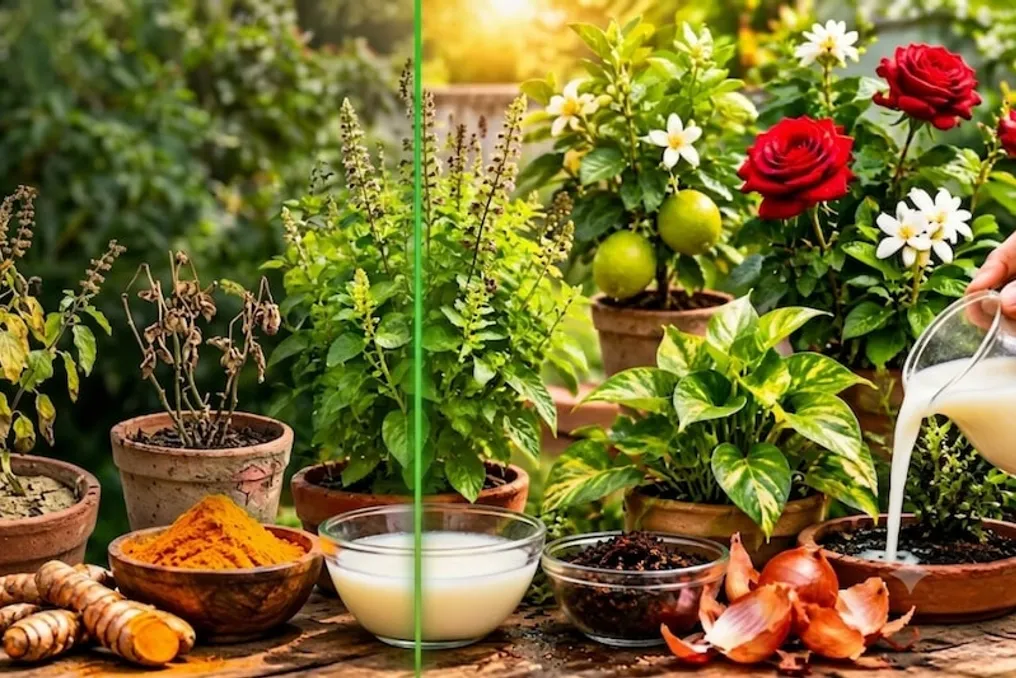
Caring for plants indoors may seem like a simple task, but maintaining their constant greenery and abundant flowering can be a difficult challenge. Although some people hire gardeners to care for their plants, many prefer to do it themselves. Various problems can arise: basil leaves turn yellow, lemon flowers drop immediately after blooming, and mogora and roses produce many leaves but do not form buds. Additionally, the growth of monstera may slow down, and new leaves become smaller compared to previous ones.

If you regularly spend money on expensive fertilizers, growth stimulants, or other gardening products to fix these minor issues, it is not necessary. Many items you have at home in the kitchen can be useful for plant care. However, it is crucial to use them correctly and in the right proportions. If your plants are growing poorly or having trouble flowering, you can try applying some simple homemade care methods that will not require financial expenditure.

How to help if basil leaves are turning yellow?

If your basil starts turning yellow instead of staying green, do not panic. First, check if there is an excessive flower stalk on the plant. If so, you need to remove dry or weak leaves. You also need to regularly prune the flower stalks so that the plant's energy is directed towards developing new leaves. There is also a folk method—adding a small amount of turmeric to the soil. Nevertheless, turmeric is not a guaranteed cure for basil problems; sufficient light, proper watering, and preventing waterlogging are necessary for good growth.

What to do if lemon flowers drop immediately after blooming?

Lemon flowering is a positive sign, but if the flowers fall to the ground immediately after opening, it can hinder fruit production. In this situation, it is important to maintain a balance of moisture and nutrition in the plant's soil. To solve this problem, it is recommended to use a method where diluted sour buttermilk (chaach) is watered at the base of the plant. When using this method, the buttermilk should be thoroughly diluted and not used too often or in large quantities. The lemon tree also requires a lot of sunlight and well-drained soil.

How to revive small and wilted monstera leaves?

If the monstera leaves look smaller and paler than before, the cause may be insufficient light, improper watering regime, or lack of space in the pot for growing roots. Some advise spraying the leaves with a solution of one glass of water and 1-2 drops of unpasteurized milk. However, leaving milk on the leaves in large amounts is undesirable, as it can cause stickiness, unpleasant odor, or fungal diseases. Therefore, it is more important to provide the plant with good light, protecting it from intense direct sun, and maintaining the correct watering schedule.

How to stimulate flowering in mogora and roses?

If you have mogora and rose plants, but they only produce leaves for a long time without flowering, you should pay attention to lighting conditions, fertilization, and pruning. Within home gardening, you can use the method of adding dried and sifted tea dregs to the soil in small amounts, as well as watering with water prepared from onion peels. The tea dregs should be used without adding milk or sugar, while avoiding excessive application to the soil. Water from onion peels must also be freshly prepared and diluted, using it in limited volume. It is important to understand that homemade fertilizers alone do not guarantee flowering; the plant also needs good light and adequate nutrition.

Important reminder before using any plant treatments

It is important to remember that the effect of any home remedy may differ for different plants. Often, the real reasons for yellowing leaves, flower drop, or slowed growth lie in overwatering, poor drainage, lack of light, pests, or nutrient deficiencies in the soil. Therefore, before applying anything to the roots or leaves, use the remedy in small doses and carefully observe the plant's reaction.

Rajasthani Curry Recipe: Making Lentil Phakoda Without Frying and Chickpea Flour
Read more
www.aajtak.in

Rajasthani Curry Recipe: Making Lentil Phakoda Without Frying and Chickpea Flour

Although many have tried various types of curry phakoda, few are familiar with Rajasthani curry made from lentils. This recipe does not require deep frying; instead, the lentil phakoda is cooked directly in the boiling curry. We will present a simple way to prepare Rajasthani lentil curry phakoda.

Curry is an important part of Indian cuisine and is prepared differently in various regions. Usually, phakoda for curry is made from chickpea flour, but in Rajasthan, a different approach is used—phakoda is made from lentils. The main feature is that these phakodas are not fried separately but are boiled directly in the simmering curry. Because of this, the phakodas absorb the tangy flavor of the curry and the aromas of the spices excellently, becoming very soft.

This Rajasthani dish is served with curry rice, flatbreads, or hot puris. Although some preliminary preparation is required for its making, its taste is sure to please.

For the Phakoda

Ingredients needed for the phakoda:

  • 1 cup of washed lentils
  • ½ teaspoon of salt
  • ¼ teaspoon of hing (asafoetida)
  • Water as needed

For the Curry

Ingredients for the curry:

  • 1 cup of yogurt
  • 4 cups of water
  • 2 tablespoons of ghee
  • ¼ teaspoon of fennel seeds
  • 10–15 black peppercorns
  • 3 cloves
  • 1 stick of cinnamon
  • ½ teaspoon of sesame seeds
  • ½ teaspoon of cumin seeds
  • 2 curry leaves
  • 10–12 curry leaves
  • 2 green chilies
  • 2 medium onions
  • ¼ teaspoon of turmeric powder
  • ¼ teaspoon of hing
  • 1 teaspoon of Kashmiri red chili powder
  • ½ cup of water
  • Salt to taste

For the Tempering (Tadka)

Ingredients for the tempering:

  • 2 tablespoons of ghee
  • 3–4 cloves of garlic
  • A little ginger
  • 3 dried red chilies
  • ½ teaspoon of red chili powder
  • A little fresh coriander

First, the lentils should be thoroughly washed with clean water 4-5 times. Then, soak the lentils in water for about 2 hours; if you want to speed up the process, you can use slightly warm water. After the lentils have swelled well, drain the water and place them in a blender. When blending, do not add too much water at once; first, add 1 tablespoon of water and gradually add a little more as needed. The lentils should become thick and smooth. It may take 4 to 5 tablespoons of water to blend, but this depends on the lentils themselves.

Transfer the blended lentils to a bowl, add ½ teaspoon of salt and ¼ teaspoon of hing. Then, knead this mixture thoroughly for 3-4 minutes to make the dough lighter and airier. To check the readiness of the dough, take a small amount of the mixture in water; if the dough starts floating on the water surface, it means it has been kneaded well.

To make the curry, mix 1 cup of yogurt and 4 cups of water in a bowl, whisking them thoroughly. Ready-made buttermilk (chaach) can also be used.

Heat 2 tablespoons of ghee in a pot. Add fennel seeds, black pepper, cloves, cinnamon, sesame seeds, cumin seeds, and curry leaves. Then add the curry leaves and finely chopped green chilies. Next, add the chopped onion and sauté it lightly without browning it too much. Add turmeric, hing, and Kashmiri red chili powder, and mix. Pour in ½ cup of water and let the spices cook well.

When the spices are fully cooked and the oil starts separating, pour in the prepared yogurt mixture. Stir constantly while adding, as it must be stirred continuously until the curry boils, otherwise, the yogurt may curdle. Salt should not be added at this stage.

After the curry boils well, reduce the heat but continue to simmer the curry. Now, form small phakodas from the lentil dough by slightly moistening your hands, and drop them directly into the boiling curry. A spoon can also be used to add the phakodas. Do not make the phakodas too large, as they expand after cooking. The curry should not stop boiling when adding the phakodas. Cook the phakodas in the curry for about 4-5 minutes. After this, add 1 teaspoon of salt and reduce the heat to medium-low.

Continue to cook the curry for another 15 minutes. During this time, the phakodas will be completely cooked, and the curry will thicken slightly.

To give the curry extra flavor, heat 2 tablespoons of ghee in a small pan. Sauté the sliced garlic until golden brown. Then add the finely chopped ginger and 3 dried red chilies. Finally, add ½ teaspoon of red chili powder and turn off the gas. Immediately pour this tempering over the curry. Add a little curry broth to the tempering pan and pour it into the pot. Cover the curry and let it sit for 5 minutes so that the flavor of the tempering fully penetrates the curry.

Finally, sprinkle with fresh coriander on top. If you did not use whole spices, you can add a little garam masala.

Popular