
New trio of Springboks forwards ready for tough battle against Wallabies in Perth
Read more
IOL
iol.co.za

New trio of Springboks forwards ready for tough battle against Wallabies in Perth

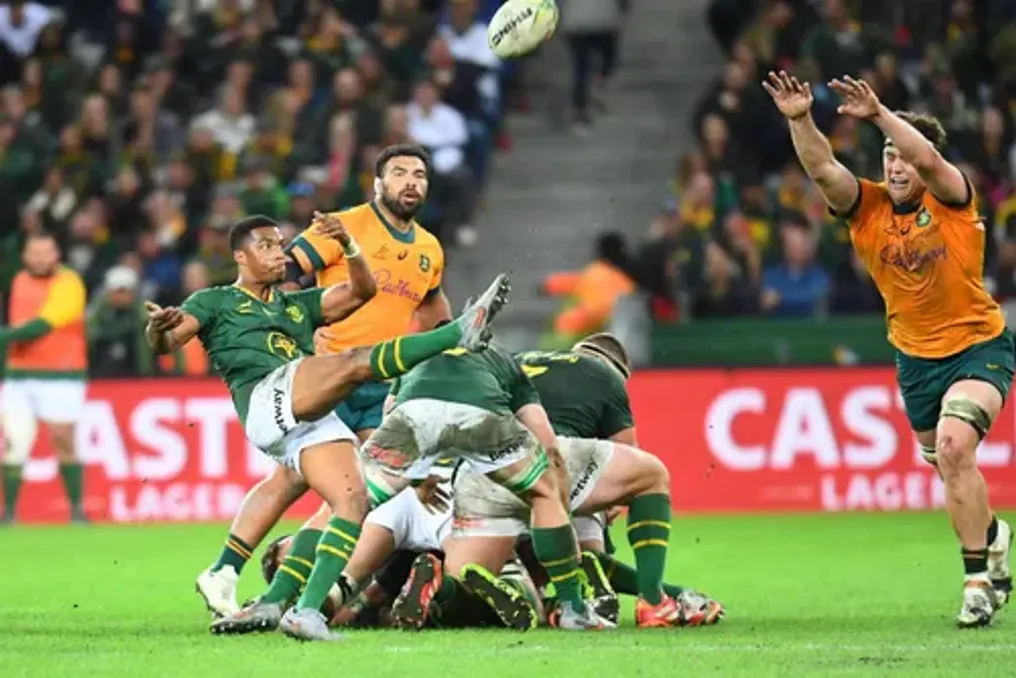
Springboks forward Marco van Staden will play in a new role at number 8 on Sunday during the match against the Wallabies in Perth. Springboks coach Rassie Erasmus believes that the new trio of forwards possesses the necessary combination of height, carrying ability, and experience in contesting the ball to counter the Wallabies in Perth on Sunday.

Erasmus explained that the Springboks do not necessarily need a traditional number 8 player, but rather a group of three forwards capable of performing various functions during out-line play, attack, defense, and ball contest.

The head coach made the decision for this duel at Optus Stadium in Perth (match starts at 11:45 AM South African time on Sunday), aiming to provide more playing time to his reserves. The Boks team made 13 changes to the starting lineup compared to the previous test match in Baltimore, with versatile forward Marco van Staden taking a spot in the back of the scrum.

Erasmus commented on the role of the eighth player, stating: 'I know you might be a little disappointed by me, but you only scrum at number 8.' He added: 'In our opinion as coaches, you should have one tall forward. Now, if this tall forward is Elraad Louw, and the other two are shorter guys, and one plays low and the other is a good carrier, we look at it like that.'

He continued that they do not have a specific role for player number 8, other than performing the scrum at that position. During out-line play, the taller forward jumps or contests, and it is rare to have two (forwards) jumping in the out-line. Physically, can he (number 8) do the job for Duane (scrum coach) during the scrum? Besides that, in our opinion—I'm not saying we are right—the guy has another role in attack, defense, kicking, and ball contest.

Ball contest as the core of Erasmus's plan

Erasmus noted that the team has several strong players who will take on the contest in Australia during ruck work. Hooker Johan Grobbelaar, left forward Jan-Hendrik Vessels, tighthead Zacharie Porten, number 6 Paul de Villiers, Van Staden, and Louw will play a vital role in securing possession for the Springboks, as well as disrupting the quick play of the Wallabies. They all enjoy putting their heads into the tackle area, trying to win possession.

Vessels may move to hooker in the second half when reserve left forward Ox Nche comes onto the field, and Erasmus also hinted that they might use Malcolm Marx at flanker to see how he handles the scrum side.

'The ball contest will be serious. I think Marco will have a huge impact there. Fraser McRae and his team members are definitely people who can disrupt the defensive ball contest. They are really good at it, and hopefully, Marco can help us with that.'

He also mentioned that Jan-Hendrik and Grobbis played against Australia, so they know what to expect. Grobbis was reliable, and after Deon (Fury) performed well for the Stormers against the All Blacks, the team felt his experience, leadership, and knowledge would be crucial in the series. He played three times in a row at the age of 39 and performed well. 'Grobbis deserves a chance now.'

Similar stories

Rassi stressed that the match against Australia will be an important step for the Springboks ahead of the 2027 World Cup
Read more
iol.co.za

Rassi stressed that the match against Australia will be an important step for the Springboks ahead of the 2027 World Cup

Rassi Erasmus stated that the Wallabies will present the Springboks with a completely different challenge after the intense series of matches against the New Zealand team. The Springboks conducted their first training session at the base in Terrigal, New South Wales, the day before the match against the Wallabies in Perth next Sunday. Rassi Erasmus emphasized the significance of the confrontation with Australia on home ground, given that only 13 months remain until the World Cup.

Erasmus noted that although the Springboks arrived in Australia from Baltimore after a tough four-match series against New Zealand, and had previously played Argentina, he believes the Wallabies will be significantly different from the New Zealand team, but the match in Perth is still very important.

He reminded that people have long been interested in the importance of this game. Erasmus highlighted the rich traditions of Australian rugby, mentioning that they were strong when playing great players like George Gregan and Stephen Larkham, and also noted that Australia has won the World Cup twice and was in the final in 2003.

An additional stimulus for Australia will be the status of host country for the next World Cup, while the Springboks will return to Perth during the tournament to play Romania in the third group match. Erasmus stated that it is extremely important for them to have the opportunity to play against the host nation of the World Cup in a major test match when opponents are fresh, and they arrive after a very difficult series against New Zealand.

Despite this, Erasmus does not intend to view the game as just a World Cup rehearsal. He expects the Wallabies team to be motivated to impress their fans. He added that both Argentina and New Zealand tested the Springboks, and they do not doubt that they will face a highly motivated Wallabies team, which has not lost under the new coach Les Kiss. Erasmus concluded that it will be a completely different type of game compared to the series against New Zealand, and they will need another full 80-minute game to achieve the desired result.

Captain Siya Kolisi reported that the team will maintain its core principles while adapting to the specific demands presented by the Wallabies. Kolisi emphasized the importance of preparation in Australia, noting that the team has gone through several tough battles against Australia where they sometimes lost. He also mentioned that the training went well, and it was nice to see many South Africans who came to support them in Terrigal. He clarified that the team's core values will remain the same, but since Australia is fundamentally different from New Zealand, they will have to adjust some aspects.

This ability to adapt will be one of the key tests for the Springboks as they begin the next phase of World Cup preparation. During Friday's training, a lighter topic arose when Erasmus was asked about the unusual buzz cuts of members of the Springboks management. According to available information, the haircuts are the result of a bet, but Erasmus declined to comment on the details, laughing.

Springboks will postpone the return of the greatest rivalry trophy due to the match against the Wallabies in Perth
Read more
iol.co.za

Springboks will postpone the return of the greatest rivalry trophy due to the match against the Wallabies in Perth

The Springboks team is forced to wait to celebrate their victory in the 'Greatest Rugby Rivalry' tournament before their fans, as they still have to play a match against the Wallabies in Perth before they can return to South Africa.

After a convincing 43-28 victory over the All Blacks in Baltimore on Saturday, the world champions will not return home immediately after completing the memorable 3-1 series.

Instead, the Springboks will travel directly from the United States to Australia, where they are scheduled to face the Wallabies in Perth on Sunday, September 27th, with the match starting at 5:45 AM South African time.

This means that Rasmus Erasmus's team will spend the next couple of weeks in Perth, preparing for another important test match. Furthermore, this could be an ideal opportunity for the management to scout for the 2027 Rugby World Cup ahead of defending the title in Australia.

For the Boks, the immediate priority is now maintaining winning momentum against Australia, rather than celebrating the success against their main rival.

The four-match 'Greatest Rugby Rivalry' series presented Springboks and All Blacks with another exciting chapter in their rich history. South Africa lost the first match at Ellis Park stadium but then won at DHL Stadium in Cape Town and FNB Stadium in Soweto, securing an undeniable 2-1 advantage in front of nearly 90,000 fans.

Subsequently, the team traveled to Baltimore, where they achieved one of the most impressive attacking victories of the year, defeating New Zealand 43-28 and winning their debut four-match series 3-1.

Although three of the four matches were played in front of passionate home crowds in Johannesburg and Cape Town, these fans will now face a wait before they can celebrate the latest acquisition by the Springboks, which was secured in front of more than 68,000 people at M&T Bank Stadium.

Five Reasons Why Springboks Could Achieve a Convincing Victory Over All Blacks in Baltimore
Read more
iol.co.za

Five Reasons Why Springboks Could Achieve a Convincing Victory Over All Blacks in Baltimore

The Springboks, led by Rassie Erasmus, are poised to achieve a dominant victory over the All Blacks. The fourth match of the 'Great Rivalry' rugby series is approaching, and signs indicate that the Springboks will have their first 80-minute match in this series and will heavily defeat the All Blacks.

The Great Rugby Rivalry

The Springbok team possesses momentum and confidence. They are in their eighth year under Rassie Erasmus and have established a habit of recovering from setbacks and performing strongly in major tournaments, such as two World Cups and the British & Irish Lions series.

This pattern is repeating itself in the 'Great Rivalry' matches. Although the Springboks lost the first match, they responded with wins in the subsequent two games and appear to have learned how to exert constant pressure on the All Blacks.

In contrast, New Zealand is only in the third month of Dave Rennie's era and is still learning on the fly. The Springboks clearly know their goals, whereas the All Blacks are still searching for their path.

All Blacks Have Suffered Mental and Physical Losses

In the match in Kalabaas, the All Blacks gave everything, leaving nothing on the field and giving South Africa everything they had, yet they still suffered a defeat. The score of 29-24 may underestimate the significance for New Zealand, and they are aware of this. More seriously, three of their key players have sustained injuries, notably their talisman Ardie Savea.

The importance of Savea to the All Blacks cannot be overstated—he is not only a world-class player but also a center of cohesion, an inspiring captain who leads by example. His absence creates a huge gap.

The Springbok attack is putting pressure on New Zealand. The dominance of the Springbok forwards was reportedly hindered by an overly meticulous approach to the scrum in the second match. However, last week, Nick Amashukeli allowed the teams to interact more freely, similar to how Matthew Carlie did in the first match.

The result was telling: the All Black forwards began spending more time moving backward. Signs suggest that Karl Dixon from England will again allow the forwards to compete honorably for the scrum in the fourth match. If this happens, the All Blacks will face a serious problem, as the authority of the Springbok forwards grows as the series progresses, and the pressure inevitably exerts physical and psychological impact.

The All Blacks are experiencing a shortage of personnel. At the start of the series, Erasmus noted that the All Blacks players accumulated about 60 minutes more per person during the World Cup than their Springbok counterparts. This is partly because Erasmus rotated his squad widely during the tournament, while Rennie did not have such an opportunity.

Now the consequences are becoming clear. Over seven matches in the RGR, several players from the All Blacks' first team were forced to return home: from early casualties Billy Proctor and Kalaba Clark to Savea, Quinn Tupai, and Luca Jakobsen. Rennie was forced to make significant changes for the fourth match, including eight newcomers in the matchday squad. This is a large number of changes for a team aiming to win a match of this magnitude.

Springboks Have Gained Speed

This series has been very intense, but when the third match reached critical moments, it was South Africa that managed to find extra pace. Jesse Kriel's try changed the course of the game, and the Springboks sealed the victory. They won two consecutive matches and, crucially, demonstrated how to finish a competition of this level.

The All Blacks must win in Baltimore to level the series score. This might seem like an advantage for New Zealand, but psychologically, it could work in reverse. The Springboks cannot afford to lose the series, so they can play with the confidence of a team that has already proven its point, and with the freedom that comes from not needing to prove anything.

If South Africa can replicate something like their rout of the All Blacks with a score of 43-10 in Wellington last year, Baltimore could become another memorable chapter in the Great Rivalry.

}, {

Popular