There is a debate about whether one should purchase an apartment by paying in cash or if a mortgage is a more advantageous option. To illustrate this dilemma, let's look at the example of two friends—Raj and Pankaj—who decided to buy an apartment worth 50 million rubles. Both friends initially had 50 million rubles in their bank accounts, but their decisions led to a huge financial disparity of over 20 million rubles after two decades.
Raj chose the old approach: he paid for the apartment entirely from his available 50 million rubles. As a result, he owned an apartment without any debts, but his entire cash reserve of 50 million rubles was exhausted.
Pankaj approached the issue more rationally. He only paid 10 million rubles as a down payment, taking out a mortgage loan for the remaining 40 million rubles at an annual interest rate of 8%. The monthly payment for this loan was 33,458 rubles. Simultaneously, Pankaj invested the remaining 40 million rubles in mutual funds.
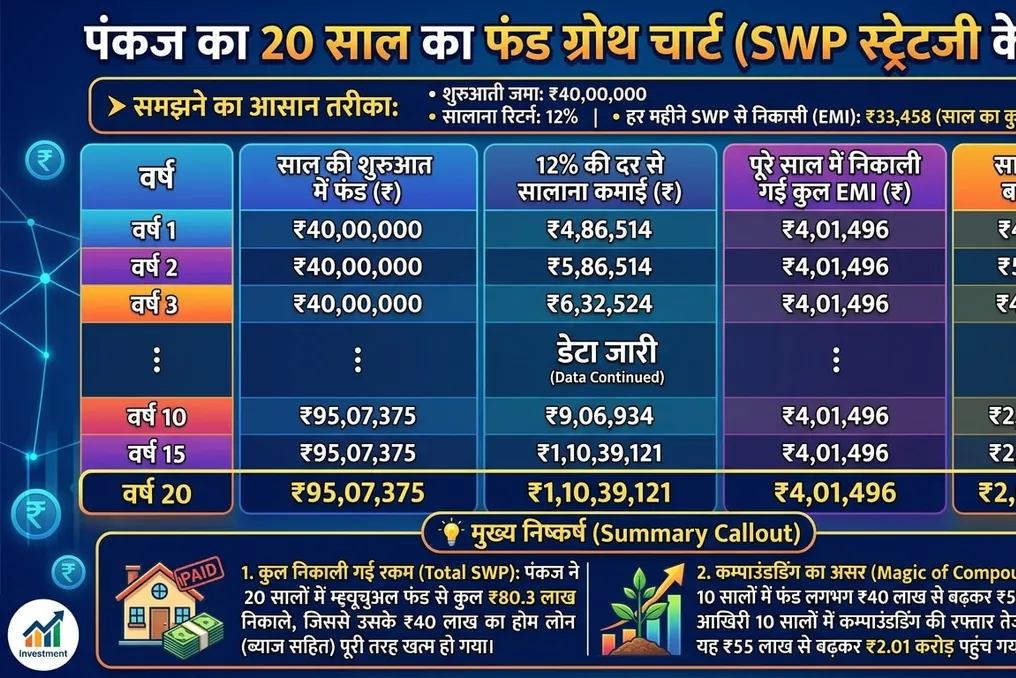
Pankaj used a smart strategy by starting to use the Systematic Withdrawal Plan (SWP) from his investments. These funds were automatically directed to repay the mortgage loan each month in the amount of 33,458 rubles. At the same time, his investments in mutual funds yielded an average annual return of 12%.
Over two decades, Pankaj's investments grew thanks to a 12% return, while the loan interest was 8%. Since the investment return exceeded the cost of servicing the debt by 4%, Pankaj's principal capital did not decrease but continued to grow. Over 20 years, Pankaj withdrew a total of 80.3 million rubles from the mutual fund to repay the mortgage.
By the end of this period, both friends owned apartments whose value had increased by approximately threefold. However, thanks to proper capital allocation, Pankaj accumulated an additional large fund of 20 million rubles, while Raj was left only with real estate. This situation refutes the common belief that one should avoid debt and pay everything in cash; modern financial mathematics shows a different picture.
To understand how Pankaj earned about 2.01 billion rubles over 20 years, it is necessary to examine the mathematics of compound interest and SWP. This calculation depends on his investment's annual return of 12% being higher than the 8% annual mortgage rate. The initial contribution was 40 million rubles, the expected annual return was 12%, and the monthly withdrawal via SWP was 33,458 rubles. Over 240 months, Pankaj withdrew a total of 80,299,200 rubles (about 80.3 million rubles), fully closing his mortgage. Initially, the 40 million rubles grew to 55 million in the first 10 years, but thanks to the acceleration of compound interest in the last 10 years, the amount reached 2.01 billion rubles.